
Will Docherty: The Man Who Could Sell Anything
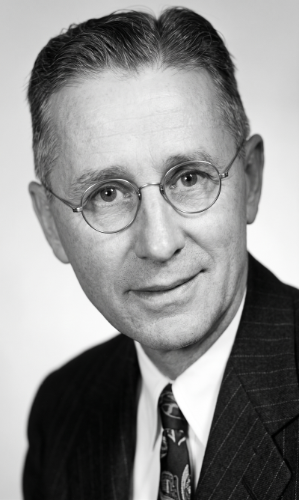
William Anderson Docherty was born on June 18, 1889, in Hutchinson, Kansas, the only child of William Thompson Docherty and Josephine Martin Docherty. His father was a Glaswegian — born in Glasgow, Scotland. W. T. was educated at the University of Glasgow, had a thick brogue, a quick wit, and a magnificent collection of athletic trophies. His ambition followed him across the Atlantic and eventually to the Missouri prairie. The two of them, father and son, would build one of Clinton's most enduring commercial enterprises.
But the story begins in a classroom.
The Class President
In August 1906, seventeen-year-old Will Docherty returned to Clinton from a summer trip to Colorado Springs. The Pikes Peak Daily News had noted his arrival at the summit of Pikes Peak — 14,110 feet above sea level, climbed entirely on foot. It was, the paper reported, a long and toilsome journey. Will told the Henry County Democrat the scenery alone made every step worthwhile — that you couldn't truly appreciate it any other way than on foot.
That fall, back at Clinton High School for his junior year, he threw himself into the student newspaper. While classmate Charles Bixman managed the advertising department, Will went door to door selling subscriptions — and by November had secured more than the paper had sold the entire previous year. He was seventeen years old, and he was already outselling everyone in the room.
In January 1907, the senior class organized and elected officers. The president of the class of 1907 was W. A. Docherty — "Billy" to his friends, "Will" to most everyone else.
After high school, he didn't slow down. He took on the role of advertising manager for the Clinton Opera House, going door to door around the square selling advertising panels on a new painted curtain — the kind of job that required charm, persistence, and a convincing argument. In December 1910, the Evening Republican noted the beautiful new curtain from Kansas City, its panels filled with ads from local merchants. It was, in miniature, a preview of what was coming — a young man with a product to sell and a town full of potential customers.
From there he moved to the W. H. Hurley Grain Company, one of Clinton's major agribusiness firms with elevators on Main, Grand, and River streets, where he learned commodities, logistics, and the rhythms of a town that runs on what it can move in and out. Then, at twenty-two, he decided it was time to run something himself.
Five Hundred Men Underground
In the summer of 1911, Will Docherty resigned from Hurley Grain, rented a room in the new Poague Building on East Jefferson Street, and opened a coal office. His first advertisement in The Evening Republican was a masterpiece of salesmanship:
"500 Men Down Deep in the Bowels of the Earth Mining Coal for You."
He didn't just sell coal; he made you feel the weight of it, the labor behind it, the moral obligation of your order to five hundred men with shovels underground.
He handled Pitcher and Owen coal — locally mined brands prized for their cleanliness and heat output — along with an impressive lineup: Kansas lump, Kansas nut, Arkansas coal, Illinois coal, and Pennsylvania anthracite for the discerning customer with a base-burner stove.
A brief word on coal varieties is in order here, because Will Docherty's business depended on the distinctions: anthracite was the premium grade, hard and nearly smokeless, ideal for heating stoves and incubators; bituminous, or soft coal, burned hotter and faster and powered the railroads and industrial furnaces; and the various regional coals — Cherokee, Brownington, Deepwater — each had their advocates among customers who knew their furnaces the way a cook or chef knows their oven.
"Fill your coal bins THIS MONTH," one ad warned, "as indications point to an advance of from one to two cents a bushel on August 1st."
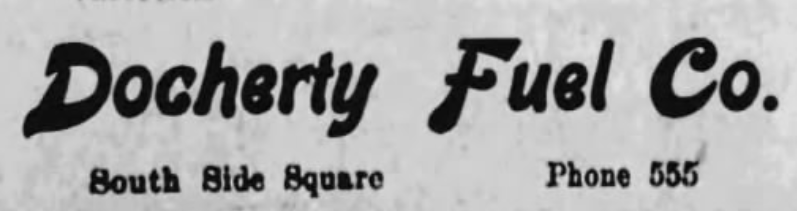
By October 1911, he had purchased the Clinton Fuel Company outright, consolidated operations at 105 South Washington Street, and chosen his phone number. It was 555. He would keep that number for the rest of his working life, across every business he ever ran, in every city where he tried to open a branch office — including Harrisonville, where the telephone exchange only went to 500 numbers, and Will Docherty was genuinely disappointed. "We don't feel at home with any other," he told the paper.
Honkers and Horse Sense
Here is where Will Docherty gets interesting.
In March 1911 — at only 22 years old — he had already traveled to Kansas City, purchased a new E.M.F.-30 automobile, and announced he was taking the local agency. This was before he had even opened his coal office. The E.M.F., built by the Everitt-Metzger-Flanders Company, was one of the more popular cars in the country at the time, produced under the Studebaker Corporation's banner. In an era when most Clinton residents still traveled by horse, Will Docherty was already selling them the future.
That September, the Henry County Republican reported that Will, along with fellow dealer Rolla Jackson, had boarded the Studebaker special train in Kansas City, bound for Detroit — as personal guests of Walter E. Flanders, head of the Studebaker Corporation. They spent two days touring the E.M.F. factories. They attended a banquet at the luxurious, Victorian-style Hotel Pontchartrain with Flanders and racing legend Barney Oldfield — a name that in 1911 carried roughly the glamour of a modern Formula One champion. They drove across the Bloomfield Hills in motorcars that cost more than most Clinton families earned in a year.
Docherty gave The Evening Republican a long interview upon his return. He described factory floors where a hundred cars were completed every single day — numbers that seemed almost mythological to a man from a Missouri town of a few thousand people. He described Flanders' home on Green Lake, surrounded by 1,200 acres of rolling hills, where the great manufacturer liked to think of himself as a farmer. He described the special train, the banquets, the hospitality. "I felt more like a millionaire who had been on a pleasant vacation," he said.
His trip was educational and informative. Afterward, he went home and sold coal.
The Aviator
There is a chapter of Will Docherty's life that deserves its own telling.
In October 1917, Will traveled to Omaha and passed the Army's physical examinations for aviation. He returned to Clinton, told the papers he'd be joining up, and went back to work — there was nothing to do but wait for his orders. So, he kept making trips to build his business. Then in December, while he was away on one of those trips to Chicago, the orders caught up with him: report immediately to Fort Meyer in Washington. He went there directly, without stopping in Clinton to say goodbye.
His parents learned he was gone the way the whole town learned most things — from the pages of the Democrat. A few days later, further orders arrived. He was to report to the School of Military Aeronautics at Cornell University in Ithaca, New York. Just like that, Will Docherty — coal dealer, car salesman, Clinton's capable man about the square — was going to learn to fly. He wrote to his parents, not through the U.S. postal service, but, once again, through the pages of the Democrat, and the paper published his letters at length. They remain among the most vivid documents of the era.
From the flying fields at Mineola, Long Island, in the spring of 1918, he described his first time in the air with the excitement of a man who has just discovered religion: "I took my first flight today. It was wonderful. Was up about 20 minutes with the instructor. The sensation is hard to describe. You suddenly ascend as if you were going up in an elevator, and then are shortly righted in the air. It is a very pleasant feeling soaring away above the field and people."
He wrote about watching a Curtiss machine, one of the standard training aircraft of the era, nose-dive into the soft earth, wrecking the plane and injuring the pilot — the way a war correspondent writes about danger, with clarity and without flinching.
"Flying without doubt is the greatest sport of the century," he wrote from Long Island in August 1918. He described the view from altitude — people below looking like pygmies, motorcars and trains like insects crawling in the dust, the towns of Long Island and Manhattan looking from the air like small candy boxes. He described going into a tailspin: "It seems as if the motor had dropped out of the ship, and if you have ever experienced such a feeling of dizziness, then is the time you realize what it means. But when you come out of the spin and glide gently down and make a nice landing, the feeling immediately passes, and again you feel safe on Mother Earth — you would say it was well worth the adventure."
Then he compared flying to kissing a girl you love. "You know it's just the beginning," he wrote, "but you immediately crave more."
He passed his flight examinations at Cornell, trained at Mineola, and was transferred south to Camp Hancock, Georgia, where he appears to have been designated an instructor — a role reserved for pilots of demonstrated skill.
He fully expected to be sent overseas and was making his arrangements when the Armistice came in November 1918. He never made it to the front.
The Year He Could Not Keep Up
By early 1919, with the war over and the economy surging, Will's automobile operation had been reorganized as the Docherty Motor Company, and it had secured the selling agency for the Scripps-Booth automobile. The Scripps-Booth was a luxury-leaning car manufactured in Detroit, founded by James Scripps Booth of the Scripps publishing family. By 1918 it had been absorbed by General Motors — at the time the largest automobile manufacturer in the country. Docherty's ads made sure you knew it.
What followed was one of the most remarkable years in Clinton commercial history.
Between January and December of 1919, barely a week passed without the Clinton Eye or the Henry County Democrat reporting another Docherty Motor Company sale. Scripps-Booth roadsters, touring cars, six-cylinder sedans. Sales to farmers, merchants, a traveling man passing through town, the county sheriff. Sales to customers in Windsor, Montrose, LaDue, Garland, Lowry City, and beyond. Two roadsters were driven all the way to Wichita, Kansas. A sub-agency was opened in Windsor, where agent Leland Cooper operated from a room leased from the local Ford dealership.
In August, Will drove a Scripps-Booth from Kansas City toward Clinton and sold it before he got home — a customer named Joe Wilds in Creighton insisted on having the car then and there. Will turned around, went back to Kansas City, and got another one. The papers reported this as news, because it was.
By November, the Clinton Eye summarized the year with barely contained admiration: the Docherty Motor Company had proved itself "live wire distributors" for the Scripps-Booth, selling satisfied customers across Henry County and the surrounding counties, with no sign of slowing down.
There was just one problem. "They are hard to get," Docherty told the paper. Scripps-Booth's peak production year was 1919, at roughly 8,100 cars nationwide. Will Docherty appears to have personally accounted for a notable share of the regional supply.
In 1920, he pivoted smoothly. The used car exchange opened, specializing in Fords. The Essex touring car arrived — made at the Hudson factory in Detroit and promoted with breathless enthusiasm in a full-page Clinton Eye article that read like automotive poetry. Then Hudson Super Sixes, Hupmobiles, Studebakers, Chalmers, Gardner cars, and eventually, by franchise from the Greenlease Motor Car Company in Kansas City, Cadillacs — "the Standard of the World," the ad announced, with the confidence of a man who had been to Detroit and knew exactly what he was talking about.
He also secured the Dunlop tire agency. This brought him, in 1928, a personal letter — typewritten and signed from Captain Malcolm Campbell, the Scottish racing driver who had just set the world land speed record of 206 miles per hour at Daytona Beach. Campbell wrote because Docherty was a fellow Scotsman, and because Dunlop tires had, in Campbell's telling, saved his life. The Henry County Democrat reported the letter with pride. Will Docherty was the kind of man to whom such letters arrived.
Meanwhile, The Fuel Business
While Will was pursuing automobiles, the fuel business was growing into something no one could have predicted when he first rented that room in the Poague Building.
The horse-drawn era didn't end overnight, but it was ending. In March 1916, teamster "Big Dutch" Gebhardt pulled up to the city scales with a load of Missouri lump coal that registered 9,000 pounds — four and a half tons, requiring four horses to move it. The papers noted it was the largest coal load any Docherty teamster had ever hauled. It was also, though no one said so at the time, a kind of farewell to the horse-drawn age.
The operation expanded steadily to meet changing times. Will converted a Ford touring car into a small delivery truck — one of the first motor-powered coal deliveries in Clinton — with a capacity of about 1,500 pounds for smaller orders around town. Then came larger trucks. Will and two others drove to Kansas City to bring back new Wilcock and Republic models, and later a Reliance rated at 3½ tons but capable, the papers claimed, of hauling five tons at full load.
The company also put a service vehicle on the road unlike anything else in Clinton. They took a Ford chassis, bored out the engine, fitted it with a Stutz racing body, and painted the whole thing a brilliant, glowing yellow. Will modestly claimed the Yellow Fellow — as it came to be known — could make 70 miles per hour. Whether it could or not, it was surely the most conspicuous vehicle in Henry County.
Not everything went smoothly. In November 1917, a driver named Ismael Pierce tried to start the big Reliance truck in the garage behind the fuel office. The engine backfired. The truck caught fire. The alarm sounded, but not before dense clouds of smoke were rolling across the square. It looked, briefly, like a serious disaster, but two lines of hose quickly brought it under control. The truck was badly damaged. The building suffered only minor harm.
The coal yard wasn't immune from mishaps either. In November 1920, a fire discovered burning deep in a coal pile had been smoldering for hours, ignited from within by spontaneous combustion — a genuine hazard of large coal storage, where oxidation deep in the pile can generate enough heat to ignite without any external flame. Between 150 and 200 tons burned before the fire department extinguished it.
On another occasion, a Ford truck left on Lewis Road two miles north of town was stripped overnight — tires, coils, and other equipment all taken. Will's response was characteristically dry. He published a notice in the Democrat informing the thief that "the remainder and more inexpensive part of the car can be found at the garage on Carter street any night from 9 to 12 o'clock, and if the color is not suitable the company will at their own expense have the car painted by George Turley."
The company took its lumps. So did Will.
On a morning in November 1915, Will himself tried to crank a Ford. The engine backfired, and the crank kicked back with enough force to break both bones in his right arm below the elbow. Cranking a cold engine was a genuine physical hazard of early automobile ownership — a sudden backfire could deliver a blow comparable to a sledgehammer. Will was laid up for several weeks, but the business kept running.
It kept running, and it kept growing. By 1914, Will's father W. T. had joined the company full-time, leaving his thirteen years as manager of the Degen department store to work alongside his son. That same year the city agreed to furnish Docherty Fuel with scale tickets — official documentation of coal weights — a small bureaucratic detail that nonetheless signals how thoroughly embedded the company had become in Clinton's civic machinery. Two years later, the city council reversed itself and required Docherty, like other large users, to pay for their own scale books. Will appears to have accepted this without complaint.
The contracts multiplied. The county courthouse and jail, won at $3.25 per ton. The city schools, filled with Owen coal. The county farm. The city hall. In April 1917, the United States government — through the Harrisonville office manager John D. Martin — placed an order for 500 tons of Brownington coal to be shipped to San Diego, California, for naval use. The first of several promised orders, the papers noted. Docherty coal was going to sea.
By the mid-1920s, the operation had outgrown anything resembling a local coal yard. The company was buying coal from ten different states and selling wholesale to customers across Missouri, Kansas, Nebraska, and Iowa. They kept a permanent field representative in Pittsburg, Kansas — in the heart of the Cherokee coal district — whose sole job was to inspect each car of coal before it shipped. In a single season they booked fifty cars for the Missouri Pacific Railway and thirty loads of southern Kansas coal for the Santa Fe. In 1922, with Pennsylvania anthracite scarce due to eastern shortages, Will traveled to Chicago to negotiate directly with his anthracite connections — returning with an allocation that made Docherty Fuel one of the few companies in the region able to supply genuine Scranton anthracite that winter.
Will believed in advertising, and he believed in it hard. When coal was scarce as "hen's teeth," the ads said so and told you they had it anyway. When a new grade arrived — like the "Ozark Special," a hand-picked Missouri coal sold under a bright yellow label — the ads explained exactly what made it worth $6.00 a ton delivered. When the Henry County Democrat noted that advertising pays, they used Docherty as their example: a Boulder, Colorado, resident saw a Docherty used-car ad in the paper and wrote all the way from Colorado to inquire about it. The company was running ads in multiple papers simultaneously — because it worked.
In 1928, the Missouri Valley Retail Merchants Association named Docherty Fuel the first coal business in the United States selected as a model operation — sending a representative to Clinton specifically to document how Will ran his enterprise. The resulting article, published in the association's magazine, included a photograph of the coal yard and quoted Will's operating philosophy at length. His motto: "He profits most who serves best."
This was not merely a slogan. It was a business model. And a promise he kept.
The South Side of the Square
By the early 1920s, the Docherty operation occupied two buildings on the south side of the square. The main fuel office sat near the opera house; the southwest corner Dugan building, newly leased, housed the used car exchange. Will was perpetually improving, expanding, and reimagining his space. In 1920 he announced plans to remodel the south-side building entirely — a new plate glass front, the existing front office converted into a proper automobile showroom, steam heat installed throughout, and the upper floor divided into modern office suites for professional tenants. By 1930 another major renovation was underway: the basement wall, undermined by water that sometimes stood for two weeks at a time, was torn out and rebuilt; the west walls were repaired; and a new office room with a large plate glass window was added at the rear, facing Center Street.
Those upstairs offices became a small community of their own. E. K. Guynn, optometrist, opened his eye care practice above the fuel company in June 1921, advertising that he could accurately fit glasses "for the most complicated cases." When Guynn eventually moved to the Elsner Building, his vacated rooms were taken over by the Missouri Bird Manufacturing Company — the enterprise run by Lawrence Brown, whose own remarkable story has been told on our museum website. The building that sold coal and automobiles on the ground floor was, above the ceiling, a hive of Clinton commerce.
It was also, in a more literal sense, a home. A newly married couple — Grover Harrison Jr. and his bride, Maxine — rented an apartment upstairs in 1931 and moved in fully furnished, ready to begin housekeeping above the fuel office. Lynn Howell, who ran the Harding Cream Station on Center Street, moved from a farm east of Clinton into rooms above the company. The Travelers Protective Association — Post Q, of which Will served as secretary and treasurer — held its meetings in the Docherty office, electing officers and dispatching delegates to state and national conventions. The Boy Scout committee of the American Legion met there, and the American Legion itself used the space. Will's building was becoming less a place of business and more of a gathering place that happened to sell things.
And what things it sold.
The automotive side was substantial: tires, tubes, motor accessories, electrical goods, auto painting and refinishing — Roscoe Pertle, brought on for that last service, promised to "recreate" your old car for you. A full-time mechanic, John Green, was hired and advertised as "The Expert Trouble Man" — "what John Green don't know about your car isn't worth knowing," the ad declared. Model T Ford parts were sold until they weren't worth stocking anymore, then cleared out at below-cost prices before the January inventory.
But Will Docherty's instinct for merchandise ran considerably further than anything automotive. When a shipment of agents' sample lampshades arrived — pleated parchment, hand-decorated, in assorted colors — he put them in the window at 59 cents each and sold out the entire first shipment. He reordered. The second shipment sold out too. At Halloween, the store stocked crepe paper, decorations, and noisemakers. At Thanksgiving, souvenirs. At Christmas, holiday goods and a lighted tree placed at strategic points around the showroom. In October 1929 — the same month the stock market collapsed and took the American economy with it — the Docherty Motor Company was advertising lampshades and Halloween novelties, cheerfully unmoved by events on Wall Street.
Will took his window displays seriously, which is to say he took them personally. In October 1924, the Henry County Democrat noted that the Docherty Motor Company window was among the prettiest on the square that week — decorated by John McGinnis and featuring "the many different things for the car owner." Later, Will designed a window display himself — a working train built entirely from automobile accessories — which the Democrat called "quite a work of art and a real credit to the designer, W. A. Docherty." The company also installed a handsome electric Dunlop tire sign, which the paper noted with civic satisfaction added to the "white way" on the south side of the square, as most of the buildings on the south side had been painted white.
Edith
In September 1921, Will married Miss Edith Owen. Her father was Walter E. Owen, a prominent Henry County prosecutor. Her mother was Eugenia Salmon Britts, the daughter of the well-known Dr. John Henry Britts, whose own story has been told in these pages.
Edith was, by every account, exceptional. A striking brunette, she graduated from Clinton High School, earned her degree at Lindenwood College in St. Charles, taught school in Minnesota, and returned to Clinton as the domestic science teacher at the high school — a position she held until the year of her marriage. Ninety guests attended her engagement party. The Henry County Democrat described the wedding in considerable detail: the palms and ferns, the violin playing "At Dawning," the ring ceremony performed by the Presbyterian minister, the wedding luncheon served in the style of the Old South, and the gold coin from a Confederate soldier's pocket tucked in the bride's slipper for luck.
They left for Chicago on the Limited, showered with kisses and rice.
Four years later, in July 1925, the Henry County Circuit Court granted Edith Owen Docherty a divorce from William A. Docherty, and restored her maiden name. The record is a single line in the court proceedings. The newspapers, which had covered their wedding at length, said nothing more.
What happened between September 1921 and July 1925 is not recorded in any source available to us. Edith returned to her maiden name and presumably to her own life. Will was thirty-six years old, running two businesses, and, for a time, alone.
In January 1926, he married Ruby Loafman of Clinton, quietly, in Kansas City. They returned to Clinton the next day and moved in with his father on South Second Street. Two years later, in January 1928, a son was born — William Martin Docherty, who would be called "Little Bill" by his grandfather and "Young Bill" by the town, to distinguish him from his father. The baby's arrival prompted the elder W. T. Docherty to announce, with delight, that he was now going to let his whiskers grow and be a proper grandfather.
W. T.
In October 1932, Will's father died quietly in his upstairs bedroom on South Second Street, slipping from sleep into something deeper on a Wednesday afternoon. He had complained that morning of feeling tired, had eaten a light lunch downtown, had been taken home by his son, had gone upstairs on his own two feet — and was gone by the time Will returned from the office.
William Thompson Docherty was seventy-three years old. He had crossed the Atlantic alone at eighteen, built a life in a country that wasn't his, managed a department store for thirteen years, and then spent his last two decades as his son's business partner and closest companion. The obituaries were long. The Clinton Eye wrote that he had "the Scotch heritage of kindness and shrewdness, and an insight into human nature which made him lovable."
A large case of athletic trophies — sprinting medals, soccer cups, relics of a young man in Glasgow in the 1870s — sat in the front room of his home. Three weeks before he died, he had brought those trophies to a Rotary Club meeting and explained each one to the membership, who received them with great appreciation.
Will had found him. The father-son team was no longer.
Hard Times
The 1930s were not gentle.
In April 1933, two armed men walked into the Docherty Fuel Company after dark. They drew a gun, forced Will to open the safe, and took $125 — roughly $3,200 in today's money. Then they threatened to take him "for a ride," which in the parlance of Depression-era criminality meant something that didn't end well for the passenger. Will Docherty talked his way out of it. He kept calm, kept negotiating, and persuaded the bandits to let him go home unharmed on the condition that he would not call the police. He kept that promise. Neighbors reported the crime. Will did not. The Clinton Eye noted, with a journalist's careful understatement, that "the pair made threats of taking Mr. Docherty for a ride, which, if they had carried out, would perhaps have made a tragic ending of the affair."
In December 1936, the store was burglarized — entrance through a back door with a skeleton key. Tires and shotgun shells were taken. The same week, Will slipped on his porch steps and badly sprained his ankle, requiring a cane. Both items appeared in the same newspaper paragraph, as though the reporter had simply run out of sympathy for both.
Through all of it, the coal contracts kept coming — courthouse, jail, county farm, city schools — year after year, won on reputation and competitive bid, delivered on time.
A Man About Town
Running two businesses was apparently not enough for Will Docherty. Through the 1920s and 1930s, he wove himself into virtually every civic organization Clinton had to offer.
He was a founding member of the Clinton Rotary Club and one of only five members who attended every one of the club's 52 meetings in 1921 — a perfect attendance record in a year when he was simultaneously running two businesses, managing a wholesale coal operation across four states, and selling automobiles as fast as General Motors could make them. He served as secretary and treasurer of Travelers Protective Association Post Q — a national organization of traveling salesmen and businesspeople that provided fellowship, mutual aid, and accident benefits to its members — hosting the organization's meetings in his own office and representing the local post at state and national conventions.
His deepest civic commitment was to the American Legion. A World War I veteran himself, Will threw himself into the Clem P. Dickinson Post No. 14 with the same energy he brought to everything else. He was appointed to the Legion's Sixth District membership committee. He led the annual membership drives — once growing the post to 216 members, the largest in its history. He represented the post at the 19th National Convention in New York City in September 1937, a trip planned with characteristic Docherty thoroughness: by automobile to St. Louis, then aboard the Missouri Department's deluxe New York Central special to Indianapolis, Buffalo, and Niagara Falls — with a stop at the Falls — then on to New York, with headquarters at the Commodore Hotel on 42nd Street and Lexington Avenue. On the return, the party stopped in Washington for a sightseeing tour of the White House, Mount Vernon, and the Tomb of the Unknown Soldier. The following year, accompanied by his wife, Ruby, and son, Bill, he represented the post at the 20th National Convention in Los Angeles. He championed Boy Scout work through the American Legion, served on the Legion's swimming pool board, and headed the committee to investigate Legion and Auxiliary quarters on the square.
In 1937, he ran for Democratic candidate for Clinton Township and lost by a single vote — 254 to 253. It was a temporary setback. He was later elected president of the Clinton Township Board and served six years, overseeing an ambitious road improvement program: in 1938, the township purchased a large motor maintainer — a motorized road grader that could smooth and resurface roads far faster than the old horse-drawn drags — capable of maintaining twenty miles of road daily. In 1941, a rock crusher was purchased that cut surfacing costs nearly in half. By the time his tenure ended, more than 30,000 tons of crushed limestone had been placed on township roads and city streets, and the township carried no debt.
In November 1938, the family home on South Second Street nearly burned. A neighbor walking past smelled smoke, investigated, and found the roof burning from the inside — fire spreading under the shingles from a faulty flue, impossible for the firemen to reach easily. A few more minutes without discovery, and the house would have been lost. Considerable damage was done by water and fire, though insurance covered part of the loss.
By 1942, with America at war again, Will — now fifty-three years old — applied for a commission in the Military Police. He was called to take his physical examination and expected to be called for active duty quickly. Whether the commission came through or the application was ultimately set aside, the record doesn't say. But the impulse itself tells you something: at an age when most men were watching the war from a distance, Will Docherty was trying to get into it.
The Turn
By the early 1940s, the world that had made Will Docherty's first two careers possible was quietly ending. Coal was losing ground to natural gas, propane, and fuel oil as homeowners converted their furnaces to cleaner, more convenient fuels. The automobile business had been dealt a more sudden blow: in February 1942, the federal government ordered civilian auto production halted entirely. The factories were converted to build tanks, jeeps, and aircraft for the war effort. There were no new cars to sell.
Will Docherty did what he had always done when the landscape shifted — he looked around, found the next thing, and got to work. This time it was insurance. In June 1943, he sold the south-side-of-the-square building to Irving Lee Bush and moved his new insurance office to the Poague Building — the very building where, thirty-two years earlier, he had rented his first coal office and written his first ad about five hundred men underground.
He became an agent for New York Life Insurance Company.
He was fifty-four years old.
Within two years he was leading all New York Life agents in the state of Missouri in new policy applications. By 1946 he had been named to the company's Top Club. He qualified for the Star Club — reserved for the company's most successful agents nationwide, from a field force of more than 5,000 — in 1952, 1955, 1956, 1957, and beyond. The company ran a sales contest among its agents and named it the "Bill Docherty Contest." His son William M. Docherty, by now working alongside his father, was one of those who won it.
In September 1962, New York Life held a luncheon in Will's honor at the King Arthur Room of Hotel Phillips in Kansas City. They presented him with a gold watch engraved: "William A. Docherty, In Recognition, 20 Years, New York Life, Senior NYLIC." His wife Ruby and son Bill were at the table. There were about fifteen in attendance.
The Last Years
In October 1963, Will collapsed at a hotel in Leavenworth, Kansas, while accompanying his son to a New York Life conference. He was taken to the University of Kansas Medical Center. He recovered enough to come home to Clinton, but his working days were finished.
His wife Ruby and son Bill cared for him at the house on South Second Street. They built a downstairs bedroom so he could be near the center of family life — close enough to hear everything, to have people around him, to remain part of the household's daily routines rather than removed to some quiet upstairs room the way old age so often removes people from active life. Ruby did her ironing in his bedroom so they could watch television together. Young Bill came home regularly and brought his father news of the business world and the town. The Christmas tree was set up and decorated in there. His pastor came regularly. The women of the Amoma Bible Class, of which Ruby was a member, sent cards.
William Anderson Docherty died on August 16, 1965, at home. He was seventy-six years old.
The funeral was held at the First Baptist Church on South Second Street. Burial was at Englewood Cemetery, beside the father who had once crossed the Atlantic alone at eighteen with nothing but ambition, and whose only son had turned out to be, in every measure that counted, exactly the same kind of man.
What He Left Behind
Will Docherty was not famous outside of Henry County. He held no public office beyond president of the Clinton Township Board. The businesses he ran are long gone, as are the buildings they occupied. His cherished phone number — 555 — vanished long ago when telephone exchanges outgrew their three-digit simplicity. No monument was built to honor him.
And, yet, what he left behind is certainly meaningful: a town that stayed warmer during the coal strikes because he hauled fuel twenty miles by wagon; roads that were smoother because he served on the board; a generation of Clinton residents who drove automobiles they might not have known they wanted, because Will Docherty drove one home from Kansas City and told them what it could do; a Legion post with a record membership because he organized the drive; scores of families whose way of life was protected by the life policies he issued; a generation of young boys’ lives he help prepare for productive futures through scouting; and the many committees he chaired or participated in.
He was, by the evidence of fifty years of newspaper clippings, a genuinely good man — cheerful, energetic, civic-minded, optimistic, and possessed of an almost uncanny ability to look at a changing world and see not what was ending but what was beginning.
There is something about his tireless ambitions, the determination, the restlessness, the constant motion — that feels like a man who had once looked down on the world from several thousand feet and found it a very interesting place indeed. The coal business. The automobile business. The insurance business. Even the Halloween, Thanksgiving, and Christmas decorations he sold in his shop on the south side of the square. What the newspaper clippings reveal, decade after decade, is that Will Docherty was simply the kind of man other people pointed to when something needed doing. Whatever the mission, whatever the challenge, Will Docherty was usually at the front of the room. Some people are just built that way.
Multiple careers. One phone number. An ability to sell almost anything. And a town that was better for having him in it.
---
Written and researched by Mark Rimel, a volunteer at the Henry County Museum. Sources include The Evening Republican, Henry County Democrat, The Henry County Republican, The Clinton Eye, Clinton Daily Democrat, Henry County Circuit Court Records, U.S. City Directories, Standard Catalog of American Cars / Scripps-Booth Automobile History, National Air and Space Museum, The State Historical Society of Missouri, and The Travelers Protective Association. © 2026 Henry County Historical Society. All rights reserved.