
The Clinton Corn Palace
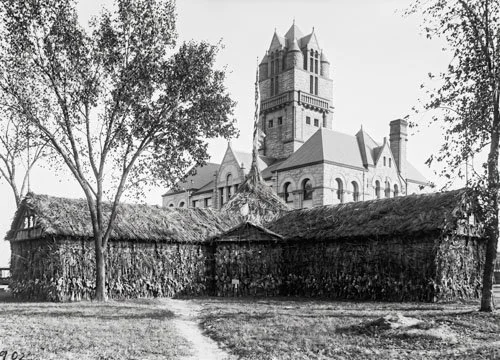
The Clinton Corn Palace on the northwest corner of the courthouse square, autumn 1902. A Kansas City Journal correspondent found its thatch and cornstalks "particularly bizarre and foreign" sitting beside the stone courthouse behind it. The photograph ran in the Kansas City Journal, October 30, 1902.
How a Town Built a Marvel of Corn, Then Sold It for Feed
For most of a week in the fall of 1902, a gasoline engine sat on the Clinton courthouse lawn, powering a circular saw. It was loud, drew onlookers, and had a strange job. All week, the saw cut ears of corn in half, lengthwise, one after another, hour after hour. The Clinton Daily Democrat noted the engine and the saw almost in passing, the way you would note any workman's tool, as though sawing corn in two were an ordinary thing to do in the middle of town.
The halved ears were carried a few steps away and pressed into the walls of a building made of corn – yes, corn. Cornstalks lined the outside, with ears still standing out from them. Sawn ears lined the inside, their flat faces turned outward and fitted together into borders, shapes, stars, and inscriptions. Overhead, a thatched roof. For one week that October, on the northwest corner of the courthouse square, Clinton had a palace. And it was the most beautiful building most people in Henry County had ever seen.
Then, two weeks later, it was gone. To understand how a town builds a palace out of corn, then takes it apart and hauls it off, you have to start a year earlier, with the rain that didn't come and then came too hard.
The Idea Born of a Wet Carnival
The season had earned a celebration. According to Pictorial Memories of Henry County, the corn palace was raised "to celebrate the abundant crop after the previous year's drought." Farmers had watched a dry year burn up their fields, and then watched the next year hand back a harvest worth bragging about. That kind of swing puts a county in the mood to gather and celebrate.
Clinton had already tried once that year. Earlier in 1902 the town held its annual Burgoo Street Fair, and the weather did not cooperate. A neighboring paper, the Appleton City Tribune, put it with some admiration: Clinton people, it said, were "made of the material that cannot be daunted by copious showers, such as fell during their Burgoo Carnival." Rained on once, the town squared its shoulders and started planning a second celebration for the same year. That stubbornness is worth holding onto, because everything that follows was done fast, and done twice in twelve months.
The corn palace itself began, the Democrat reported on October 6, as a real estate-driven idea. "A move is on foot by real estate men to get up a 'Corn Palace' in Clinton," the paper wrote, describing a temporary building in the courthouse yard, covered outside with cornstalks and inside with ears of corn, with premiums offered for farm products and poultry. From the very first notice, then, this was not only a harvest party. It was a pitch. We will come back to who, exactly, the pitch was aimed at.
The plans moved almost as fast as the paper could print them. On October 7, the County Court granted use of the courthouse yard. By October 11, a subscription paper was circulating among the merchants because building the structure and paying the premiums would cost several hundred dollars, and J. R. Gunn, president of the Citizens' Bank, had agreed to serve as treasurer of the fund. The Frisco and the Katy railroads were already being asked for special excursion rates. Within a week, the idea of a corn palace was conceived, a site was secured, a treasurer was found, and two railroads were listening.
Corn Will Be King
The building went up under a headline the Democrat clearly relished: "CORN WILL BE KING." When it was finished, two papers led their readers around it, and between them we can still see it plainly.
It was, in the words of the Kansas City Journal's correspondent, "a cruciform structure, with a conical cupola." Not tall. Set against the towering limestone courthouse, it looked almost humble. But it was covered, every inch, in the county's crop. The outer walls wore stalks of corn, with ears and heavier leaves bunched into a thick band, a dado, about four feet up from the ground all the way around. Just under the eaves ran a frieze of the brown and gray heads of kaffir corn. The roof was thatched with the long leaves stripped from cornstalks. The effect, the Journal said, was "particularly bizarre and foreign," standing there against the modern courthouse and the straight brick lines of the business square. You can see exactly what he meant in the one surviving photograph.
Inside was where the art was. The plain board walls disappeared under mosaics worked entirely in ears of corn. The Journal described a festooned border of white and yellow ears, striped drapery hanging from it, and against that background "circles, crosses, diamonds, lettering and other intricate designs" picked out in red, yellow, black, white, and variegated ears. This is where that gasoline engine and its saw came in. Every design was built from ears sawed in half so their flat, colored faces could be fitted flush to the wall.
What’s that, you ask? Red, yellow, black, and variegated corn? The colors were real, not painted on. The corn of 1902 was open-pollinated, grown from seed farmers saved and replanted year after year, and it came in colors that today's fields have all but lost. Deep reds, near-blacks, creamy whites, and speckled calicoes were common in the crop, some of them named field varieties like the grimly nicknamed "Bloody Butcher," a red dent corn grown for meal and feed. Only later, when hybrid seed took over in the twentieth century and bred corn to a uniform yellow, did the rainbow drain out of the everyday cornfield. So the palette on those walls came, almost certainly, straight from the county's own harvest, sorted by eye. The papers record no dye, and none would have been needed.
Sorting those colors was one thing; arranging them into finished designs was another, and one man deserved more credit for it than he got at the time. The Democrat said so, though not until after the carnival closed. His name was George Rimer, and he was the artist. "Mr. Rimer had simply the ideas of the promoters," the paper wrote on November 7. "He had to reduce those ideas to order and system, to design the decorations and superintend the work; and above all he had to work quickly." A Chicago traveling man who had, by his own account, "been all over the country and seen all kinds of novel sights," told the palace's secretary that Clinton's corn decorations were the most beautiful he had ever seen. High praise for a rush job built out of sawed corn.
The loveliest thing in Clinton was also the most flammable, and the town knew exactly what it had built. A palace of dried cornstalks and thatch is a bonfire waiting for a match, and this one was lit by electricity at night; the wiring ran right through the dry stalks. So, the city authorities set a hose reel on the ground, banned smoking in and around the building, and posted men to watch it around the clock.
A Palace Aimed at the World
Now, back to that pitch.
The promoters were remarkably open about the corn palace's purpose. The Kansas City Journal explained it all: the carnival, it reported, "was originally projected by an enterprising real estate firm as a private advertising scheme," and only became a public celebration once the rest of the town's businessmen saw its value and took it up. The Home Product Display, the Democrat announced, would be "open to the world," and the Journal explained who in the world that meant. Clinton was thick that week with "homeseekers from other states, attracted by the cheap railway rates" and by the chance to learn "at first hands the truth about the natural resources of this rich section of the Missouri coal and corn belt."
So, the beautiful building had a purpose. It was there to catch the eye of a farmer from Iowa or Illinois, or elsewhere, get him off a train in Clinton, walk him through a palace that proved Henry County soil could grow corn in abundance, and, with luck, sell him a farm. The harvest festival was sincere. It was also a sales tool. Both things are true at once, and the men who built it would not have seen any contradiction in that.
If the idea of a whole building made of crops sounds like something Clinton dreamed up on its own, it wasn't, and this is one of the quiet surprises of the story. Clinton was catching a wave that had already crested to the north. Beginning in 1887, Sioux City, Iowa, built a corn palace every year for five years, and the idea spread across the Midwest into a full-blown craze: a coal palace in Ottumwa, a flax palace in Forest City, a bluegrass palace, a sugar beet palace, and more corn palaces besides. By one count, at least thirty-four corn palaces went up across the Midwest between 1887 and 1930. When Sioux City finally quit, Mitchell, South Dakota, picked up the idea in 1892 and never let it go; the Mitchell Corn Palace still stands and still draws visitors today.
Which puts Clinton's palace in its true light. Both Pictorial Memories and the Kansas City Journal called it the first of its kind in Missouri, the Journal naming it "the first corn carnival ever held in Missouri." That may well be right. But even if it was Missouri's first, it was late to the party. The northern towns had been at this for fifteen years. In 1902, Clinton was a small Missouri county seat borrowing a proven bit of showmanship and making it its own. There is no shame in that. It is, if anything, a compliment to the town's nerve that it looked at what Sioux City and Mitchell were doing and said, plainly, we can do that here. (The northern towns also learned the hard way about fire; Sioux City's palace burned in 1891. Clinton's hose reel and night watchmen were not being overcautious.)
More Than Corn
Here is the thing the name of the palace hides: the corn was mostly the wrapping. Step inside, and Henry County was selling everything it had.
The Journal's correspondent inventoried the displays in every detail. There were ears of corn eighteen inches long and cornstalks standing eighteen feet high, potatoes both sweet and Irish, each weighing three to five pounds, and wheat, oats, millet, kaffir corn, clover and timothy seed, with "enough poultry, pumpkins and garden truck to equip a county fair." Impressive, but that much you would expect at a corn carnival.
The manufactured goods are what give the game away. On display, the correspondent noted, was a Clinton-made gasoline engine, glazed pottery of good quality from a Clinton factory, vitrified sewer and paving brick from the big yards at Brownington, and drain tile and sewer pipe from Deepwater, which he called "among the most extensive on the continent."
That Deepwater plant was the Dickey Clay Company's, and the Democrat singled out its display for special notice, calling the firm "one of Henry County's leading industries" and taking evident pride in a neighbor who had shown up to help fill the palace. Around these sat samples of the raw clay itself and of the free-burning soft coal dug from the Deepwater mines. The county seat's merchants took booths too: the White Furniture Company and George Moore, the confectioner, both set up handsome booths inside the building. A corn palace, and inside it, furniture and candy and sewer pipe.
The Journal's phrase for all this was exact. It was "the Missouri coal and corn belt," and the palace was corn on the outside and a trade catalog inside. It advertised not only what Henry County could grow but also what it could dig and make. If you were that homeseeker freshly off the train, the message was hard to miss: come here, and you can farm rich ground, and there is plenty of work and industry here, too.
And in a place of honor sat the hardware of a champion. Colonel G. M. Casey's Tebo Lawn herd of Shorthorns, valued at forty thousand dollars, was Henry County stock, and the palace displayed its trophies: the massive Armour trophy and the blue and purple ribbons won at the American Royal, taken by a ten-thousand-dollar bull named "Choice Goods." The "massive silver cup" the Democrat admired, and the "Armour trophy" the Journal named were the same prize, set shining among the walls of corn.
The Big Days
The carnival ran from the last week of October into the first days of November, opening Monday the 27th, with sources disagreeing only on whether it closed on the first or the second. Monday was for receiving and arranging the displays. After that, the week filled up: Tuesday brought prizes for the best team of mules and the best all-purpose stallion, and Wednesday featured the horse and mule colt show. A brass band played under the central cupola every day. The Journal's reporter gave it the driest compliment in the whole account of the event, a red-coated band, he wrote, "that might be better" playing "music that could be worse." Faint praise, at best.
The building itself was a genuine hit. When the first of the "big days" came on Wednesday, the Democrat reported that "all day long the building was thronged with delighted visitors," admiring the corn mosaics and the displays of farm, orchard, and garden. M. L. Bonham added a handsome bank of palms that filled the west wing. The poultry show, the paper admitted, was "not large," but it had its charms, including several coops of Belgian hares and fancy rabbits that delighted the children. A serious pitch to sell the county to adults, and a pen of rabbits for the children, side by side.
The week's headline speaker was meant to lend the whole thing weight, but the story turns a little wry. On Friday afternoon, the featured address came from a man the Democrat called "that distinguished Missourian, Hon. Norman J. Coleman." He was even more distinguished than that suggests. Norman J. Colman, as his name is more often spelled, was a St. Louis farm journalist, founder and editor of the well-respected Colman's Rural World, a leading Missouri agricultural weekly. He served as lieutenant governor of Missouri (a title the local papers would generously round up to 'Governor’) and, in 1889, became the nation's first United States Secretary of Agriculture, helping write the Hatch Act that established the country's agricultural experiment stations. When he stood at the Clinton courthouse to talk about farming, he was speaking to Henry County farmers about their own trade — and, as a lifelong farm-journal man, in their own language.
Still, Clinton, by and large, didn't come. The Democrat said so, gently but unmistakably: "It is to be regretted that Gov. Coleman did not have a large crowd to hear him, as his address contained much valuable instruction for farmers and stockmen." He spoke on Missouri's agricultural progress and looked ahead to the great Louisiana Purchase Exposition, the St. Louis World's Fair, coming in 1904. It was a serious speech by a serious man, and the seats were not full. A palace of colored corn could pack the square. An hour on farm economics, even from the man who had once run the nation's agriculture agency, could not.
Clinton Makes the Big Papers
For all the fun of it, remember what the corn palace was built to do: get Clinton noticed. On that count it worked, and the Democrat kept score with pride.
The St. Louis papers gave it space. So did the Kansas City World and the Associated Press. The Kansas City Star ran a telegram and a picture. But the prize, the paper felt, went to the Kansas City Journal, which sent its own staff correspondent to Clinton and ran over a column of copy with a large picture, called out by "a red head line across the front page." The Democrat could hardly have asked for more, and said so: the Journal "did us proud and itself credit."
There is a quiet irony in that. The very article the Democrat was crowing about, that staff correspondent's long, admiring, sharp-eyed report, is the one that survives most fully today, and the large picture that ran with it is very likely the photograph the museum now has in its archives. The best advertising Clinton got in 1902 became, a century later, the clearest window we have back onto the palace. What was meant to sell farms ended up preserving a story worth remembering.
The neighboring small-town papers noticed too, and their voices give the story its texture. The Nevada Mail congratulated Clinton on its energy and foresight. The Appleton City Tribune admired the town's refusal to be daunted. Editor Mack V. Thralls of the Urich Herald came in person and headed straight for the palace, which he called "the principal attraction." He left an inventory that reads like a poem of plenty: "great walls of corn arranged in colors making various inscriptions, cereals, vegetables, poultry, broom corn, apples, flowers, Belgian hares, speckled corn, red corn, white corn, yellow corn and all such in great profusion." The county seat, he wrote, "deserves congratulations on the enterprise shown."
Clinton had wanted the outside world to look, and the outside world looked.
Sold by the Bushel
And then came the part nobody likes to plan for: what to do with a palace once the party is over.
For a few days, Clinton tried to keep it. A movement to preserve the corn palace exhibit for several weeks began, and Mayor Armstrong "enthusiastically indorses the idea," the Democrat reported on November 3. The County Court granted permission to keep the building in the courthouse yard a while longer, in part because "a large delegation of northern homeseekers" was still expected, those Iowa and Illinois farmers the whole thing had been aimed at. For a moment, it looked as though the palace might linger for a while.
It could not, of course. It was made of feed. Left standing, it would rot, or draw vermin, or catch the very spark the watchmen had been guarding against. And so, on November 6, a notice appeared that is somehow both ordinary and astonishing. "The corn with which the palace is lined, and the covering on the outside is for sale," it read. See A. L. Armstrong, or Ed Hunter, secretary of the corn palace.
The most beautiful building Henry County had ever seen was put up for sale by the bushel.
A firm called Foote Brothers bought it. On November 11, the Democrat recorded the plain arithmetic of the thing: the Footes "received some 135 bushels" of corn from the palace they had bought. That is the last we hear of it. A hundred and thirty-five bushels of shelled and stalked corn, carted off to be fed to the livestock of Henry County over the coming winter.
Think about what that means. Every one of those ears had been selected for color and size, hauled to the square, sawed in half by a gasoline engine, and fitted by George Rimer's hand into a mosaic that stopped a well-traveled Chicago man in his tracks. Thousands admired it, photographers captured it for the front page of a Kansas City daily, and it was lit at night like nothing the town had ever seen. Within two weeks, it was cattle feed. Nobody thought that was a tragedy, because everyone had known from the first cornstalk that this was how it would end.
That is the truest thing about the corn palace. It was never meant to last. It was built, on purpose, out of the most ordinary thing in Henry County, and it did its work: it celebrated the crop, drew the crowds, and got Clinton's name into the big-city papers. Then, the work done, the palace quietly became what feed corn was always going to become. It fed the stock through the winter.
Corn was king in Clinton for one week in 1902. Then the king of crops went to the feed trough, and the town went home satisfied.
---
By Mark Rimel. Primary research and source material provided and verified by the author; drafting and editing done in collaboration with an AI writing assistant. © All rights reserved 2026.
Research sources include: The Clinton Daily Democrat, Henry County Democrat, Kansas City Journal, Modern Farmer, Sioux City Public Museum, University of Virginia, West Virginia University, Encyclopedia Britannica, Wikipedia, and the book Pictorial Memories of Henry County, Missouri, Henry County Historical Society.