
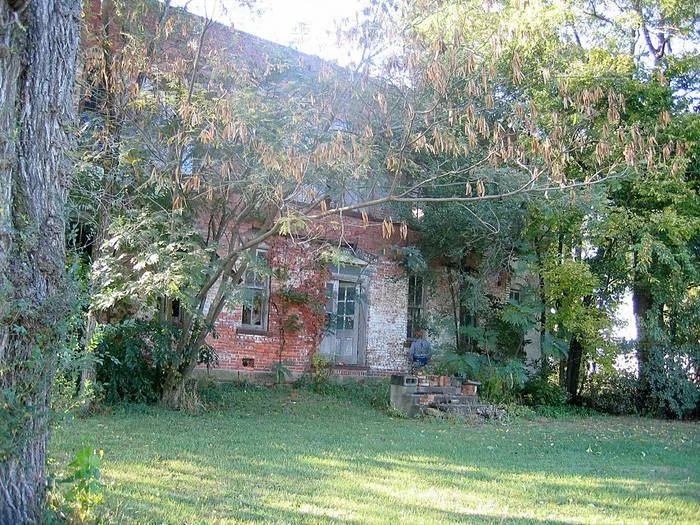
This photograph was submitted by LaDon Brennan to Find a Grave in 2007. It is believed to show the Henry County Poor Farm building in its final years of deterioration. The attribution has not been independently verified. If you have photographs of the Henry County Poor Farm, the Henry County Historical Society would welcome them for its permanent files.
For nearly 80 years, a working farm about two and a half miles northwest of Clinton served as Henry County's answer to a hard question every community eventually faces: what do we owe the people who cannot care for themselves? The county's answer was the poor farm — an institution that housed the aged, the sick, the disabled, the mentally ill, orphaned and abandoned children, and the destitute, all under one roof on a single section of land. Its story is not always easy to read. It is, however, a real and revealing part of Henry County's past, and the museum's purpose here is to share it plainly rather than to soften or rewrite it.
Before the Farm: "Boarding Around"
Henry County cared for its poor long before it owned a farm. At the May term of the county court in 1837 — only a few years after the county was organized — a blind and homeless man named George Manship presented himself as a county charge and, by the court's own account, became the first person the county formally supported.
To become a "county charge" meant asking the county to assume legal and financial responsibility for you — and in 1837, there was nowhere else to turn. There was no state or federal aid, and no charities like those we know today; the county court was the only door to knock on. Nor was it an easy step. In a society that prized self-sufficiency and drew a hard line between the "deserving" and the "undeserving" poor, appearing before the court to be declared unable to survive on one's own meant a public loss of standing. People generally came only when work, family, and neighbors had all run out.
In those early decades, the custom was to "board around" the poor: paying private families to take them in wherever room could be found. As the number of dependents grew, so did the cost.
Children were treated differently. In 1846, the court "bound out" a 13-year-old orphan, Elijah E. Gates, to a local man, who, by written indenture, agreed to teach the boy the blacksmith's trade, ensure he learned to read, write, and cipher, and — when Gates reached 21 — to give him a Bible, two new suits of clothes, and $10. Apprenticeship of this kind was the era's substitute for what we would now call foster care.
Opening the Farm
By 1871, the county had decided that owning a farm would be cheaper and more orderly than boarding the poor in scattered homes. At the April term that year, the county court purchased 160 acres from Frederic Crissman for $7,200. The tract lay in Fields Creek Township — roughly 140 acres of prairie and 20 of timber — and its legal description (Section 33, Township 42, Range 26, with an adjoining parcel in Section 17) matches the location later recorded for the county farm cemetery.
The farm opened under a three-person arrangement that would persist, in form, for decades: a superintendent (often the county physician) responsible for medical care and oversight, a manager or foreman who actually ran the farm, and the county court above them both. The first team consisted of superintendent "Uncle Bob" Allen, physician Dr. J. W. Stewart, and farm manager D. A. Henry.
How the Farm Was Meant to Work
The poor farm was designed to pay its own way, and to a remarkable degree it did. Able-bodied residents worked the land, and the produce fed the household. Dr. Stewart's annual report for 1875, presented to the county court in January 1876, showed the farm finishing the year $228.72 ahead — corn, wheat, hogs, potatoes, peaches, and sorghum more than covered the cost of feeding, clothing, and doctoring an average of 15 residents at roughly $66.80 per person for the year.
Each year, the court awarded the manager's and physician's contracts to the lowest bidder. In 1879, the Henry County Democrat noted that salaries had fallen to $175 apiece and warned that thrift had limits: "very low salaries will not always command the best care and attention, and hence is not always the cheapest in the end." It was an argument the county would revisit often. Over the years, reports and newspaper visits generally praised the managers and described the residents as clean, fed, and reasonably comfortable — though "reasonably comfortable" carried a different meaning in a 19th-century almshouse than it would today.
Who Lived There
This is the heart of the story, and the part that most needs to be told honestly.
The people sent to the poor farm were, overwhelmingly, those who had no one else. Newspaper accounts and county records name the elderly with no family, the blind, widows, unwed mothers, men broken by drink, strangers who fell ill far from home, and — in growing numbers — people with mental illness and developmental disabilities. In 1881 the superintendent's list ran to 18 adults and three children. By 1896 a visiting group of Clinton ministers counted near 60 residents.
Behind the counts were individual lives. In April 1880, a young woman traveling under a false name left her week-old infant beside a railroad fence southwest of Clinton. The next morning, a schoolboy found the baby nearly frozen. It was taken to the poor farm, where the matron nursed it back to health. The county, in the words of the day, was taking care of "a waif that belongs elsewhere." That same year, Samuel W. Pierson — a well-liked plasterer who had worked in Clinton for a dozen years — slipped into alcoholism and died penniless. Friends were raising money for a proper burial when his body was carried to the poor farm cemetery instead, a small, sad race between community kindness and a pauper's fate.
Not everyone in the era was indifferent. When Clinton's Ministers' Alliance visited in 1893, they were troubled to learn that paupers were buried without a religious service, and they urged the county to treat the dead "as human beings, not as dogs." They asked townspeople to send books, magazines, and pictures and proposed a small fruit garden so residents would have work and fresh food. Decades later, in 1926, Justice Robert Renfro persuaded Clinton merchants to fund a radio and loudspeaker for the farm so its residents might have some entertainment. These actions are reminders that the impulse toward dignity coexisted with the era's harshness.
The Words They Used
The language of these times can be jarring today, and it is worth pausing to consider. The institution itself was called, at various times, the poor farm, the poor house, the county farm, the county infirmary, and the almshouse — meaning a "charity house," from the Old English word alms, meaning gifts given to the poor. One phrase recurs so often in the Henry County papers that it became a grim shorthand for the whole institution: "over the hill to the poor house." It appears again and again in headlines of stories about people making that last, unwanted journey.
Its residents were generally called inmates — a word that then simply meant "one who dwells within," without the criminal connotation it later took on — and paupers, meaning people supported by public charity.
The terms applied to residents' conditions were harder, even cruel. Words like insane, lunatic, idiot, imbecile, feeble-minded, demented, half-witted, and crazy were the ordinary vocabulary of 19th-century medicine and law for what we would now describe as mental illness or intellectual and developmental disability. Today they are considered inaccurate and offensive.
Offensive, too, were the racial labels such as colored, negro, and negress, which likewise reflect the usage of the period and are not language of today.
Several medical terms have simply gone out of use: consumption meant tuberculosis of the lungs, and white swelling referred to the same disease settled in a joint. Dropsy was the fluid swelling we now associate with heart or kidney failure, and inflammatory rheumatism was a catch-all for painful joint inflammation of the kind we would now sort into the various forms of arthritis.
The Register, One Saturday Morning in 1896
The most vivid record we have is a single day's snapshot. When a reporter for The Clinton Eye visited the farm on a Saturday morning in the summer of 1896, he copied the register of residents then living there and published it on August 8. It is not the full roll — hundreds of people passed through the poor farm over its 79 years — but it is what one visitor saw that morning, and it is reproduced here as he wrote it. The words are his and the era's, not the museum's; we have left them unchanged because to soften them would be to hide what was done.
Among those he listed:
Mrs. Mattie Crawford and 6-year-old son, crazy; from Deepwater.
Wesley Campbell, white swelling; quite infirm.
Emma Altha Carrel, crazy; from near Lucas.
John Evans, cripple.
Mrs. Foard, crazy; near Windsor.
James Gaupp, idiot.
Sallie Gill, blind, 75 or 80 years old; Calhoun.
Frances Gray, demented, about 60; near Windsor.
Mary Gaupp, little girl, foolish.
Mrs. Hatch, crazy.
A. J. Hinchel, crazy; tramp.
Mary Jane and Mary Adley Hicks, county charges; near Petersburg.
Henry Knox, colored, pauper, about 80; Calhoun.
Will L. Lucas, crazy; 50 or 60; Montrose.
Sarah Marchbanks, colored woman, crazy.
Henry Marchel and daughter, Frances, from near Brownington; crazy.
Martha McEwen, insane; middle aged.
Kate Rawden, paralytic, pauper; from near Windsor.
John Gideon Ried, idiot.
George Runner, half-witted.
Thomas Schindler, epileptic; near La Due.
Sarah Smith, pauper, middle aged.
James Sanders, insane, about 35; near Creighton.
James J. Stow, cripple; Deepwater.
Will Slover, insane, tramp.
Susan Woodall, cripple; North Station.
Jane Wade, insane; middle aged. Has some property.
For a few residents the reporter wrote more than a single line, and his own words are better than any I could put in their place:
A. J. Nelson, crazy; from Windsor. "Andy" is an industrious mortal, and was slashing weeds at the garden's edge, though the sun's rays were beating down on his scantily covered person with terrific force. He is some 70 odd.
John Watson, aged 65, a tramp, hailing from Oklahoma, feeling his burden of years, feeble yet useful about the place, is willing for life's sunset to o'ertake him here.
Emma Williams and baby boy, outcast. A sad case, truly! As we look about there comes the wagon to bear away from her bosom the body of her babe, but this morning dead! Looking at such and other victims of man's perfidy, we but feel that if there is no hell, there ought to be.
One story the reporter told deserves to be followed to its end. He described a woman named Sophia Sipple this way:
Sophia Sipple, idiot; born in Württemberg, Germany, and when a wee girl, playing about her father's farm in the old country, one day fell headlong from the hay-loft, injuries resulting that dethroned intelligence; her parents were well-to-do, and the distracted mother sought in vain the child's cure, even traveling the whole world over with her child, still hoping that somewhere and somehow a restoration of reason would come to her little girl; pursuing her mission, the mother died in this country, and the daughter, now grown to womanhood, goes crooning and staring about the premises of the Henry County poor farm. Cruel fate! Wondrous mother love!
Sophia did not leave. She appears in the farm's records in 1896 and again nearly two decades later, when the Henry County Democrat of November 19, 1914, carried her death notice: she had died at the county poor farm, about 80 years old, still described as insane. A child injured on a German farm, carried around the world by a mother searching for a cure that never came, ended her long life on a prairie in west-central Missouri, among strangers. The whole of it — from the hayloft to the grave — is a matter of record.
The same 1896 account closed with a quieter list. In the cemetery in the northwest corner of the farm, the reporter noted that six people were then buried: an infant; Annie Talbert; "old aunt Amy Goodin," said to have been 111 years old at her death; Bob Jackson, who had once worked in a Clinton livery barn; and two men named Tom Andrew and William Bailey. There were others, he added — these were only the ones he could name.
The Farm as a Makeshift Asylum
Over time, the poor farm became something it was never designed to be: the county's default home for the mentally ill. When the state asylum at Fulton returned patients it deemed "incurable," they came to the farm, where they were kept in rooms the newspapers described as cells. Henry County built a small frame building for them in 1886, added a stockade with a high board fence in 1887 (including a raised platform so residents could look out over the countryside), and constructed dedicated "insane wards" in 1891 and 1893. By 1896, the farm's brick building held 24 rooms, eight of which were cells.
State officials viewed this arrangement as a failure. In 1895, a legislative committee reported that the worst cases entering Missouri's asylums came from its poorhouses and urged that counties be barred from confining the insane on poor farms. In 1899, the new State Board of Charities and Correction went further, describing Missouri's poorhouses in general as "penal rather than charitable dumping places" where the blind, the insane, the aged, and the intelligent poor were mingled indiscriminately. Through the board's work, more than 100 people were moved from Missouri's poorhouses to asylums.
Closing the Farm
The poor farm did not end abruptly; it faded as better alternatives arrived. State asylums gradually took in the mentally ill. Missouri's blind-pension law offered another path out — in 1923, a blind resident named John A. Walsh received his first state pension check and left the farm to live with relatives near Urich, "over the hill from the poor house" for once. The largest shift came from Washington: almshouses had long been the main institutional refuge for the aged poor, and the Social Security Act of 1935, with its old-age assistance program, steadily reduced the need for them across the country.
Henry County's farm outlasted many. The 1930 federal census still listed 29 residents there, under the heading "Almshouse," ranging in age from 10 to 87, most of them over 60. County and cemetery records indicate the county closed the poor farm in 1950 and leased its building to J. D. Arnold for use as a rest home.
The land was eventually sold to a neighboring farmer. The poor farm's cemetery in the northwest corner of the property, which held at least 44 known burials and never had permanent markers, was plowed under. A large brick building — the one that once held eight cells and 16 rooms — reportedly still stood into the early 2000s, abandoned and falling in on itself.
Why the Museum Tells This Story
It would be easy to read these records and feel only their cruelty — the cells, the plowed-over graves, the casual labels. But history is not written to flatter the present, and the Henry County Museum's task is not to rewrite the past to match today's sensibilities. Attitudes, customs, medicine, and language all change with time; what one generation considers ordinary, the next may find hard to defend. The poor farm reflected the values, limits, and genuine efforts of the people who built and ran it, and understanding those honestly — the compassion and the callousness alike — tells us more than any tidied-up version could.
The people who lived and died on that section of prairie northwest of Clinton were our county's own. Sharing their story, in full and without flinching, is one way of finally treating them as the ministers of 1893 asked: as human beings.
Written by Mark Rimel and researched by both Mark Rimel and Keith Pettersen. Sources include newspaper accounts from: The Clinton Advocate, Henry County Democrat, The Clinton Eye, The Clinton Daily Democrat, The Henry County Republican, The Evening Advocate, The Evening Republican, and The Windsor Review. Additional sources include the County Farm Cemetery / Clinton Poor Farm Cemetery records compiled at Find a Grave (findagrave.com), U.S. Social Security Administration, Historical Development (ssa.gov); SeniorLiving.org, "Senior Living History: 1930–1939"; and the Social Security Act of 1935. © 2026 Henry County Historical Society. All rights reserved.