
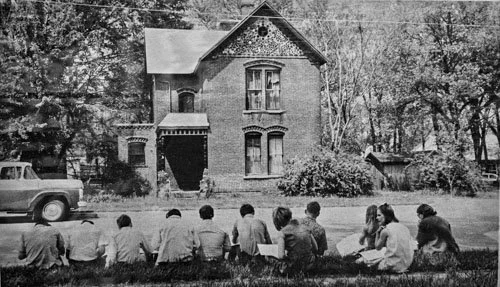
If you grew up in Clinton, you may remember the house at 619 East Ohio Street — the brick one with the strange porch posts. They weren't traditional wooden posts. They were stoneware jars, stacked and set in place, holding up the roof of a man's front porch.
Look higher, and it got even stranger. Broken pottery was worked into the gable. Jar lids formed a border around it. And at the very top, in a little round window, sat a clay puppy dog, fashioned by the owner's own hands, watching the traffic go by on East Ohio.
Generations of Clinton High School students sketched that house in art class. Far fewer knew the man who built it, or that he made nearly everything in it — the bricks, the jars, the dog.
A Trade Learned at Fifteen
Nathaniel H. Duff was born in Abingdon, in Washington County, Virginia, on February 25, 1843. He was raised on a farm and schooled in that county, and in 1858, at fifteen, he went off to Taylorsville, Tennessee, to learn the trade of brick laying.
Hold that date a moment.
A boy who takes up a trade in 1858 is only eighteen when the country comes apart. Duff served in the Confederate Army with Company H of the 37th Virginia Regiment.
When the war ended, he did not go home to the farm in Abingdon or back to Taylorsville to finish learning his trade. Instead, he drifted — Pennsylvania, Illinois, then Missouri. More precisely, Sedalia, Missouri. And in 1868, at twenty-five, he came to Clinton and set up a brickyard.
He would spend the next forty-three years here.
The Man in the Back Pages
Duff never made headlines. He made bricks. The Henry County Democrat recorded him the way it recorded the weather — steadily, in small pieces, in the back pages.
July 1877: "N. H. Duff is preparing to burn a brick kiln north of town."
June 1879: Duff takes out an ad, and for once we hear him in his own voice: "I have just completed burning and have opened a kiln of 130,000 bricks, which I offer for sale to the public at reasonable figures."
March 1881: Another ad. "I have on hand 200,000 brick, and am ready at any time to contract for early spring work."
June 1881: The paper reports that "Sharp & Rogers and Mr. N. H. Duff have each burnt large kilns of brick, and there need be no further scarcity in this market."
That last line is worth reading twice. Clinton in those years was a boom town. The railroad came through in 1870, the county's coal was drawing people in, and a fast-growing county seat needs brick for all of it — stores, banks, churches, foundations, sidewalks. It also, being a boom town of wooden storefronts thrown up in a hurry, kept catching fire and rebuilding. Either way, the answer was brick, and the supply of it was news. Duff was a big part of the answer.
September 1881: "N. H. Duff has completed all big jobs of brick work and is now ready for any and all business from his friends. He has an abundance of brick and will do work with his customary dispatch and neatness."
Customary dispatch and neatness. It is not a bad epitaph for a working man.
The Rest of the Man
The brick notices tell you what he did. The other news items tell you who he was.
A pair of mules once ran away with a cart on the public square, and Duff was driving. He was thrown from his seat and considerably bruised; the mules and the cart came through fine.
When the Odd Fellows set out to build the finest lodge room in the West — and the Democrat meant that literally, running a long, breathless piece about satin paper, plush chairs, and a ceiling medallion of cupids — Duff was one of seven men named to the hall committee. He was a joiner, a builder, a man his lodge trusted with a thousand-dollar project.
Fire took Don Fike's grocery on the square one summer night and reached across to lick at John Driggs' brick furniture store. The cornice caught fire, and the building seemed doomed. And then a handful of men got up on the roof with axes — Prof. Stahl, Harry Kemp, Burt Moore, Adam Hartfeltz, and N. H. Duff among them — and cut the burning tin loose and rolled it over the front, while citizens passed buckets up in a double line from the cisterns behind the drug store. They saved the building.
Duff was not a soft man. He walked into Fred Shock's blacksmith shop one morning to collect a four-dollar debt, and Shock hit him on the head with a hammer, cutting his hat and raising, as the paper put it, "a bump of great size." Shock pleaded guilty and paid a forty-dollar fine plus fifteen in costs. A four-dollar debt cost him fifty-five.
And then there is one item that stops you. A nephew, Robert H. Duff, lay dangerously ill of typhoid fever at Nathaniel's house on a November Sunday, and died there. Robert had been born in Taylorsville, East Tennessee — the very town where Nathaniel had learned his trade twenty years before. He had come to Clinton the prior summer with his wife and two children and gone to work for his uncle at the kiln. Twenty years on, and a thousand miles from Virginia, Nathaniel Duff was pulling family out of Taylorsville and putting them to work in his brick business. The Odd Fellows buried Robert. His widow took the children and went home to her parents.
Family Life
Nathaniel married Lulu Messick on November 3, 1870. She had been born in Warsaw, Kentucky, and had come to Clinton when she was young. They had four children. Allie came first. Next was Willie F. — who died before he was two and lies in Oak Grove Cemetery, a small grave that predates everything else this family would build. Lillie followed, and Claudia came last.
The House He Signed
In 1898, at fifty-five, Nathaniel Duff built his family a home on East Ohio Street out of brick from his own yard.
Think about what that meant to him. A man who had spent thirty years selling other people the materials for their homes, their stores, their churches — finally building his own out of his own product. And he could not stop. Stoneware jars for the porch posts. Broken pottery worked into the gable. Jar lids as a border. And, whimsically, a little clay dog sat in the little round window at the top, watching traffic pass by.
Most men sign their work with a plaque. Duff signed his with a puppy.
The Last Wall
He never really retired. At sixty-three, he and Pete Morrisette went down to Osceola to lay the pressed brick walls of the Methodist church, then being rebuilt. The Osceola paper called them expert brick masons of Clinton and predicted the finished church would be one of the handsomest of its kind in southwest Missouri.
Five years later, a single line ran in the Democrat: "N. H. Duff is critically ill with a spinal trouble." He had been failing for months and bedfast for five weeks. He died on Thursday evening, December 7, 1911, at ten minutes past five.
His obituary was as simple as it was odd:
"Deceased was born in Abington, Washington county, Virginia, February 25, 1843, and was consequently 68 years, 8 months, and 12 days of age at the time of his death."
There is something almost unbearably careful about that line. Not "he was 68." Not "nearly 69." Someone at the Democrat sat down and worked out the exact span of Nathaniel Duff's life, down to the day — the way you would measure a wall or count bricks out of a kiln.
Two small things about that sentence. The first is that they got the arithmetic a hair wrong: from February 25, 1843, to December 7, 1911, is 68 years, nine months, and 12 days. The second is that in the same column, the paper called him a stone mason.
He had made bricks in this town for forty-three years — millions of them, by any honest count — and on the way out the door, the paper got his trade wrong by one word and his lifespan wrong by one month. It is a fitting end for a man whose work is everywhere in Clinton and whose name is almost nowhere.
He was carried from the house on East Ohio Street on a Sunday afternoon and laid to rest in Englewood Cemetery.
The Women Who Kept the House
The story of 619 East Ohio doesn't end in 1911. It barely turns a page.
Lulu and the daughters stayed. Allie clerked at Degen's, the big department store on the square, and rose to head the lace and embroidery department. When J. C. Penney opened on the east side of the square in 1925, she was one of their first employees, in dry goods. Claudia kept books for Jones Baggage Company. Lillie became the first wife of Eugene Consalus, Sr. Allie never married.
Then, one by one, they passed away. Lulu died in the house of chronic colitis on a September morning in 1922 at 1:45 a.m. Claudia died in Kansas City in 1930. Allie stayed on in her father's house until February 1, 1962. Lillie until November 16, 1965.
From the day the last brick was set in 1898 to the day the last daughter left it, the Duff house was a Duff house for sixty-seven years.
Nathaniel, Lulu, and all three daughters lie together in Englewood Cemetery.
---
Written by Mark Rimel, based largely on Early Homes and Families by Brenda Dehn and Betty Maxwell. Additional research draws on Henry County Democrat articles, 1877–1922. © 2026 Henry County Historical Society. All rights reserved.