
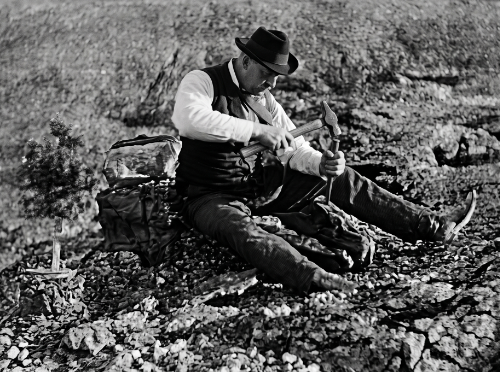
How a one-legged country doctor from Clinton ended up with his fossils in the Smithsonian — and a 300-million-year-old tree named in his honor.
In his later years, a visitor to the big brick house at 139 East Franklin Street would have met a courtly, wooden-legged gentleman moving among an orchard of improbable things: white, yellow, red, and black raspberries, currants and gooseberries, apple, apricot, peach, and plum trees marching from Second Street clear back to the railroad. Inside, the shelves told a rather strange story. Among a Clinton doctor's ordinary clutter sat slabs of gray shale, split open like a book, each one pressed with the leaves and bark of trees that had died a very long time ago — long before Missouri, long before mammals, long before nearly anything.
Dr. John Henry Britts lived two lives at once. In one, he was exactly what he appeared to be: a beloved small-town physician, a mayor, a state senator, a builder of the finest house in town. In the other, quietly and almost as a hobby, he became a figure in the history of science. The remarkable thing — the thing that sends a little jolt through you when you find it — is that the second life is not a local legend. It checks out, right down to the catalog numbers — and the national reputation behind them.
A Doctor's Son, Twice Over
He was born in Greencastle, Indiana, on November 1, 1836, the only son of Dr. George M. and Mary J. Rogers Britts. Medicine ran thick in the family. His father was a country doctor; his grandfather, Dr. Henry Rogers, and his uncle, Dr. John A. Rogers, were physicians too. When John came of age, he simply learned at their elbows — the ordinary path to a medical career in an era before formal schooling was required. He capped that apprenticeship with a year of lectures at the St. Louis Medical College in 1857–58, and later earned his degree there — his studies presumably interrupted by the Civil War years. That school would one day become the medical school of Washington University.
His father had led the family to Henry County in 1842, back to Indiana in 1844, and eventually settled in Clinton, then a village of about 250 souls. In 1859, the young Dr. Britts hung out his own shingle in the town of Austin in Cass County — near where Anne Elizabeth Freeland Lewis lived. She was a planter's daughter who had been educated at the Baptist College in Columbia, at a time when higher education for women was uncommon. The two became engaged. And then the country came apart.
A House Divided — Literally
Few families felt the Civil War's contradictions more personally than the Brittses. Dr. George Britts, the town postmaster and John’s father, was a staunch Union man. John took the other side entirely. Engaged to a Southern woman and surrounded by Southern neighbors, he enlisted for the Confederacy — and raised a company of his own, made up entirely of the sons of the area's Southern families. Those were the boys of one Henry County neighborhood, marching off together behind their doctor. The father tried to talk his son out of it, but he failed — and, the account says, the two men never spoke of it again.
The war fell hardest of all on Anne's family. The Missouri–Kansas border was its own private hell of raids and reprisals, and in 1863 the Union issued the infamous Order No. 11, which forcibly emptied several Missouri border counties of their residents to deny cover to guerrillas. The Lewis family's home and its thousand acres were burned; crops, furnishings, food, clothing, and livestock were all taken. Ironically, it was John's Unionist father who came to their rescue. With no way to reach relatives in St. Louis, the family borrowed two teams of oxen and two wagons from a neighbor and made their way to a farm ten miles north of Clinton, where Anne taught in a neighborhood school while the war dragged on.
The Long Way Home
Here, the story turns almost cinematic, and we'll tell it the way the family did.
At the siege of Vicksburg, a shell fired from a river gunboat struck the hospital where Dr. Britts was working — hospitals were supposed to be off-limits — and cost him part of his right leg. He was carried to Montgomery, Alabama, and nursed back to health, then served on through the fall of Atlanta, the burning city later seared into the national memory by Gone with the Wind.
When the war ended, a U.S. officer asked him to stay behind and tend fifty wounded Confederates too badly hurt to be moved. He took the Oath of Allegiance to the Union and did it. Then he started home, penniless and one-legged. In his bag were two bottles of quinine — the bitter bark extract that was then the only real weapon against malaria, and worth more than gold in the mosquito-ridden South.
That night, a Mississippi planter took him in and turned out to have a whole household down with malaria. Britts spent one of his precious bottles on them, and the grateful planter pressed a twenty-dollar gold piece into his hand. It was enough to get him to St. Louis, where friends fitted him with a proper artificial leg.
He refused to wear it. For the rest of his life, he stumped around on a plain wooden leg instead — the first of several hints that this was a man who valued the practical over the fancy.
The Yankee and the Rebel
He reached Clinton in the fall of 1865 and married Anne a short time later, on November 1 — his own birthday — and now his wedding day besides. They set up their first home at the southwest corner of the square. Before long, he acquired a lot on East Franklin Street and built a two-story frame house there — the house where all six of their daughters would be born.
Then came one of those partnerships that could only have happened in a country trying to knit itself back together. Dr. Britts, the wounded Confederate, went into practice with Dr. Perez Smith Jennings, a transplanted New Englander from Maine — a Yankee, in the shorthand of the day. By every account, it worked beautifully. They even shared an unusual arrangement: whenever either man collected a fee, he split it down the middle with the other, no questions asked. The partnership lasted some twenty-eight years, until Jennings's death in the early 1890s. Independent genealogical records confirm the pairing exactly as the family remembered it — the ex-Rebel and the ex-Yankee, dividing every dollar between them for nearly three decades.
The House on East Franklin
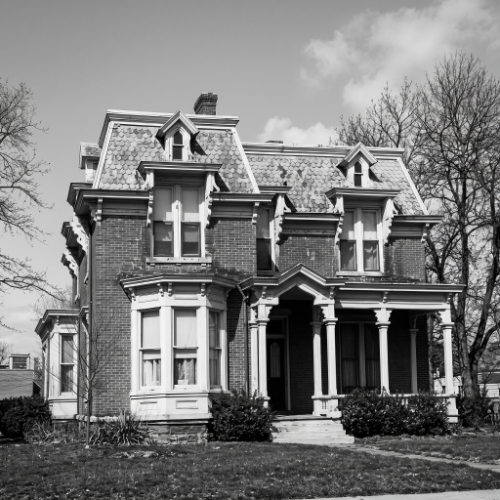
By 1879, Dr. Britts had prospered enough to build something extraordinary for a prairie county seat: a ten-room red brick home at 139 East Franklin. He did not do it modestly. He brought in an architect from St. Louis, an interior decorator from Kennard's, a fashionable St. Louis firm, and — the detail that makes people smile — a fresco painter from Italy to decorate the two parlors. A fresco is paint applied to wet plaster, so the color becomes part of the wall itself. Imagine hiring an Italian craftsman to do Renaissance church-work in 1870s Henry County.
The grounds mirrored the man's restless curiosity. He grew fruits most of his neighbors had never tasted, and the old frame house he'd outgrown was cut up and repurposed — part converted into a laundry with its own smokehouse, coal house, and buggy shed, the rest hauled off to North Fourth Street to live another life. Nothing wasted; everything a little unusual.
The Vanished Forest
And now the fossils — which is where a good local story becomes something bigger.
In 1882, Britts was elected to the Missouri Senate, where, as a Democrat, he chaired the Committee on Mines and Mining. Henry County sat atop coal, and coal in Missouri comes wrapped in shale full of fossil plants — the pressed remains of a swamp forest that grew here roughly 300 million years ago, in the age geologists call the Carboniferous, the "coal-making" period. When a farmer's plow or a miner's pick turned up a curious slab, word went to Dr. Britts.
Here's the wonder of it. The coal he was helping to survey and the fossils he was collecting are the same thing: that coal is the compressed body of that lost forest. And the forest's giants were scale trees — Lepidodendron — towering relatives of the ankle-high club mosses that today creep across the forest floor. Back then they grew a hundred feet tall, their trunks patterned in diamond-shaped leaf scars like the skin of some enormous reptile. Britts was pulling the leaves of these trees out of the very coal their forests had become.
His collection grew into one of the finest of its kind in the country, and he sent specimens east to the leading scientists of the day. Chief among them was Leo Lesquereux, the foremost American authority on fossil plants, then compiling the definitive catalog of North America's coal-age flora. Britts kept him supplied with material from the Clinton coal.
Now, the museum's own account has always said that Britts furnished the Smithsonian with specimens, "many never before described." It's the kind of claim you'd expect a proud local history to make — and the kind you brace yourself to find exaggerated. It isn't. Dig into the scientific record, and the confirmation is startling in its specificity:
Lesquereux named a species of scale tree Lepidodendron brittsii — after Dr. Britts — from a specimen Britts himself collected. It was published in 1880 and is still cited in peer-reviewed paleobotany today. A tree that lived 300 million years ago carries a Clinton doctor's name in the permanent literature of science.
The reference specimens behind several of Lesquereux's species — including brittsii — are cataloged as type specimens in the United States National Museum, better known as the Smithsonian, each labeled as collected by Dr. J. H. Britts.
A word on why that matters. A type specimen is the single physical example that forever defines a species — the master copy against which every future find is measured. To have collected even one is a real contribution to science. To have your name on a species, drawn from a specimen you found in a Missouri coal seam, is the kind of immortality most professional scientists have never achieved. Britts did it as what the nineteenth century called an amateur — a word that then meant not "unskilled" but "one who does it for love," and whose amateurs regularly rewrote the textbooks.
There's a quiet correction buried in all this, and it flatters him. The old account credits his fossil interest to his Senate committee work in 1882. But Lepidodendron brittsii was published in 1880 — two years earlier. The collecting came first. The Senate seat didn't spark his passion; it simply gave an already-serious naturalist a bigger stage. Later, the U.S. Geological Survey's landmark 1899 study of Missouri's coal-age plants would rest largely on collections from Henry County — the ground Britts had spent decades working.
Senator, Mayor, Citizen
Public life suited him. Elected Mayor of Clinton in 1888, he and his council pushed through the town's first real modernization: two miles of sewer laid, the principal streets leading off the square paved, and a proper system of sidewalks established. The man who dug into the deep past also dragged his hometown forward into its future.
What the House Held After
The family's private history was far darker than its public success. John and Anne had six daughters and buried three of them young. Lucy, born in 1867, died at four. Mary, born in 1866, was seventeen and just leaving for college when she drank tainted water at a picnic and died of typhoid fever. Edith, born in 1878, died at nineteen of tuberculosis. Only three daughters lived to grow old.
Dr. Britts died on November 14, 1909, with the services held in the home he had built. Anne followed on November 15, 1916 — very nearly the same November day, seven years on, in the house where they had begun their marriage on a November 1st half a century before.
The home stayed in the family for generations. Their daughter Ann lived there, joined for a time by her sister Eugenia after Eugenia's husband, Walter E. Owen, passed away. As for Ann, she lived to be one hundred, dying on November 30, 1976. She rests, as her father does, in the Britts family plot in Englewood Cemetery.
Sadly, the house itself is gone now — the lot at 139 East Franklin stands empty near the railroad tracks, the orchard and the frescoed parlors long vanished. But somewhere in a Smithsonian drawer, a slab of Missouri shale still bears the name Britts, exactly where a country doctor's curiosity placed it.
---
Written by Mark Rimel. A note on sources: This account draws on the Henry County Museum's book, Early Homes and Families, written by Betty Maxwell and Brenda Dehn. Other independently documented records include the Missouri Secretary of State's legislative rolls; Leo Lesquereux's Coal Flora and the published catalog of his type specimens in the U.S. National Museum (Smithsonian); and the U.S. Geological Survey's 1899 monograph on the fossil flora of Missouri's Lower Coal Measures. All rights reserved ©2026.