
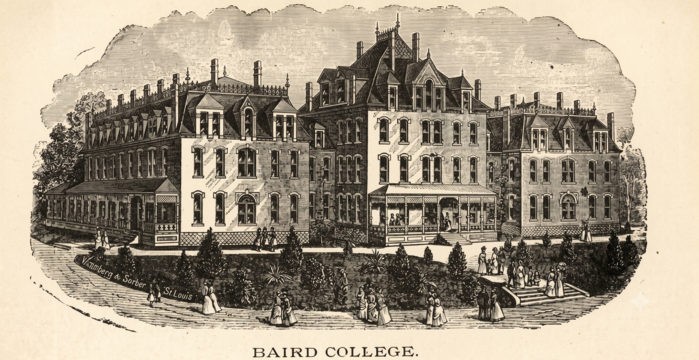
On a Tuesday morning in the fall of 1885, a bell rang out over South Second Street, and one hundred young women filed into the main room of a magnificent new building. Fifty of them had come from all across Missouri, Texas, Kansas, and the Indian Territory, what would eventually become Oklahoma. The other fifty were Clinton girls, daughters of the town that had built this place. When they were seated — eight to a table, the arrangement chosen deliberately to feel more like a gathering than a classroom — Mrs. Priscilla Baird welcomed them with words that set the tone for everything that would follow.
"Ladies," she said, "we are glad to greet so many of you this morning as pupils of Baird College. We hope that this may be the commencement of a grand success for this institution, and we ask that each of you labor with us to make it such."
It was, as the Clinton Advocate put it, "a red letter day for Clinton."
A Town Makes a Decision
In the decades following the Civil War, small Midwestern towns understood something clearly: institutions meant prosperity. A railroad depot, a county seat, a college — these were the things that separated a town with a future from one that would quietly fade. Colleges in particular were magnets for economic life. Boarding students spent money locally. Faculty salaries circulated through shops and businesses. Visitors came and went. Civic pride swelled. Towns competed for them.
At the same time, demand for quality education for young women was growing faster than the supply of institutions to meet it. Families of means wanted their daughters educated beyond the common school level, but options — particularly in southwest Missouri — were limited. For an experienced educator with the right temperament and financial creativity, that gap looked like an opportunity.
Homer T. Baird saw it clearly. He had spent years running Hardin College in Mexico, Missouri, a small city about 40 miles northeast of Columbia. He knew the market was ready for a college of his own. All he needed was a location. By his own later account, he came to Clinton in the spring of 1885 "almost a stranger" to the community — no deep local ties, no prior history with Henry County. But he came with a proposition that was both straightforward and bold: if the citizens would secure land and finance a building, he would furnish it at his own expense, hire the faculty, and operate the college — all while honoring scholarship pledges to investors until the building's cost was recouped. The community absorbed the construction risk; he retained operational control. It was, in its way, a bet that suited both sides perfectly.
Prominent names stepped forward — Judge Gantt, Judge Dorman, A. C. Avery, H. W. Salmon, J. H. Britts, A. P. Frowein, and others — and within days $14,000 had been pledged. By April, the project was declared an assured fact. A location was chosen, plans were commissioned from Isaac S. Taylor, a leading architect from St. Louis, and bids were solicited for a building estimated to cost $32,000.
The contract was awarded to Harry Kemp of Clinton at $33,462. Brick work began that June — over a million bricks, most of them shipped in from outside the area since the local kilns couldn't meet the demand — and the pace of construction was remarkable enough to draw repeated praise from the local press. One month after signing the contract, much of the structure was already above the first floor. By late September, carpenters and plasterers were finished and painters nearly so. The Clinton Advocate described it as fresh "as a newly blown rose."
Baird College opened on September 29, 1885, on schedule.
The Building Itself
What rose on South Second Street, between Allen and Henry Streets, was no modest schoolhouse. The finished structure had a frontage of 187-½ feet, with a north wing reaching 124 feet deep and a south wing 89 feet. The center elevation climbed four stories — 75 feet from ground to pinnacle — and the wings stood three stories tall. In all, there were 110 rooms, plus halls, corridors, and two broad stairways. A fine elevator was added later. The building was supplied with gas lighting, bathrooms on every floor, speaking tubes, electric bells, and fire escapes throughout.
By 1888, advertisements were calling it 'the best building in the State,' a claim that, given the investment poured into it, was not entirely without foundation. 'Upon the college as it stands today,' the Henry County Republican noted in 1895, “there has been expended over seventy thousand dollars.”
A visiting writer from the St. Louis Republic described the building as sitting 'mother-like, amid stately trees' — and the image matched what visitors actually found inside. The broad reception hall was hung with paintings done by the college's own students and decorated with white statues in wall niches. The same elegance carried through parlors, drawing rooms, bedrooms, libraries, dining rooms, and recitation halls alike.
The Bairds
The college bore the family name, and the family was its heart.
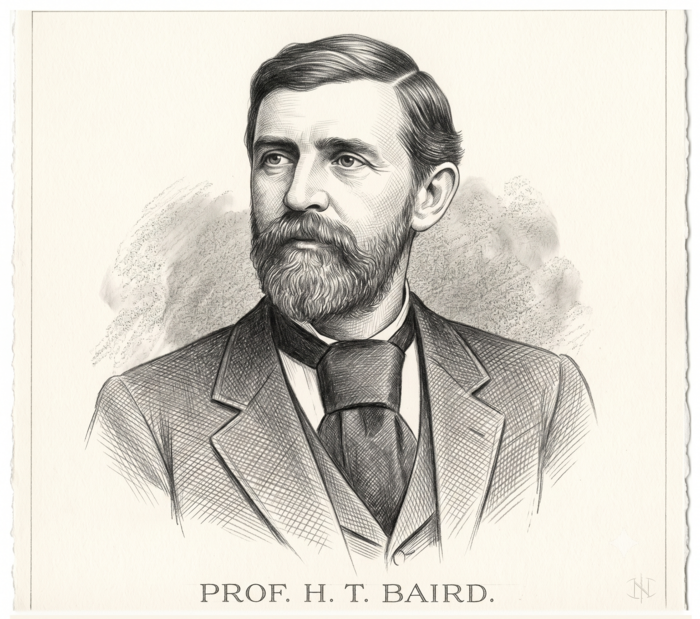
Professor H. T. Baird was the financier, promoter, and general manager — a man who, as one Mexico, Missouri paper noted before the move to Clinton, "cannot be surpassed as a financier and business manager, and as a canvasser for a college we don't think he has an equal."
His wife, Priscilla Baird, was the president of the faculty and the soul of the institution. She had previously served as president of Hardin College in Mexico, where her reputation as an educator was firmly established. At the opening ceremonies in Clinton, she told her new students that the college had but one rule: "do right." Conscience, she said, was a more reliable guide than any list of regulations. She greeted them "as children to be ruled by love and guided by grace."
Those weren't just words. Former students at reunions decades later still spoke of her with unmistakable warmth. Letters written to them by Mrs. Baird at their departures were read aloud at those gatherings and moved listeners to tears.
The third member of the family, central to the college's life, was Miss Itonia Baird — "Miss Tony" to the students — daughter of the founders. She was a gifted musician and language teacher who had trained in Brussels, Belgium, studying three years in instrumental music and three more in vocalization. She served as music director for years, accompanied performances at the piano, and became a beloved figure in the life of the college.
The whole family, the Clinton Eye later recalled, was "so well known that this will be a good drawing card."
Life at the College
Baird College was a comprehensive institution — though not a college in the modern sense. It served young women at every level, from primary grades through full collegiate study. Many families sent their daughters for a year or two of music, languages, or general refinement with no intention of pursuing a degree. Others came for the full program. The curriculum encompassed classical studies, natural sciences, mathematics, history, modern and ancient languages, literature, elocution (the art of public speaking), fine arts, and music.
Advertisements boasted a faculty of fifteen specialists — and it wasn't an idle boast. Over the years the faculty included graduates from institutions in Berlin, Amsterdam, Boston, and Brussels. Professor Henri Appy, who joined in 1894, had served as director of the Academy of Music at Amsterdam, Holland, for six years. The Clinton Daily Democrat described a faculty concert he gave that fall as a revelation: "His wonderful perfection in the art of music needs no words of praise."
The college was declared "Christian, but non-sectarian" — a distinction the Bairds took seriously. Students chose their own church and Sunday school affiliation and were expected to attend consistently. At the same time, no denominational doctrine was taught in the school itself. As Professor Baird told the students at the opening: "No doctrinal tenets are to be taught here."
The rules were firm but parental in spirit rather than punitive. Students were not permitted to correspond with young gentlemen without written permission from home. Calls from young men required prior arrangement and a teacher present. Pocket money was capped at ten dollars per year — "Extravagance in youth leads to poverty in old age," the catalogue advised. Cakes and confectionery from home were discouraged; fresh fruit was acceptable.
Despite — or perhaps because of — those regulations, the college girls found ways to enjoy themselves. Decades later, at reunions, alumnae swapped stories about midnight candy-making sessions, contraband love notes, unauthorized dates, and at least one occasion when a group of girls tried to hoist visitors up to an upper-story window in a clothes basket. True or not, that last story was still making the rounds in the 1940s.
Community Life
Baird College wasn't a place apart from Clinton — it was woven into the fabric of the town. Its students attended community events, performed for the public, and were regular fixtures in the city's social calendar. When the Business Men's Review parade wound around the public square in 1890, a Baird College float carried a replica of the college building and a student dressed as the Goddess of Liberty.
The college's theatrical and musical productions were genuine public entertainments. As early as December of 1885, barely two months after the college opened, an operetta performance at City Hall drew an enthusiastic crowd. The Clinton Advocate singled out 16-year-old Lily Henderson for a solo that "thrilled the auditors with delight," predicting that "Baird College will furnish a great singer" in her.
Among the performers that same evening was a student named Courtney Thomas, playing the Gypsy Queen with what the reviewer called charming presence. She would go on to fulfill that promise in ways Clinton could scarcely have imagined — leaving for Paris, building a celebrated career under the name Vera Courtenay, and receiving honors from kings, queens, and the Shah of Persia. She returned to Clinton more than once to attend Baird College reunions, and at the 1927 gathering delivered the principal address — Madame Courtenay, as she was known in Paris, nearly overcome with emotion as she spoke to her old schoolmates.
The college's spring art exhibitions, which displayed paintings and drawings produced by students during the year, drew crowds of citizens who came to inspect and admire. The work was done in oils, crayons, and watercolors, and the range of subjects — portraits, seascapes, winter scenes, studies of animals and plants — spoke to the breadth and seriousness of the program.
Commencement week was the high point of the year, a full calendar of contests, recitals, religious send-off sermons for the graduates, and formal exercises that filled Clinton's churches and opera house night after night. The Baptist church, which hosted many of these events, routinely overflowed. "Clinton has no room large enough to hold the audience that will gather on such occasions," the Evening Advocate noted with a mixture of pride and frustration in 1888.
The Record
By the time of Baird College's tenth-anniversary celebration in 1895, the numbers told an impressive story. More than 1,500 students from 25 states and territories had enrolled over the decade, with 1,000 of them having boarded in the building — students at every level, from those pursuing the full collegiate program to those who came simply for a year of music or languages. Of those who completed the full course of study, 125 alumnae had gone out into the world, scattered across the western states. The graduating class alone had grown from a single graduate in 1886 to twenty-five by 1895. And in music, art, and elocution alone, more than 3,000 names had been enrolled — a figure the Henry County Republican called “a record unequaled by any institution of the kind in the West.”
The college brought an estimated $50,000 per year into the Clinton economy at its height, and its presence shaped the character of the city in ways that went beyond commerce. 'The benefits to be derived to Clinton and Henry County from an institution like Baird College in our midst, directly or indirectly, cannot now be fully estimated,' the building committee had written in 1885 — and time proved them right. The Board of Directors, reflecting on the first ten years, put it plainly: "The school has been to Clinton all and even more than was promised."
The Long Goodbye
In 1892, Professor Baird was stricken with nervous prostration — what we would today recognize as a severe mental and physical breakdown. He never fully recovered his capacity for the demanding financial management that had driven the school's growth. For five years the college continued on, but by 1897 he made the difficult decision to lease the operation to Professor John E. Fesler of Fort Scott, Kansas. With that, the Baird family — the professor, Mrs. Baird, and Miss Tony — stepped away from the institution they had built.
Fesler's management faced difficulties almost immediately. Rumors of unprofitable operations and internal faculty friction surfaced by late 1897. He was replaced in 1899 by Reverend H. L. Walker, who renamed the institution Central College for Women and attempted to broaden its reach by adding a boys' school — the Clinton Military Academy — at a separate location. Neither effort stabilized enrollment. In 1904, a group of students walked out over complaints about accommodations and management — a sign of how far the institution had drifted from its earlier footing. Walker, like Fesler before him, stepped away after roughly five years.
By 1905, ownership had passed to Dr. E. P. Chittenden of Kearney, Nebraska — and though the historical record tells us little about his background or intentions, the building's future as an educational institution was clearly entering its final chapter.
In 1910, the Seventh-day Adventist Church purchased the property and opened the Clinton German Seminary — so named because much of its student body and faculty spoke German as their primary language. The seminary grew through the early years, eventually offering a full four-year college program by 1915. But with the coming of World War I, "German Seminary" became an uncomfortable name, and the school was renamed the Clinton Theological Seminary in 1917. Fires in 1924 and 1925 proved to be the end; the seminary was unable to reopen and closed permanently.
The building itself stood silent for years afterward, a hulking reminder of more active days. In 1938, it was purchased by W. F. Hall, owner of the Industrial Iron Works, and demolished — a process that took four months.
Today, a quiet row of single-family homes occupies the block on South Second Street between Allen and Henry Streets where the building once stood.
What They Remembered
The Baird College alumnae held reunions well into the 1920s, gathering women from across the country who had been students when the college was at its height. The reunions grew large enough to have chapters in Kansas City and California, with a combined membership list of 325 former students. At the 1929 reunion in Clinton, 72 women sat down to a luncheon decorated in the old college colors of blue and white.
They ate fried chicken and listened to letters read from those who couldn't be there. They talked about their Clinton beaux, and how all the boys would go to the Baptist church because that was where the Baird girls attended services. They remembered the parties and the romances. Someone displayed the gold thimble that had belonged to Mrs. Baird. Someone else produced the old bell that had called the students to rise in the morning, to meals, and to class — the same bell that she had once hidden on Halloween so the girls could sleep late.
One story led to another, and they stayed at the luncheon table, in what one account called "the Garden of Memory," until nearly five o'clock.
A local retrospective written in 1938 at the time of the building's demolition said it best: "When Baird College is mentioned, fond memories are recalled from yester years. Within its quaint and historic walls, desires have been born, ambitions quickened, dreams visualized, and destinies of life determined."
For nearly fifteen years, that building on South Second Street was the pride of Clinton and the glory of Henry County — and the women who passed through it carried that truth with them wherever they went.
Written by Mark Rimel and researched by Keith Pettersen, both volunteers at the Henry County Museum. Sources include: The Clinton Advocate, The Evening Advocate, The Clinton Eye, The Henry County Republican, The Clinton Daily Democrat, and Henry County Democrat.