
A 169-Year-Old Land Grant Finds Its Rightful Home at the Henry County Museum
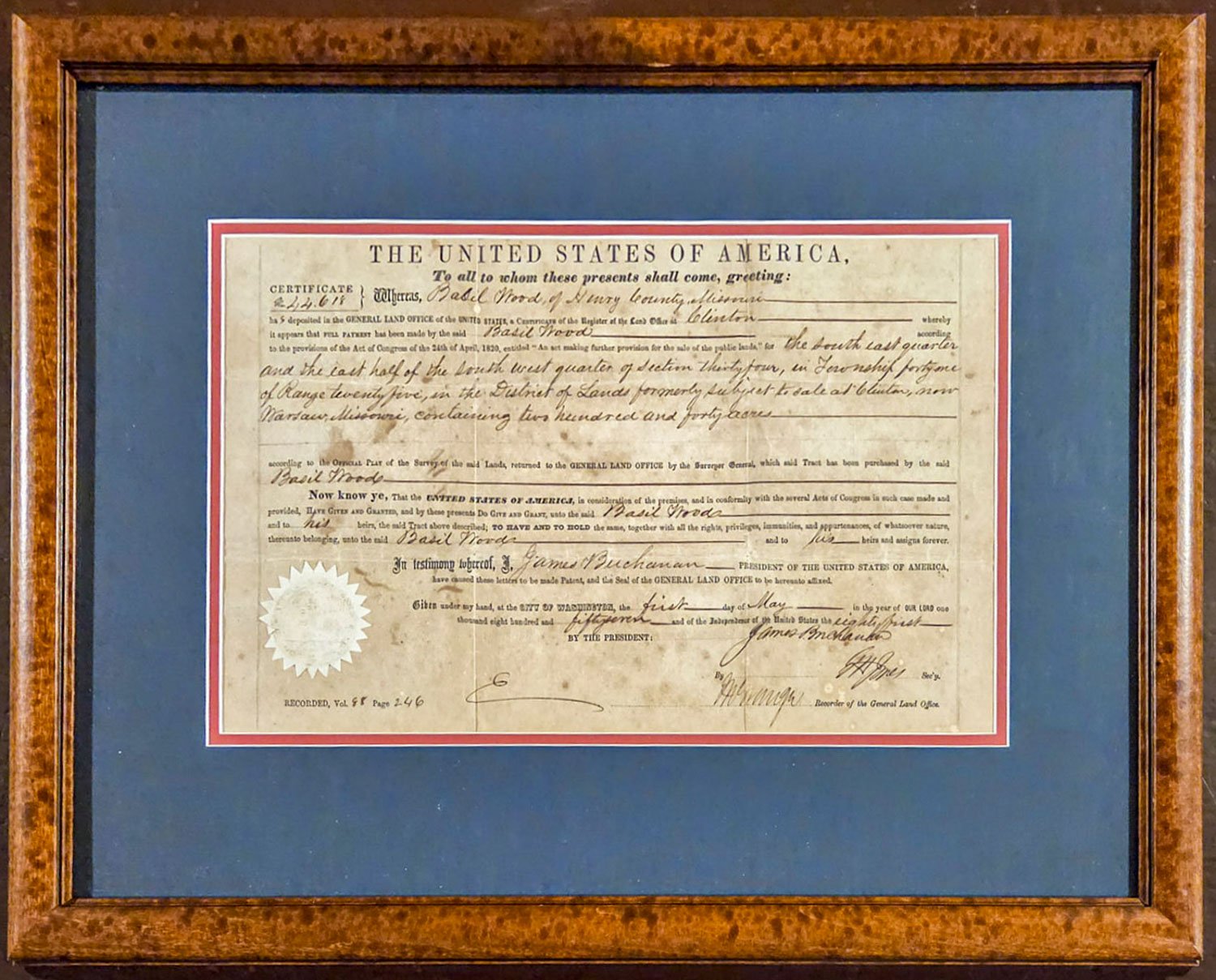
There is something quietly remarkable about holding a document that carries the signature of a President of the United States — especially one that speaks directly to the land beneath your feet. In April 2026, just such a document arrived at the Henry County Historical Society, donated by Dr. Lynda Nelson-Day of Naples, Florida. It is a framed federal land grant, issued on May 1, 1857, conveying 240 acres of Henry County land to a man named Basil Wood. It is signed by President James Buchanan.
It is 169 years old and in remarkable condition.
The Story Behind the Gift
The land grant came to Dr. Nelson-Day through her great-aunt, Nina Crouch, whose late husband, Ray Crouch, had kept it in his family's possession for generations. When Nina Crouch's estate was settled, the framed document was among the items that surfaced — a beautiful artifact that clearly deserved a proper home.
Dr. Nelson-Day knew exactly where that home should be.
"This framed land grant being donated to the Henry County Historical Society in Clinton, Missouri, was included in my great-aunt Nina Crouch's estate," she wrote in her letter accompanying the donation. "It belonged to her late husband, Ray Crouch's family."
The grant was formally donated on April 29, 2026, and is now part of the museum's collection. We are deeply grateful for Dr. Nelson-Day's generosity and her thoughtfulness in connecting this piece of history with the community where it belongs.
What the Document Says
The grant itself follows the formal, somewhat stately language of federal land documents of its era — the kind of language that felt as solid and permanent as the land it described. It opens, as all such grants did, with the words "The United States of America, To all to whom these presents shall come, greeting." From there, it identifies the recipient:
Basil Wood, of Henry County, Missouri.
(A small historical footnote: the donor's accompanying letter refers to the recipient as "Basil Woods" — with an "s." The grant itself, however, consistently spells the name without the "s." History comes with its imperfections, and both versions appear in the documentary record.)
The grant states that Wood paid in full for his land, as required under the Act of Congress of April 24, 1820 — the law that governed the sale of public lands across the young nation. In exchange, he received the southeast quarter and the east half of the southwest quarter of Section 34, in Township 41 North, Range 25 West — land that lies squarely within what is today Henry County, Missouri. It was then, and it remains today, Henry County ground.
The total: 240 acres. The price: $1.25 per acre, for a sum of $300 — the equivalent of roughly $11,000 in today's dollars. Not a small investment for a frontier settler, but a clean and permanent transaction. No liens. No installment payments. A full cash purchase, and with it, a deed signed by the President of the United States.
The document was recorded in Volume 48, Page 246 of the General Land Office records and bears the land office's embossed seal, still faintly visible after nearly 170 years.
A President's Signature
James Buchanan, the 15th President of the United States, served from 1857 to 1861 — one of the most turbulent periods in American history, as the country careened toward civil war. His presidency is often remembered in that shadow. But in May of 1857, he put his pen to a document that meant something very immediate and very personal to one man in Henry County, Missouri: the legal right to farm, build, and plant roots on 240 acres of Missouri prairie.
Buchanan's signature on the grant is legible and confident, a quiet reminder that the machinery of American government reached all the way to the frontier, one family at a time.
The Land Act of 1820 and What It Meant for Missouri
The grant references the Act of Congress of April 24, 1820 — commonly known as the Land Act of 1820 — and for good reason. That law ended the ability to purchase public domain lands on a credit or installment system, requiring full cash payment at the time of purchase. To make land more affordable, Congress also reduced the minimum price from $2.00 to $1.25 per acre and the minimum tract size from 160 to 80 acres.
For settlers heading west into Missouri in the mid-1800s, this law was enormously significant. It meant that if you had the cash — $1.25 per acre — you could walk into the land office in Clinton, make your payment, and receive, eventually, a signed document from the President of the United States saying that the land was yours.
That is exactly what Basil Wood did.
How Did the Federal Government Sell Land Inside a Missouri County?
It's a fair question. Henry County was organized by the Missouri legislature on December 13, 1834 — named first as Rives County, after Virginia senator William Cabell Rives, then renamed Henry County in 1841 in honor of Revolutionary War patriot Patrick Henry, after Rives switched political parties and fell out of favor. If Missouri had already established Henry County, how was it that the federal government was still selling land inside it more than twenty years later?
The answer lies in understanding two separate things: the right to govern land, and the right to own it.
When the United States acquired the Louisiana Territory from France in 1803, it became the legal owner of all that land — including everything that would one day become Missouri. When Missouri achieved statehood in 1821, it gained the right to govern itself: to create counties, hold elections, build roads, and pass laws. But becoming a state did not automatically transfer ownership of the unsold land within its borders to Missouri. The federal government retained the deed to every unsold acre until it chose to sell or grant it.
When Missouri drew the lines around Henry County in 1834, it was organizing its government within those boundaries — yet much of the land within those lines still legally belonged to the United States. The state could govern the county, but the federal government still held the keys to most of the property within it.
Only when someone like Basil Wood walked into the Clinton land office, paid his $300 in full, and eventually received his signed patent did that specific parcel pass from federal ownership to private hands. From that moment forward, the land was his — and any future sale would be recorded not in Washington, but at the county courthouse, as a deed between private owners. That is the same basic system we still use today.
Think of it this way: Missouri drew the county lines. The federal government held the title until each parcel was sold, one family at a time.
Prairie Land — Right Here in Henry County
When most people hear the word "prairie," they think of Kansas — wide open skies, endless flat grassland, the stuff of Western movies. But western Missouri was every bit as much prairie country before the settlers arrived, and Henry County was squarely in the middle of it.
Before European settlement, roughly one-third of Missouri — about 15 million acres — was covered in tallgrass prairie, and it dominated the northern and western portions of the state. The grass could grow tall enough to hide a rider on horseback. Bison, elk, deer, and prairie chickens were so abundant they seemed to cover the horizon. Henry County's own historical marker, which still stands at the courthouse in Clinton, describes the county as being located "in the prairie region of west central Missouri." The prairie was not just nearby — it was here.
Basil Wood's 240 acres were almost certainly this type of land: a rolling, grass-covered expanse of tallgrass prairie, rich with the deep root systems that had been building fertile soil for thousands of years. For a settler with a plow and a vision, it was exactly what the frontier promised.
Today, only about 4 percent of Missouri's original prairie survives, mostly in the western part of the state. The steel plow — and the generations of farmers who used it — transformed that sea of grass into the cropland and pasture that defines the region today. Basil Wood was part of that transformation, and his 240 acres were part of that story.
The Scale of It All
Wood's grant was one transaction among hundreds of thousands. The Missouri State Archives land records database contains over 280,000 entries from federal land sales and state-issued patents alone — and that does not include the separate records of French and Spanish land concessions that predate American ownership. In addition to direct federal sales, the United States government donated approximately 6.5 million acres of Missouri land to the state for public purposes — funding schools, supporting higher education, building roads and canals — which the state then sold through its own patent system.
The scale is almost impossible to picture. Across more than a century, from the opening of the first federal land office in Missouri in 1818 through the early 1900s, the American frontier was transferred from government ownership to private hands in parcels of 80, 160, and 240 acres at a time — each one representing a family, a decision, and a future.
Basil Wood's grant is one of those parcels. And now it hangs on a wall at the Henry County Museum, where it belongs.
A Document Worth Seeing
The land grant is beautifully framed and remarkably well-preserved — a testament to how carefully the Crouch family kept it over the years. The original document, with its formal printed text, the handwritten entries filling in the specific details of Wood's purchase, and the signature of a sitting President of the United States, is the kind of artifact that makes history feel immediate and personal.
We invite you to come see it at the Henry County Museum. Documents like this one are rare survivors — the vast majority of land grants from this era have long since been lost to time, fire, or simple neglect. This one made it. And thanks to the generosity of Dr. Lynda Nelson-Day, it is now here in Clinton, where it belongs.
---
Written and researched by Mark Rimel, a volunteer at the Henry County Museum. Sources include, the physical land grant document donated to the Henry County Historical Society, the Dr. Lynda Nelson-Day donor letter, the Bureau of Labor Statistics, the historical marker placed in Clinton by the State Historical Society of Missouri, Land Act of 1820 via Wikipedia, The Church of Jesus Christ of Latter-day Saints (federal land office history), Missouri State Archives via Missouri Digital Heritage, University of Missouri Digital Library, Missouri Department of Conservation, Missouri Botanical Garden and the Shaw Nature Reserve, and the Missouri Prairie Foundation. All rights reserved ©2026.