
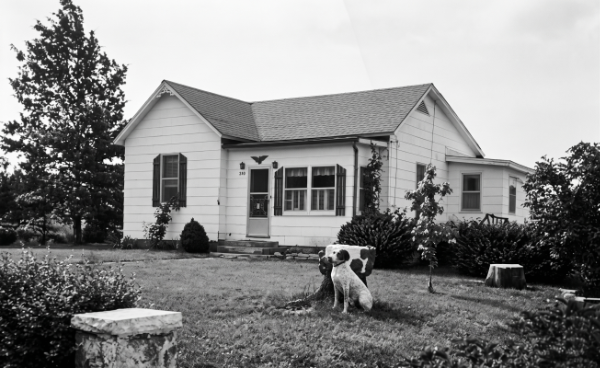
506 East Bodine Avenue
Harry S. Truman’s parents’ house in Clinton, 1905.
At 506 East Bodine Avenue in Clinton, there’s a house with an unlikely claim to history. It’s been remodeled significantly over the decades — a 1960s photograph in the Clinton Daily Democrat archives shows how different it once looked — but it’s still standing. For a brief stretch in 1905, that address was home to the family of a young Kansas City bank clerk who would one day become the 33rd President of the United States.
The story of Harry S Truman and Clinton, Missouri, is one that local people debated for decades, and with good reason: the details are a little complicated, and the truth turned out to be more interesting than the legend.
A Family That Never Stayed Long in One Place
Harry S Truman was born on Thursday, May 8, 1884, in Lamar, Missouri. He was the eldest child of John Anderson Truman — a mule trader and farmer — and Martha Ellen Young Truman. The family moved often, and the full count of residences is hard to pin down. What is documented is a general drift across Missouri: from Lamar to a farm near Grandview in 1887, then to Independence in 1890, and eventually to Kansas City in 1902. By 1901, Harry had graduated from Independence High School, and with college out of reach — the family simply didn’t have the money — he set about finding work.
His early jobs tell the story of a young man trying to get traction. He spent two weeks in the mailroom of the Kansas City Star, then worked as a timekeeper for a railroad construction company. In April 1903, he landed a clerk’s position at the National Bank of Commerce in Kansas City, working in the vault at $35 a month. His brother Vivian worked there alongside him. A supervisor’s evaluation called him “a willing worker, almost always here, and tries hard to please everybody. We never had a boy in the vault like him before.” He was later promoted to personal filing clerk for the bank president at $40 a month — a modest but meaningful step up for a young man with a family depending on him.
The Clinton Connection
In early 1905, John and Martha Truman decided to make yet another move — this time to Clinton, Missouri. On March 15, 1905, both Harry and Vivian quit their jobs at the National Bank of Commerce to help their parents pack up and relocate. It was a brief leave from work, not a permanent move for Harry. By April 3, just weeks later, he was back in Kansas City applying for his old job again. On that application, he wrote plainly: “My family are depending on me to help meet expenses.” He was rehired on the spot.
The family settled at 506 East Bodine Avenue, in a house next door to that of Dr. L. M. Kluttz, a local veterinarian. They also owned an 80-acre farm about five miles outside of town, near what locals called Lewis Station. Vivian and Mary Jane, Harry’s younger sister, attended school here in Clinton. Harry’s father, John Truman, as was his nature, was trading in mules.
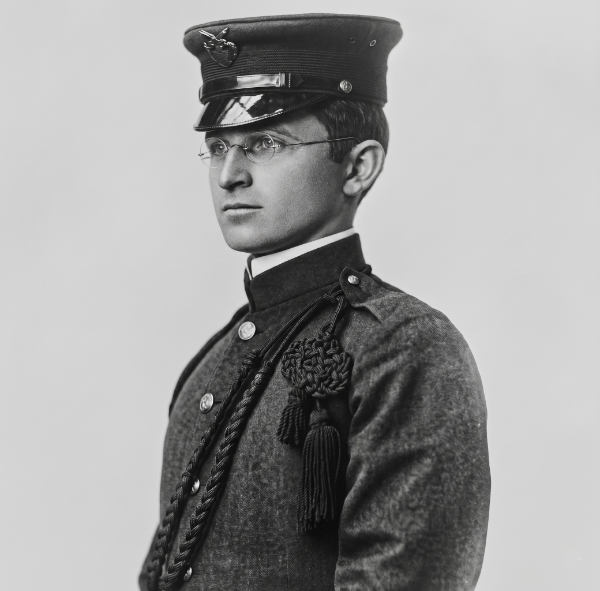
Harry S Truman wearing his Missouri National Guard uniform in 1905.
Harry did not live in Clinton. He was back in Kansas City, working — first finishing out his time at the National Bank of Commerce, then moving on to the Union National Bank. But he came to Clinton on weekends to visit his parents. It was also during this period that he enlisted in Battery "B" of the Missouri National Guard — memorizing the eye chart this time to pass the vision test he had failed years earlier when hoping to attend West Point. He was proud of the uniform: blue with red stripes down the trouser legs and red piping on the cuffs. Whether he ever wore it on one of his weekend visits to Clinton is not documented, but the Clinton Daily Democrat thought it a reasonable guess. The family stayed on Bodine for only about three or four months before eventually moving on to Grandview, where Harry joined them in 1906 to help work on the family farm.
That much was settled definitively in 1950, when the Henry County Democrat wrote directly to President Truman to resolve the long-running local debate about whether he had ever actually lived here. The reply came back quickly. The President confirmed that his family had lived in Clinton, but that he himself had not. He recalled the address as "either 506 or 508" Bodine, and said he had made several weekend visits. His secretary, Charles Ross, added a footnote confirming the address with the help of Jerry Kluttz — a former Clinton resident and well-known syndicated columnist for the Washington Post — who settled it simply: "I lived next door at the time, at 510 Bodine."
One other note worth making: the 1953 Henry County Democrat quoted neighbor Lee Kluttz as saying the family lived on Bodine “about three or four months in 1900.” That date doesn’t hold up. In 1900, Harry was only 16 years old and still in high school in Independence — nowhere near a bank job in Kansas City. The Truman Library’s own records place the Clinton move firmly in March 1905, and Harry’s own words in both his 1934 campaign visit and his 1950 White House letter confirm it. Lee Kluttz’s memory, recalled nearly half a century after the fact, was simply off on the year.
So, to settle it once and for all, Harry Truman visited Clinton, but didn't reside here. It was his parents who lived here, and only briefly. Even so, his presence in the community during those visits left a mark that lasted for decades.
The Kluttz Connection: A Neighborhood That Made History
Of all the threads connecting Truman to Clinton, none is more enjoyable than the one running through the Kluttz family next door.
According to accounts published in The Clinton Eye in August 1945, young Harry Truman took particular pleasure in riding along with Dr. L. M. Kluttz on his veterinary calls to farms around the community. It makes for quite a mental picture — a future president bouncing along in a doctor’s buggy, getting a firsthand look at farm life around Clinton. Truman told this story to newspaper men more than once, and with obvious pleasure.
That connection across the fence line would prove to have a very long reach.
Dr. Kluttz’s son, Jerry, grew up at 510 Bodine and went on to become a syndicated columnist and radio commentator for the Washington Post in Washington, D.C. When Truman arrived at the White House in April 1945 following Franklin Roosevelt’s death, Jerry Kluttz was among the journalists at one of his first presidential press conferences. He greeted the new president with a nod to their shared roots: “As one Missouri farm boy to another, I wish you the best of luck.” Truman laughed, took both his hands, and replied warmly. The bond between two men who had grown up side-by-side on East Bodine Avenue was now playing out in the White House press room.
The story of how Jerry even knew about the Truman connection is itself a good one. According to The Clinton Eye (August 23, 1945), Jerry’s sister had been told about it by Margaret Truman herself, while she was teaching in Independence. Word traveled slowly in those days, but it traveled.
The Kluttz family kept the connection alive for years. Dr. Kluttz’s son Lee worked at the Clinton Post Office and was one of the people who confirmed the Bodine address to reporters. And in May 1951, Lee’s son Robert Lee Kluttz — grandson of the old veterinarian next door — mailed President Truman an invitation to his high school graduation at Clinton High School. He received a gracious reply from the White House, signed by the President’s secretary, William D. Hassett, extending Truman’s “belated congratulations and very best wishes” to Robert and his classmates. A letter from the Oval Office to a kid on South Orchard Street in Clinton, all because of a fence line on East Bodine Avenue forty-some years earlier.
“Mornin’, Capt’n Harry”: The 1934 Campaign Visits
By the time Harry Truman came back to Clinton in the summer of 1934, running for the Democratic nomination for U.S. Senate, a great deal had happened in the years between. He had served in World War I as the captain of Battery D, 129th Field Artillery — a unit that had seen heavy action in France and whose men had become fiercely loyal to their commander. He had come home, married Bess Wallace, tried his hand at a men’s clothing store that eventually failed, and then entered politics, winning election to the Jackson County Court and serving with a reputation for straight dealing. Among those who had served under him in Battery D were soldiers from the Clinton area, and a few of them were still right here in town.
Truman's June 1934 stop in Clinton was really just a brief detour on his way to Carterville to speak to the Young Democratic Club — or so it seemed. But while he was here, he ran into Walter B. "Bristles" Menefee, a former sergeant in Battery D. The Henry County Democrat captured the moment perfectly: "Menefee's right hand jerked up a salute as he used the old salutation, 'Mornin', Capt'n Harry,' as Truman was called by all his men." Two old soldiers, one now running for Senate, meeting on a Clinton street corner. It must have been something to see.
Ed Moore was another Clinton veteran who had served in Battery D, and both he and Menefee were enthusiastically backing their old captain’s Senate bid. Truman had also visited the Clem P. Dickinson American Legion Post No. 14 in Clinton on at least two previous occasions. His ties to the veteran community here ran deep.
Truman was back again in July 1934, this time spending more time with local Democrats. He set the record straight on his family’s time in Clinton — “Along about 1904 my parents lived in Clinton, their home being on Bodine Ave., next to that of the late Doctor Kluttz. I was employed in Kansas City, but spent my Sundays in Clinton with my parents. They owned a small farm then near Lewis Station” — and he talked about his record in Jackson County. He had overseen the spending of $55 million in public funds without a hint of scandal. “I can truly say that I am poorer now than when I went into office,” he told the Democrat, “but the satisfaction remains to me of the consciousness of a duty well performed.”
He won the Democratic primary and went on to win the Senate seat.
From Senator to President
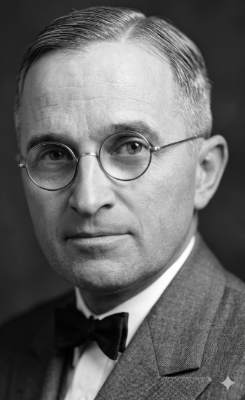
Harry S Truman, circa 1929
Clinton followed Truman’s rise with the particular interest of a community that felt it had some claim on the man.
When he was nominated for Vice President at the Democratic National Convention in Chicago in July 1944, the Henry County Democrat ran a full account of the dramatic convention scene — ballots shifting, delegations switching, excitement building until the Missouri senator swept past Henry Wallace on the second ballot and took the nomination. The paper noted that Truman "has always seemed like a neighbor" and that the nomination was "especially pleasing to Democracy of Clinton and Henry County" — the paper's customary way of referring to local Democrats.
One Clinton man put it plainly: “Truman has no wild flights of rose-colored imagination but is a man of sound, common sense, something that is always needed in Washington.”
On April 12, 1945, Franklin Roosevelt died. Harry Truman was sworn in as President of the United States at 7:09 that evening in the Cabinet Room of the White House. The Henry County Democrat reported the news the following week, describing him as “the former Missouri farm boy, said to have been for a brief period a citizen of Clinton.”
By July of that same year, Jerry Kluttz was back in Clinton visiting his family, and he reported that the opinion of Truman in Washington was very high — that the new president “has taken hold of a hard job in excellent fashion.” He also passed along that Truman had greeted him at that first press conference warmly, saying: “This is from one Missouri farm boy to another Missouri farm boy.” And that Truman had recalled his time on Bodine Avenue with obvious pleasure.
Walter Menefee and the Inauguration
Perhaps no Clintonian’s personal connection to Harry Truman ran deeper than that of Walter “Bristles” Menefee.
Menefee had risen to become the Clinton Postmaster — a presidential appointment that meant he served, in a sense, under the very man he used to salute as “Capt’n Harry.” Behind his desk hung an autographed portrait of the President inscribed: “Kindest regards to my friend and buddy, Walter Menefee — Harry S Truman.”
When Truman was inaugurated in January 1949 as the elected President of the United States, Menefee was there. He traveled with 85 fellow Battery D veterans and their wives, departing Kansas City Union Station at 1:55 in the morning on January 18th, picking up more comrades in St. Louis and Cincinnati, arriving in Washington by special train. They were put up at the Hamilton Hotel, issued caps, armbands, canes, and song sheets. They attended Mass at a cathedral. And they were there when their old captain took the oath of office.
Menefee talked about it for years afterward, showing his souvenirs to anyone who wanted to see them. The Clinton Eye published a full account of his experience in 1963, when Menefee retired after 25 years as Clinton Postmaster — noting that he had given “a vivid picture of the ceremonies honoring a one-time resident of Clinton, President Harry S Truman.”
Truman Comes Back: The 1953 Henry County Fair
After leaving the White House in January 1953, Harry Truman returned to private life in Independence. He didn’t stay quiet long — and one of his very first public appearances as a former president was right here in Henry County.
The invitation came from the Henry County Fair Board, passed through Walter Menefee. Truman’s reply, dated February 12, 1953, and written on Federal Reserve Bank letterhead from Kansas City, was warm and characteristically plain-spoken: “Arthur Bell has been assigned to me by the Governor to help me out on various things and to keep people from picking on me. He and I have made up our minds that if that ‘Ham Breakfast’ comes off on August eleventh, we will both try to be there.” Arthur Bell, mentioned in that letter, was a sergeant in the State Highway Patrol — and, like Menefee, a veteran of Battery D.
They were there.
When the fair committee traveled to Kansas City in March 1953 to finalize arrangements, Truman told them: “I’m anxious to come back to Clinton to greet old friends.” It would be, the Henry County Democrat noted, his first public appearance since leaving the White House — and he chose to spend it in Henry County.
The August 11 schedule included a country ham breakfast at the new fairgrounds north of Clinton, a speech, a ride in the grand parade, an address from the grandstand, and a dedication of a new barn. Lee Kluttz, still living in Clinton and still working at the Post Office, confirmed to reporters covering the visit that John Truman had indeed traded in mules during the family’s time here — a detail that speaks to how well the old neighbors still remembered one another after nearly 50 years.
A Neighbor’s Memory
There is one more voice worth hearing. In December 1972, following Truman’s death, the Columbia Daily Tribune published a remembrance by a writer who had grown up on East Bodine Avenue himself:
“Harry Truman was a personal president for me. The two of us grew up half a block and half a century apart on East Bodine Avenue in Clinton, Missouri. We both knew the pinch of poverty, but it left no marks — we both have always cleaned our plates, even as men who no longer feel a financial squeeze.”
He wrote of coming of age in Henry County politics in the late 1940s, driving voters to the polls in Democratic primaries, and listening to men who had been part of the Pendergast machine recall their memories of Harry Truman. “From those tales emerged the image of a man with great personal integrity and unyielding opinion, a man who did what he felt was the best to do, regardless of the desires of Tom Pendergast or the needs of one of history’s most powerful political machines.”
That is very much the Truman that Clinton people knew, or at least felt they knew. He was never a stranger here. He was the neighbor kid who rode in Dr. Kluttz’s buggy out to the farms, the young man who came home on weekends from the bank to see his folks, the old soldier whose men still snapped a salute when they saw him on the street.
The house at 506 East Bodine is still there. It looks different than it once did — time and remodeling have seen to that — but it’s there. And for those who know the story, it’s worth a second glance.
The Clinton Eye once pointed out, somewhat wistfully, that tourists passing through Clinton were driving right past the former homes of notable figures — including Harry Truman — without knowing it. “How many tourists, unfamiliar with this area,” the paper asked in 1956, “know that they are passing through the former homes of such celebrities as Harry Truman, Jane Froman, or Wayne King?” It’s a fair question, and one that feels just as relevant today.
Written by Mark Rimel and researched by Keith Pettersen, both are volunteers at the Henry County Museum. Sources include Henry County Democrat, Clinton Eye, Kansas City Times, Columbia Daily Tribune, Truman Presidential Library, Encyclopedia Britannica, U.S. National Park Service, State Historical Society of Missouri, and pendergastkc.org. All rights reserved ©2026.