
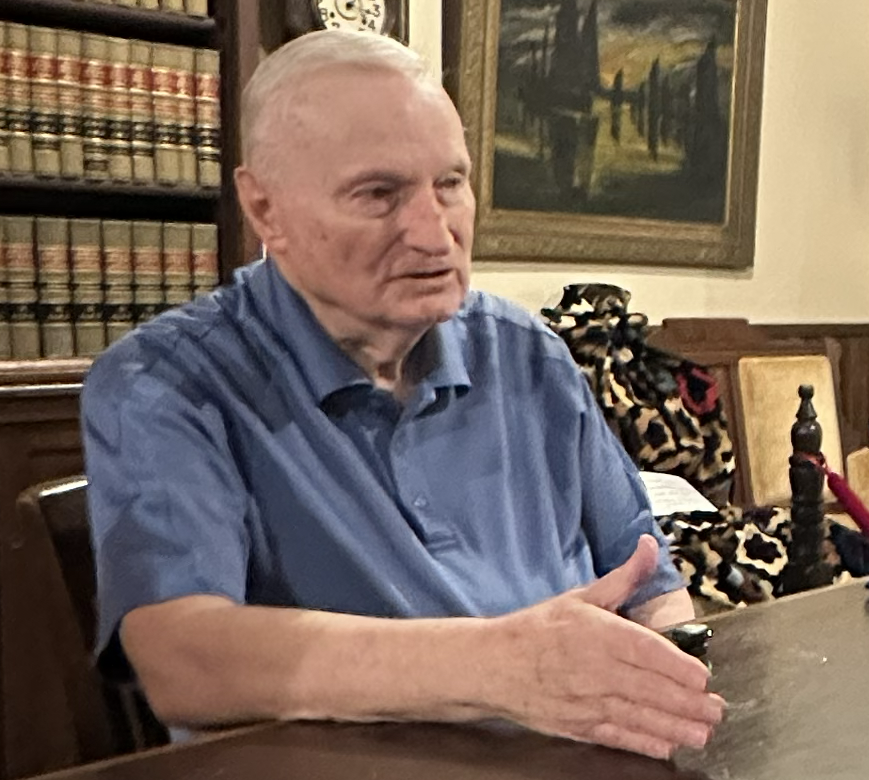
Marvin Rhoads can close his eyes and walk the streets of Clinton the way it used to be. Every block, every house, every storefront — he knows who lived there, who worked there, who came and went. He is 92 years old, born on February 15, 1933, in a house on West Jefferson Street. He has been paying attention to this town ever since.
“I can just, it’s just like I’m there almost,” he says, and you believe him completely.
The Boy Who Grew Up Here
Marvin was born during the depths of the Great Depression, the youngest of five children of Holland and Inez Rhoads. His middle name is Francis, though he has always just used the initial F — nobody needed to know, he says, and then tells you anyway. His father, Holland, had come up from the coal mines of southeastern Kansas, where he’d gone to work as a teenager after losing his own father. He eventually hired on with the Croco Coal Company in Clinton. His mother, Inez, used the initial K as a middle name on her Social Security card because her maiden name was Kabul — the rules required a middle initial, so she borrowed one from her own past.
He barely remembers the house on West Jefferson Street. They moved from there to Rogers Street, then to a farmhouse on what was then called 35 Highway, just off the road near Martin Curve. The family moved often enough that Marvin jokes they must have relocated every time the rent came due. His older brother Russell — who will turn 100 on July 3rd, 2026, and is the only sibling still living besides Marvin — offered a more charitable explanation: the same landlord owned most of the places they lived in.
One house that stayed with him was a farmhouse near the highway. The dirt road in front turned to knee-deep dust during the dry spells of the 1930s and to knee-deep mud when the rains finally came. His father, who worked at the coal mine, had to park his car near the highway on rainy days and walk the rest of the way to the house, one muddy step at a time. Then there were the winter snows. His grandmother would make her way along a narrow, snow-covered path to collect eggs from the chicken house. “I can remember all that kind of stuff just like it was yesterday,” Marvin says.
And it was there, when he was three or four years old, that his brother accidentally cut off one of Marvin’s fingers. Marvin picked it up and carried it to his mother. A doctor named Carol drove out from Clinton, looked the situation over, and — because the boy was so young — decided to try sewing it back on. He did. It healed. Marvin displays the hand when he tells the story. “It’s kind of stiff on this joint here,” he says, “but it’s better than nothing.”
Teachers, Scouts, and the Square on Saturday Night
Marvin went to Jefferson Park School, then Washington School, then back to Jefferson Park when the family moved again — a shuffle he made peace with, eventually. The best thing that ever happened to him, he says, was landing back at Jefferson Park in seventh grade, because that is where he found two teachers who changed everything.
The first was a widowed woman named Fannie Parks, who taught seventh grade with a warmth that made school feel worth attending. The second was Mrs. Nolde, the superintendent’s wife, who was strict in a way that made things stick — if she taught you something, Marvin says, you had better still know it six or eight months later, or she was upset. “They took me from not liking school to really enjoying school,” he says. “They taught me more stuff and gave me more confidence than anybody I’ve ever been around.”
Mr. Nolde was the school superintendent and an active member of the Rotary Club. He came to Washington School one day to talk with some of the boys about starting a new Scout troop. Marvin had just finished every Cub Scout rank and was interested in the idea. He was the first member of what became Troop 430, and he tells you so with quiet pride: he was Troop 430’s first Eagle Scout. He earned twenty-seven merit badges and received the Court of Honor, presided over by H. Roe Bartle, at the Municipal Auditorium in Kansas City.
Bartle, a mover and shaker in his time — later mayor of Kansas City – and the man whose title as Chief of Scouting is said to have given Lamar Hunt the idea for the name of his new football team, the Kansas City Chiefs, used to come down to Scout camp at Camp Osceola and sing for the boys after supper. Beautiful voice, Marvin says. Big, heavyset man. Genuinely wonderful person.
Around this same time, Marvin was also the patrol boy captain at Jefferson Park School — a detail he credits to Charlotte Delozier, who was two years behind him in school and used to walk past his corner on her way home.
In those years, the square in downtown Clinton was the center of everything. On Saturdays, it was nearly impossible to find a parking spot. Farmers came in from the county. Women shopped. Men visited on the sidewalk. People who lived in town would drive their cars to the square on Saturday morning and walk home — just to hold the spot for that night. “The kids would go to the movie,” Marvin says, “and the parents would visit. It was quite a deal.”
There were five shoe stores on the square alone. There were Sears, Penney’s, and several clothing stores. There were Stone’s Drugstore, Hutchison’s, and Williams. And there were the theaters. As a boy, Marvin became an usher at the Uptown Theater on the south side of the square. When a fire tore through that block in 1947, he moved to the Lee Theater on the west side, where manager Clarence Dickrath put him in a suit and tie and eventually made him the night manager — still just a teenager. When the Go-Sho Theater opened nearby — named for the Ghosen family that owned both houses — Marvin was there, taking tickets on opening night.
The Air Force, Baseball, and the Road Away from Clinton
After high school, Marvin’s first job came before he’d even had time to decide what he wanted to do with his life. He had been working part-time at the Fashion Boot Shop during his junior and senior years through the school’s diversified occupations program. On the day he graduated, he was heading to the bank on an errand when he ran into the general manager of United Telephone. His sister worked in the telephone company’s office, so Marvin knew the man. The offer came fast: why don’t you come work for us? The shoe store owner himself told Marvin to take the job. “That’s more money than I can pay you,” he said.
Marvin worked at the telephone company from May until February, then enlisted in the Air Force in 1952. He served four years during the Korean War. He passed every qualifying exam — pilot, navigator, bombardier — and chose pilot training, with his eye on the F-86 jet fighter. He was assigned to an air base just north of Dallas in Denison, Texas, while his class formed up. It was there he learned about the height restriction: he was a quarter of an inch too tall for the F-86. The Air Force proposed putting him in bombers instead, but Marvin declined. He had no interest in being responsible for a crew.
Having stepped away from pilot training, he chose engineering school at Fort Belvoir, Virginia. But before that chapter began, he made his mark in Denison another way entirely. Word got around that he could pitch a baseball. He hitchhiked home to Clinton — five hundred miles each way — to pick up his shoes and glove, came back, tried out for the base team, and made it. He spent that summer pitching his way across Texas and Oklahoma. One of his fellow pitchers was a young man named David Autry, whose father came to every game. David was the nephew of Gene Autry — the singing cowboy star of 1930s and '40s Hollywood who later owned the California Angels — and they were from Gene Autry, Oklahoma, a town named in his honor. Marvin believes David eventually became the team's general manager.
He came home from the service in 1956 to find Clinton had changed in just four years. Television had swept through town the way a strong wind moves — fast, and all at once. Marvin's own family had owned one of the first sets in Clinton, a Hamilton, he thinks, and he had watched firsthand as living rooms filled up and the square emptied out. The theaters that had once turned people away at the door now had rows of empty seats. The Saturday nights he had grown up with — the parking wars, the sidewalk visits, the lobbies packed between shows — had not slowly faded. They had simply stopped.
He went back to the telephone company for a while but grew bored with it. He enrolled at the University of Kansas to study geology, ran out of money after about two and a half years, and came back to Clinton to work at Stier’s Clothing Store on the north side of the square. Then, at a bowling tournament one Sunday afternoon, some men from Sedalia asked if he’d be interested in coming to work at Broadway Bowling Lanes. He was. He moved to Sedalia and got himself a little apartment.
From Sedalia, he followed two of those same men to Marshall, where they built the Golden Lanes — a twelve-lane operation that became, by Marvin’s account, the busiest bowling alley in the state of Missouri. They averaged fifty-nine games per lane for the year, with leagues running nearly every hour and open bowling filling the rest. On Friday nights, the staff had to clear people off the lanes at 9 a.m. Saturday to make room for junior bowling.
It was during those Marshall years that Marvin met Ronna. Her brother-in-law bowled in a league there. One evening Marvin was sitting at the snack bar with a friend when Ronna walked through the door. The friend looked at her and said, without any preamble: “If I were you, I’d just marry that girl.” Six months later, Marvin did. That friend was his best man. They were married on August 29, 1962.
Trucks, Springfield, and the Call That Brought Him Home
Not long after building the Marshall bowling alley, Marvin was approached by Doc Chapin, a veterinarian back in Clinton, who wanted a partner to build a bowling alley right there in Henry County. They built Meadowlark Lanes together. It did not go the way Marshall had. Clinton averaged fifteen games per lane in its first year. “There was just nobody here,” Marvin says, without particular bitterness. Marshall had factories, MFA, a shoe company, leagues running year-round. Clinton had none of that.
Marvin sold his share of Meadowlark Lanes and moved on. He managed a bowling alley in Chillicothe for a time — it was there that his son Robin David was born on October 14, 1964 — then went back to Marshall when that operation opened up again. His next move was into trucking: Orscheln Truck Lines offered him a position managing their office in Marshall. Good pay, but the job ran seven days a week, around the clock. It was the kind of schedule that wears on a person and a family.
He and Ronna decided they wanted a different kind of life. They liked Springfield. So, they moved there, and Marvin found work with another trucking company in town. He was on his way back from a company training school in Kansas City — his parents and Ronna’s family both still lived in Clinton — when they stopped for a weekend visit and heard that Ralph Gates was looking for help at the Fashion Boot Shop. Marvin called. Gates told him he’d just hired someone else and wished he’d known sooner.
Marvin went back to Springfield. The next evening, Gates called. The other man hadn’t worked out. Was Marvin still interested? Marvin said yes, but with one condition: if he came and liked it, and Gates ever decided to get out of the shoe business, Marvin would have first right to buy it. They made the agreement over the phone. That was around 1967.
Forty-Six Years Behind the Counter
Marvin had been running the Fashion Boot Shop at 128 South Main Street for about a year when Ralph Gates had a serious stroke. Gates tried to come back, but he couldn’t manage it. One morning he walked in, looked at Marvin, and said: “Would you like to have the shoe store?” They worked it out that same day. Gates kept his word, and in 1972 Marvin became the owner. He kept the name.
He owned the Fashion Boot Shop for forty-six years. He watched the world change from behind that counter — watched the square thin out, watched Walmart arrive (store number twenty, one of the very first) and wisely decided never to compete with it directly but always to carry what it didn’t. He built a program with Schreiber Foods, which required all its employees to wear steel-toed boots: they’d bring in thirty-five or forty new workers at a time, sit them all down, and Marvin would fit every one of them. Schreiber kept the shop going for years. He gave their employees a break on price — they were buying so many, it was the right thing to do.
He remembered customers by name, by size, and by habit. There was a woman from Montrose who came in every Thursday on her day off from the bank, stopped at Nagle’s for clothes, and bought shoes from Marvin. He had another customer — related to the Glasscocks, who had lumber yards scattered across Topeka, and Marshall, and points between — who wore a particular Oxford made by Soft Spots, came in whenever she was passing through Clinton, and bought the shoe in nearly every color, every time. Her husband would sit out in the car and read the newspaper.
Nike eventually required all its retailers to have a computer and used it as a club over independent shops: no computer, no shoes. Nike bought the Fashion Boot Shop its first computer. It didn’t pan out the way Nike expected. Marvin did very little on it, and Nike kept selling to him anyway. He had done business with the right people for too long.
What finally changed things was the internet. Companies started building their own direct sales channels and pulling back from independent retailers. Nike got harder to deal with. New Balance, which had been a strong part of his business, was available online — and often at higher prices than Marvin charged, though people didn’t always know that. Credit card fees had become a real expense; people stopped carrying cash and would use a card to buy a tin of polish. “We might as well give it to them,” he says, “because it cost us more to run the credit card than we were making off the polish.”
By the time all of this was picking up speed, Marvin had already sold the building. The buyers let him stay rent-free for as long as he wanted. He and Ronna decided to close at the end of 2018. COVID arrived less than two years later. “Somebody has always been looking out for me,” he says, and he means it.
What He Started, and What He Worries About
Long before he closed the store, Marvin had been working to keep the downtown alive. He was president of the downtown association when he heard a woman speak at some event about a new Missouri Main Street Program — the state was going to select five pilot cities. He came back to Clinton with the idea that they ought to apply. He and a small group that included Barry Glasscock, David Cummings, Diane Brownsberger, and a man from the MoPub office on the square raised the required $80,000, went to Jefferson City to make their case, and got selected. Clinton was one of five.
They used the program to strip the old metal awnings from the storefronts — those 1960s modernizations that had covered over the original building faces — and replace them with canvas. Nearly every business on the square participated. A woman named Thelma Decker was especially involved. The program gave downtown Clinton a real lift, Marvin says, and kept things going for quite a while.
He also co-founded the Clinton Alumni Association with a friend, Kathy Odom. They reached out to schools with existing programs and drove up to Fort Osage, whose alumni association helped them understand how to build one from scratch. They came back and started it. That is the pattern with Marvin. “I was always a starter,” he says, smiling. “I never was a finisher.”
He also remembered things about Clinton’s past that are harder to talk about. There was a janitor at the Lee Theater named Tony Baldwin, a Black man who had worked there for years and lived in a small room behind the projection booth upstairs. On the wall of that room, Marvin recalls, Baldwin kept a permit — issued by the city of Clinton — allowing him to remain in town after dark south of Oak Street. Without such a permit, Black residents were not allowed to stay in Clinton overnight past that line. “What a sad time,” Marvin says quietly.
He remembers the Davido family, too — Louis Davido ran a large furniture store, and when World War II began, guards were posted outside the family’s home on the corner of Rogers and Main because people were threatening them. They were Jewish. Marvin, who was a small boy at the time, has never been able to make sense of it. “We were fighting the Germans,” he says. “I’ve never figured out why people were so against the Jews here. I’ve even asked preachers to explain it to me.” A man who had grown up in Kansas City with the surname Lipschitz changed his name before moving to Clinton — afraid, simply, to arrive with a Jewish name.
These are the memories Marvin Rhoads keeps alongside the Saturday nights, the Eagle Scout badge, and the shoe store. He does not flinch from them. They belong to the same town.
What worries him now is harder to smile about. He drives around Clinton and sees houses with peeling paint, overgrown yards, and piles of trash that never seem to go away. Streets he can picture as they once were — every house kept up, every lawn tended. Today, he sees sights in neighborhoods that look unfamiliar to him in ways that go beyond time passing. "I'm kind of embarrassed to be living in Clinton now," he says quietly, and then catches himself, because he loves this place the way you can only love somewhere you have never really left.
The Best Decision He Ever Made
When asked what the best decision of his life was, Marvin doesn’t hesitate.
“Getting married to Ronna.”
He says it simply, the way people say things they have known for a long time. They have gotten along, he says, in a way that has been just unbelievable. She has been sick lately. It has been hard. He mentions it once, briefly, and moves on — not because it doesn’t matter, but because some things are too large for casual conversation.
The second-best decision, he says, was transferring to Jefferson Park School in the seventh grade and finding those two teachers. Everything that followed — the confidence, the curiosity, the Eagle Scout, the store, the life — traces back, in some measure, to Fannie Parks and Mrs. Nolde.
What Ninety-Two Years Looks Like
Marvin Rhoads has lived in Clinton for ninety-two years, give or take his time in the Air Force and those wandering years of bowling alleys and truck lines in Sedalia, Marshall, Chillicothe, and Springfield. He has seen the square when it hummed on Saturday night and when it went quiet. He has seen Tom Mix’s Wild West show pitched just across the road from his house. He has seen the first television in Clinton flicker to life in his own living room. He has watched the internet do to retailers what television did to the movie houses.
He has forgotten almost none of it.
Walk down any street in Clinton with Marvin Rhoads, even in imagination, and he will tell you who lived in every house. He will tell you what the house looked like then, and what it looks like now, and which ones he misses. He has been paying attention to this town for nearly a century, and the town is luckier for it — even if the town doesn’t always know.
Written by Mark Rimel, a volunteer at the Henry County Museum. Marvin Rhoads is a longtime Clinton resident, businessman, and community leader. He was interviewed as part of the Henry County Museum’s ongoing oral history project. The memories, views, and opinions expressed are Mr. Rhoads' own, reflecting a lifetime of living in and around Clinton, Missouri. All rights reserved ©2026.