

Flags At Englewood by artist Woody Parker
Every May, as Memorial Day approaches and Clinton residents begin loading their cars with flowers, the wrought-iron gates of Englewood Cemetery swing open to welcome them, as they have for 140 years. The Avenue of Flags stands at attention. The old trees — maples, elms, and evergreens paid for by subscription and planted in the spring of 1886 — cast long afternoon shadows across the graves. And somewhere beneath that peaceful ground lie nearly everything Henry County has ever been: its soldiers, its statesmen, its judges, its business leaders, its coal miners, its farmers, its children, and at least one pointer bird dog named Lum, who loved the place so much he never left.
This is the story of how a muddy field a mile and a half east of Clinton became one of the finest cemeteries in Missouri. Getting there in 1885 meant leaving the last streets of a booming town and navigating an unpaved, ungraded dirt track that turned to soup after every rain — hard going even in dry weather.
The Problem with Oak Grove
By the mid-1880s, Clinton had a problem. The city's original burial ground, Oak Grove Cemetery on the west side of town, was running out of room. The town had grown, the population had grown, and the dead, as they do, kept accumulating. Something had to be done.
In early 1885, the Board of Aldermen — acting, as the ordinance carefully notes, "under the advice of a large number of the citizens of Clinton" — negotiated a deal with a local landowner named John Shobe. The city would purchase eighty acres of open ground about a mile east of the city limits, on the west half of the northeast quarter of Section 12, Township 41 North, Range 26 West. The price was $3,600.
The city paid $1,000 down and received a deed for the north forty acres, with a contract to convey the south forty acres once the remaining $2,600 — plus six percent annual interest — was paid in full.
On May 28, 1885, the Board of Aldermen formally ratified the purchase by ordinance and named the new grounds Englewood Cemetery — a name evoking the pleasant, wooded English countryside that its founders no doubt hoped it would one day resemble. They appointed a sexton, the caretaker responsible for digging graves, to maintain the grounds, and keep burial records, and set the price for burial permits at five dollars — about $170 in today's money — establishing that all revenue from lot sales or burial fees would be kept "separate and apart from all other monies belonging to the city." The new cemetery would pay its own way.
Lots were laid out at twenty feet square and priced at $20 each. In October 1885, a map of the new cemetery — showing ten acres divided into blocks and lots — was hanging in the office of city clerk Orem, who predicted that Englewood would "be the principal burying ground some day, and will be a sylvan retreat of rare beauty when completed.”
He was right on both counts.
The First Resident
In the spring of 1947, Englewood's sexton, Robert S. Allen, was sorting through the cemetery's oldest records when he found an entry that answered a question people had been asking for decades: who was the very first person buried in Englewood Cemetery?
Her name was Essie Elizabeth Tussey. She was three years old.
Essie died on April 23, 1885 — only weeks after the ordinance establishing the cemetery had been signed — and was buried in the west row of lots, just north of the entrance on the west side. Her father, Julian Cicero Tussey, was a photographer who had his studio in Clinton for many years.
It is a detail that lingers. The first resident of Clinton's magnificent new "city of the dead" was a child not yet old enough for school, buried in a field that still smelled of fresh-turned earth.
A Slow Start, Then a Rush
Englewood got off to a modest beginning. In the first year, there were only about fifty graves. Many Clintonians still had pre-paid lots at Oak Grove and were reluctant to abandon them. Others simply didn't like the idea of burying their loved ones in what one newspaper called "an open field so far from town."
The community's first real effort to change that perception came in the spring of 1886, when two local civic boosters — John Bixman and John Linn — went door to door through Clinton soliciting subscriptions, a common practice in which residents pledged small amounts toward a shared civic goal. They raised $45.35 from the public, plus a five-dollar donation from the Odd Fellows lodge, and spent nearly every cent of it purchasing 339 trees from the Bonham nursery. Maples, ash, elm, box elder, willow, and evergreens were planted throughout the cemetery at a total cost of $48.25. "The cemetery now presents a beautiful appearance," the Advocate reported, "being covered with a lush carpet of timothy grass."
The results were encouraging. Of those 339 trees, over 300 survived the drought of the summer of 1886 — a result that surprised even the planters. That fall, John Linn told an Advocate reporter that he was already proud of what Englewood had become. "It is wonderful how many patrons Englewood has secured since its opening one year ago," he said. In its first twelve months, forty-seven burial permits had been issued, and the remains of thirteen more persons had been moved there from other cemeteries.
But early pride didn't solve everything. The fence was a chronic problem — and one that discouraged families from trusting the cemetery with their loved ones. The May 1887 newspapers reported cattle "gaining entrance through the dilapidated fences," trampling bushes and plants on private lots. The fence was repaired, but it apparently didn't take. Two months later, a cow and calf were found inside the cemetery with the gate locked. The fence was in such poor condition that a locked gate was beside the point.
The road to the cemetery didn't help either. For years, it was a genuine ordeal — unpaved, rutted, and seasonally impassable. In March 1897, an exasperated reader wrote to the Clinton Daily Democrat that "Thursday, some of the vehicles were with great difficulty pulled over the bad roads to the cemetery. Yesterday, a special train on the Blair Line was called into use to cover a part of the distance." He proposed that the city build a proper sidewalk and offered to donate ten dollars toward it. The Democrat ran another editorial about the road situation in September 1903, noting that "if discussion could be cut into paving blocks and stirred into mortar, a good paved road could have been built at small cost."
Italian Marble Monuments Among the Graves
The early monuments at Englewood were, by the newspapers' enthusiastic accounts, something to see.
The most celebrated monument was erected in September 1886 on the lot belonging to William J. Seifried, in memory of his wife Amelia, who had died at just 26 years of age. Seifried made his living as an interior decorator in Clinton. The newspapers credited him with designing "many of the most beautiful home interiors" in the city, and he clearly brought a professional eye to the commission.
The monument he commissioned for her was thirteen feet tall, carved entirely in Italy from Italian marble, and shipped to Clinton by I. W. Moody, a monument dealer from Fort Scott, Kansas. At its base was a square foundation bearing the name "Seifried." Rising above that was a stone inscribed with the name "Amelia" and a quotation. Above that, sheltered beneath a carved canopy of stone, stood the figure of an angel, erect. The Evening Advocate called it "one of the best pieces of sculptor's work ever seen in this city." Its cost was nearly $800 — roughly $27,000 in today's money — a remarkable tribute from a grieving husband.
Nearby stood another monument from the Seifried lot, marking the graves of the couple's twin children. On a base about three feet high lay two carved babes, faces turned heavenward and eyes closed, representing the children at rest.
William J. Seifried lived another fifty years, eventually joining Amelia at Englewood when he died in 1935.
The Migration of the Dead
The Seifried monument — and others like it — did something beyond honoring the dead. They sent a message to the living. If Clinton's most prominent families were commissioning Italian marble angels for Englewood, perhaps it was time to reconsider where the rest of the community's loved ones were resting.
Amelia Seifried had been buried initially at Oak Grove — Englewood didn't yet exist when she died — but her husband had her remains moved to the new cemetery, a decision that spoke quietly to how quickly Englewood was earning the community's trust. Others were reaching the same conclusion.
Oak Grove Cemetery had served Clinton since the town's earliest days. It was a small burial ground on the west side of town, and by the mid-1880s it was simply out of room. That overcrowding was the very reason Englewood had been established.
Families began doing something that would have seemed unthinkable just a few years earlier. They started moving their dead. Not just choosing Englewood for new burials, but returning to Oak Grove, opening graves, and transferring the remains of parents, spouses, and children to the new cemetery. One of the most affecting examples appears almost as a passing detail in an 1886 newspaper account. A local man named E. Allison had quietly moved the remains of his four young daughters from Oak Grove to Englewood. Four children, reburied together in a place their father had decided was more worthy of them.
By 1897, thirty-one of that year's sixty-four interments at Englewood were re-interments — nearly half — most of them transfers from Oak Grove. In March 1898, the city council made it official, passing an ordinance forbidding any further burials at Oak Grove. Families who still held lots there were offered equivalent lots at Englewood in exchange for relinquishing their Oak Grove plots and moving whatever remains were buried on them.
As loyalties shifted, Oak Grove's maintenance fund dried up and the old cemetery fell into increasing neglect. Sexton John Slack, who cared for both cemeteries, could do only so much with the limited funds available. The contrast with the thriving, tree-lined Englewood was stark.
Today, Oak Grove sits quietly on the west side of Clinton, its severely eroded headstones covering only a fraction of the available ground. It is a remnant of what was once the community's only burial place. Now you know why.
What the Death Records Tell Us
For several years in the 1890s, the Clinton Daily Democrat published complete annual lists of everyone interred at Englewood — name, age, date, and cause of death. These lists are both heartbreaking and historically illuminating.
The year 1896 saw 59 interments. The causes of death read like a medical dictionary of the pre-antibiotic era: consumption (tuberculosis), pneumonia, typhoid fever, scarlet fever, malaria, diphtheria, heart trouble, lung trouble, kidney trouble, stomach trouble, bowel trouble, appendicitis, gallstones, brain fever, paralysis, and simple "old age." Children died of measles, whooping cough, and membranous croup. Two men — Richard Barter and Ed Smith, both 35 — were killed in a railroad wreck on the same day in September. A 17-year-old named James Gaupp was killed by a railroad car in October.
Reading these lists is a reminder of how precarious life was in a small Missouri town in the 1890s, and of how many children and young people never made it to old age. In 1897, fourteen of the sixty-four interments were infants under one year old. In 1898, the Democrat noted that "the infant mortality for the year was unusually large."
The 1898 list includes John Shobe, the man who had sold the city the very land on which Englewood was built. He died at age 59 of dropsy, a painful accumulation of fluid in the body, often caused by heart or kidney failure.
That same list also includes the death of Col. William H. McLane on November 22, 1898, at the age of eighty-two, a man whose name would later be immortalized in the cemetery's most distinctive building.
Notable Residents
The everyday names in those death records share the ground at Englewood with some of the most significant figures in Henry County and Missouri history. Missouri's own historical marker, erected in 1960, calls out several by name.
Col. William H. McLane (1816–1898) was, by any measure, one of Henry County's most distinguished citizens. A Union Army colonel who commanded the 8th Missouri Infantry, a former state legislator, a U.S. Marshal, and a lifelong advocate of temperance, he was remembered at his funeral as a man of absolute integrity who had never been heard to question the truthfulness of a neighbor. He is buried at Englewood.
Harvey W. Salmon served as State Treasurer of Missouri from 1873 to 1875 and was a prominent figure in state Democratic politics for decades. He was also a Confederate veteran who had served throughout the Civil War. When he died in April 1927 at the age of 88, his body was brought to Clinton and interred beside his wife at Englewood.
B. G. Boone served as Missouri's Attorney General from 1885 to 1889. His funeral in 1900 was conducted at the Cumberland Presbyterian Church with full Masonic rites. The pulpit was, as the Henry County Democrat reported, "almost hidden beneath a floral decoration of roses and calla lilies."
Judge J. B. Gantt served on the Missouri Supreme Court for a decade, from 1890 to 1900, and had previously been Circuit Judge for this district. He had been wounded five times while serving in the Confederate army during the Civil War. When he died in 1912, a special train brought his remains from Jefferson City to Clinton, the courthouse flags were at half-mast, and the business houses were closed as a mark of respect.
Dr. John H. Britts (1836–1909) was one of Clinton's most beloved figures — a Confederate surgeon who lost his right leg at Vicksburg in 1863 when a fifteen-inch mortar shell fired by Admiral Porter's fleet exploded in his hospital room. He went on to become Clinton's mayor and a state senator. He was also a serious amateur geologist who supplied specimens and scientific data to the Smithsonian Institution in Washington, contributing to a federal monograph on the fossil plants found in Missouri's ancient coal-bearing rock formations. His obituary in the Henry County Democrat ran to thousands of words.
Judge James D. Lindsay served on the Missouri Supreme Court Commission from 1923 to 1930, having risen from country lawyer to one of the state's most respected jurists. He was found dead on his sleeping porch in Jefferson City on a Monday morning in August 1930. His passing reminded his eulogists of a poem he had long admired — Bryant's "Thanatopsis" — and its closing lines: "approach thy grave / Like one who wraps the draperies of his couch / About him, and lies down to pleasant dreams." It seemed, they noted, an apt description of how he went.
C. C. Dickinson (1849–1938) may be Englewood's most politically significant resident. Born in Virginia, he came to Clinton in 1872 and served as congressman from Missouri's Sixth Congressional District for twenty-two years — serving on the Ways and Means Committee for seventeen of those years, longer than any other Missourian in history. He was also one of the principal advocates for the Twentieth Amendment to the U.S. Constitution, the "Lame Duck Amendment," which moved the start of presidential and congressional terms from March to January. When he died in January 1938, his funeral cortege to Englewood "was one of the longest ever seen in Clinton."
The Ladies Who Kept Englewood Alive
The men buried in that Notable Residents section made the history books. But any honest history of Englewood Cemetery has to acknowledge that for much of its existence, the people doing the most sustained work to maintain and beautify the grounds were women.
The Ladies' Cemetery Association — later the Clinton Women's Cemetery Association — planted trees, organized the annual Memorial Day observances, raised money for improvements, maintained the flower beds, and lobbied the city year after year, decade after decade.
In 1919, the Association met at the home of Miss Kate McLane — herself a central figure in its work — and planned that year's agenda: new trees, new shrubs, and continued care of the grounds. Dues were one dollar annually. The meeting raised eighteen dollars.
In 1928, the Association had a distinctive centerpiece of the cemetery re-decorated: a large ornamental vase bearing reproductions of two of the most celebrated bas-relief designs in Western art — "Day" and "Night," by the Danish sculptor Bertel Thorvaldsen (1770–1844). Thorvaldsen's "Day" takes the form of a young woman scattering the roses of dawn, glancing back at a small figure holding a torch of light. His "Night" descends gently, bearing in her arms the children Sleep and Death, poppies braided in her hair. The reliefs were first modeled in 1815 and became Thorvaldsen's most popular designs, reproduced widely throughout the 19th century. That this vase stood in the center of a small-town Missouri cemetery is a testament to the cultural ambitions of the women who placed it there.
In 1938, after years of fundraising, the Association completed its biggest project to date: a handsome wrought iron picket fence, four feet high, built in welded eight-foot panels, encircling portions of the cemetery. The entrance gates were donated by Miss Birdie McBeth of Kansas City as a memorial to her aunt, the late Miss Kate McLane. The total cost came to nearly $2,000 — roughly $43,000 today — with the city contributing $200 and the Association and private donors raising the rest. It was an impressive achievement, though the committee was already looking ahead. Additional sections of fence were still needed, and the women of the Association had every intention of seeing the job through.
The McLane Chapel
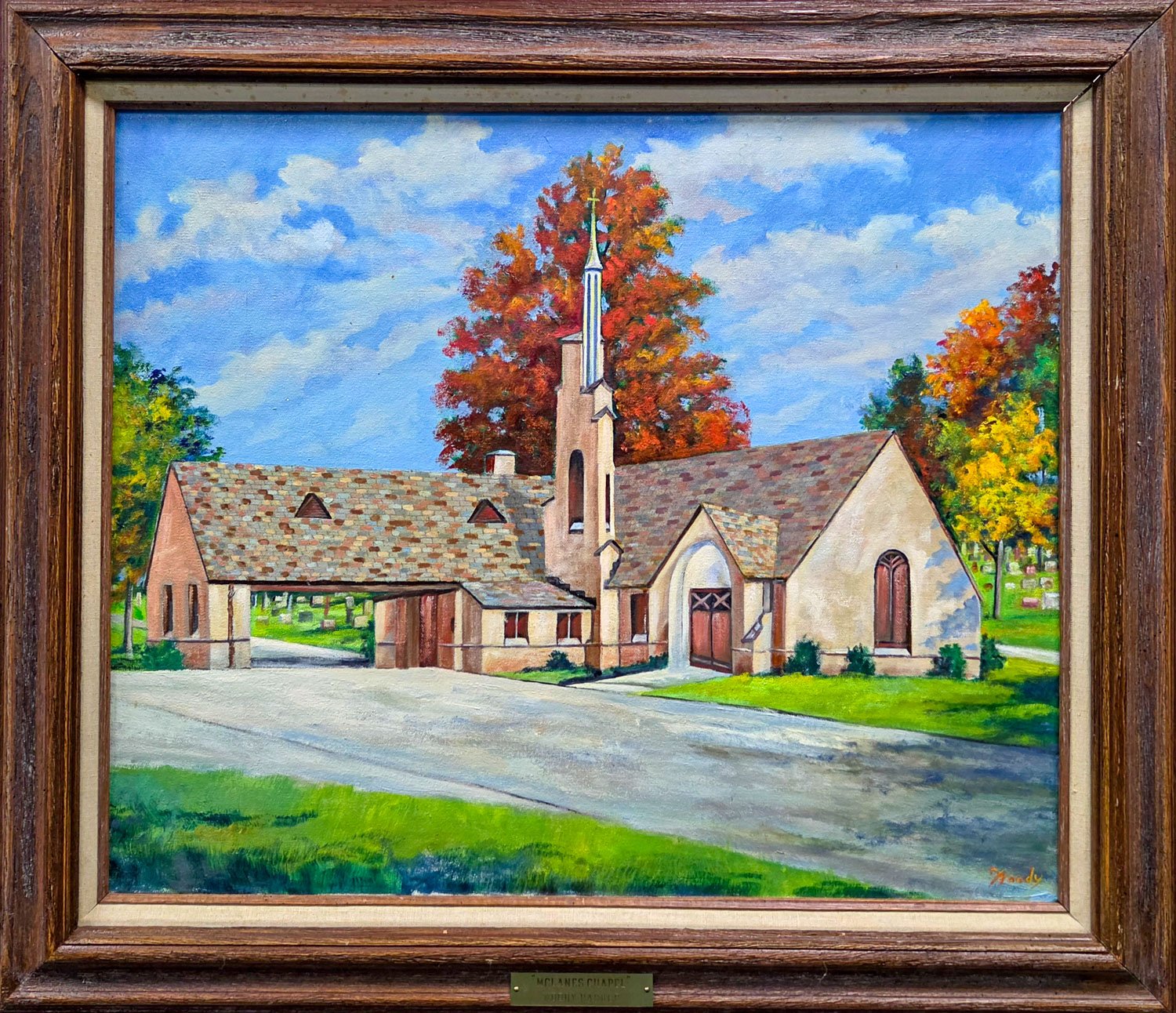
The most architecturally notable structure at Englewood connects directly back to Col. William H. McLane, whose death appeared in those 1898 mortality records and whose distinguished life was remembered in the Notable Residents section above.
Decades after his death, his granddaughter Katherine McBeth left money in her will for the construction of a chapel at Englewood in his memory. In February 1950, a contract was awarded to the F. H. Woodruff and Son Construction Company of Clinton for $62,450 — roughly $800,000 in today's money. The McLane Memorial Chapel was completed that year, and it remains one of the most graceful buildings in Clinton.
Katherine McBeth's connection to the cemetery ran deeper still. She was also the niece of Miss Kate McLane — the longtime heart of the Ladies' Cemetery Association — in whose memory the cemetery's entrance gates had already been donated. One family, across three generations, left an enduring mark on Englewood.
Coal Under the Dead
And now for something that tends to surprise people.
For several years in the early 1900s, the City of Clinton was leasing the mineral rights beneath Englewood Cemetery to a coal miner.
In February 1903, the city council passed an ordinance granting Edward Barnhart the right to sink shafts and operate coal mines on fifteen acres of the south side of the Englewood tract — the portion not yet laid out in burial lots. The lease ran three years, with an option to renew. Barnhart paid a royalty of one-half cent per bushel of coal extracted.
This was not as eccentric as it sounds. In the late 19th and early 20th centuries, Henry County was one of Missouri's leading coal-producing counties. Coal seams ran under much of the local landscape. When the city had drilled an artesian well at Englewood in the summer of 1898, drillers had struck a fourteen-inch coal vein at forty feet depth and a two-and-a-half-foot vein at seventy-two feet before hitting an inexhaustible supply of water at 120 feet.
The coal was there. It seemed like a waste not to use it.
Depression-Era Work
The Great Depression left its mark on Englewood in an unexpected way. In the winter of 1932, the Associated Charities of Clinton put unemployed men to work at the cemetery. Pay was $1.50 per day, not in cash, but in groceries. Under the direction of Sexton Herman Gebhardt, the men re-spaded the central flower circle, cleaned out the small lake in the northwest corner, pulled twenty old tree stumps, and filled in the holes.
"I greatly appreciate the plan of the Civic Club," Sexton Gebhardt told the Democrat, "and Clinton people should appreciate the cooperative plan into which they have entered for the upkeep of Englewood cemetery."
In 1933, the federal Civil Works Administration put twenty-five men to work at Englewood — chopping out decayed trees, widening drives, planting cedar trees along the east side, and setting hard maple saplings in a new addition. Unlike the grocery-wage arrangement of the previous year, these workers were paid in cash: 35 cents an hour for 30 hours a week.
And then there was Lum.
In March 1951, the caretakers at Englewood arrived one morning to find a half-starved puppy on the floor of the tool house. They fed him. The next morning, he was waiting for breakfast again. They kept feeding him. Two years later, Lum was a huge and rollicking pointer bird dog with four devoted caretakers — H. A. Wright, Roy Foster, E. L. Keller, and Lawrence Mayer — who brought him scraps from home every day. Lum had never, to anyone's knowledge, been outside the gates of Englewood Cemetery.
"We built Lum a dog house," said Wright, "but he doesn't like it. He still sleeps on the floor of the tool house. And that's because it was probably his first home."
The Numbers
By 1930, the annual interment rate was approaching 100 per year. By 1947, the total number of burials in Englewood stood at 5,160. The cemetery that had begun with fifty graves in its first year had grown into something the founders could measure in acres and lots, but perhaps never fully in lives.
They couldn't have imagined the scope of the story that would unfold within those boundaries — the Italian marble monuments, the state treasurers and Supreme Court judges, the Depression-era workers paid in groceries, the graves relocated from a reservoir. The sheer human weight of it all.
The growth didn't come only from new burials. Englewood absorbed the dead of other cemeteries as circumstances required. In the 1890s, more than 200 bodies were transferred from the abandoned Oak Grove Cemetery. Rural landholders periodically consolidated family graveyards here throughout the late 19th and early 20th centuries.
In 1978, as the U.S. Army Corps of Engineers prepared to fill Truman Lake behind the newly completed Harry S Truman Dam on the Osage River, cemeteries across south Henry County faced inundation. The Corps relocated the graves from Dunning Cemetery to Englewood before the waters rose, bringing with them the remains of families that had been buried in the rural townships for generations.
Englewood has functioned not just as a burial ground, but as a repository — a place where memory, once established, is protected against loss. Today, the cemetery holds more than 14,000 known burials, with the number growing by at least 100 annually. The original 80 acres purchased from John Shobe remain the foundation, and there is still room to grow.
A Place Worth Visiting
Fourteen thousand lives is an abstraction until you walk among the headstones and read the names. There is the sculptor's work that came from Italy: the Seifried angel, thirteen feet of marble, erected in 1886. There is the Thorvaldsen vase in the center, with Night descending on one side and Day ascending on the other. built with a granddaughter's love and a businessman's foresight. Then there is the Avenue of the Flags to honor our veterans, with flags placed each Memorial Day by volunteers who knew none of them personally but who understand, in some inherited way, that they owe them the gesture of gratitude.
And somewhere in the west row of lots, just north of the middle entrance, is the grave of Essie Elizabeth Tussey, three years old, who was the first.
For 140 years, Clinton has been bringing its dead here. The city has fenced the grounds, planted the trees, drilled the wells, built the roads, commissioned the art, and sent its daughters out each spring with trowels and flower bulbs. It has also, more than once, nearly let the place fall into neglect — and then rallied, usually thanks to a handful of stubborn volunteers with a dollar in dues and a long memory.
That, too, is history.
Researched by Keith Pettersen and written by Mark Rimel, volunteers at the Henry County Museum. Sources: Newspaper clippings from the Clinton Advocate, Evening Advocate, Clinton Eye, Henry County Democrat, Henry County Republican, and Clinton Daily Democrat, 1885–1960, from Newspapers.com; MOGenWeb Henry County Cemetery records; Englewood Cemetery official website (englewoodcemetery.com); Historical Marker Database (hmdb.org); Bertel Thorvaldsen biographical information from the Victoria & Albert Museum collections and the Thorvaldsens Museum, Copenhagen. All rights reserved ©2026.