
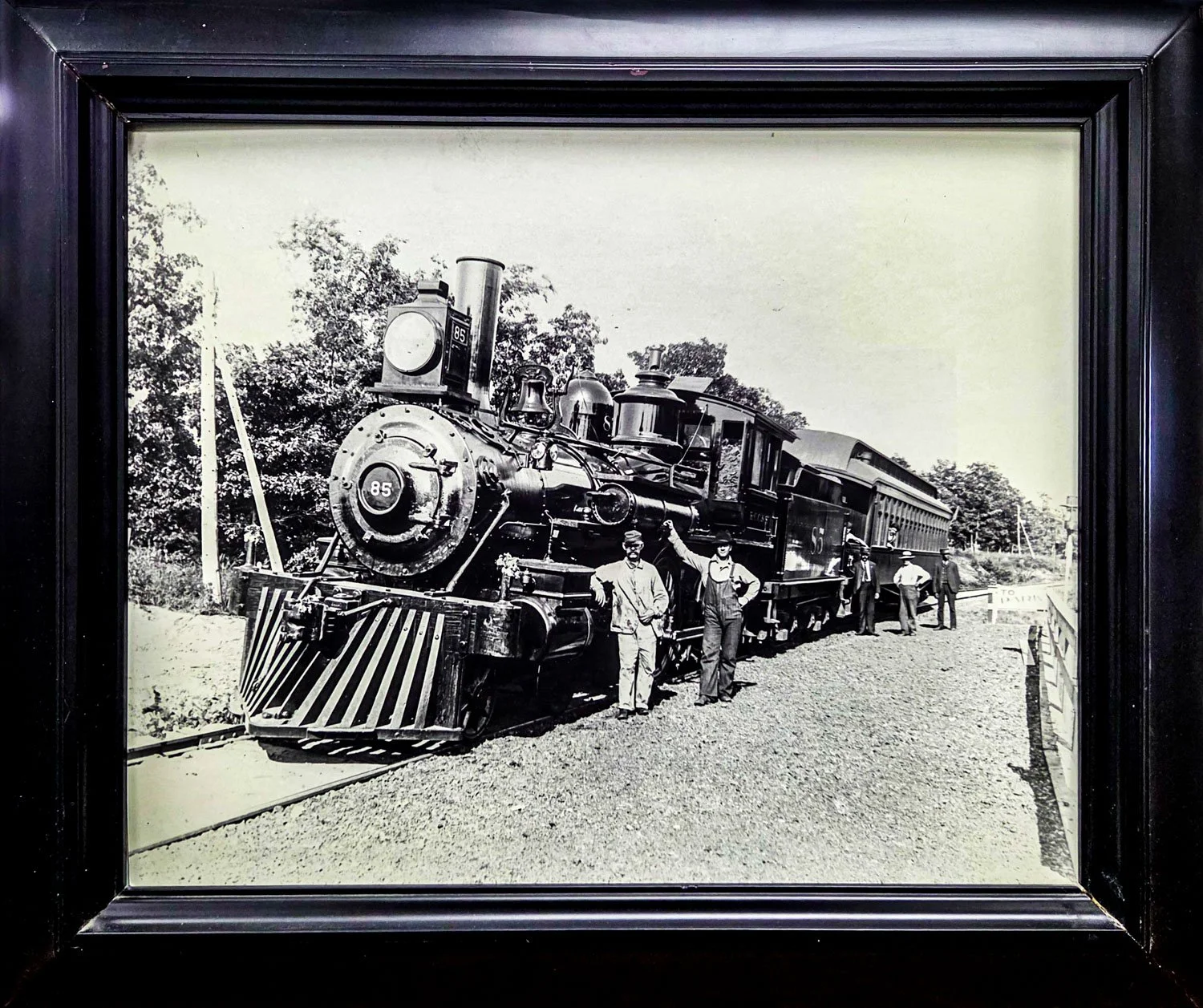
On a Saturday afternoon, April 25, 2026, at the Henry County Museum’s Adair Annex and Welcome Center, an eager crowd gathered to hear Mike Landis, a news anchor at KOLR 10 in Springfield and an avid railroad enthusiast and historian, speak about the history of a railroad that once defined this part of Missouri. He presented rare photographs, vintage maps, and a storyteller's instinct for bringing the past to life. His talk centered on his book Show Me Katy, a comprehensive history of the Missouri-Kansas-Texas Railroad in Missouri. He covered more than a century of railroad history in Henry County, from the first spike driven in 1870 to the quiet end of an era in the late 1980s.
Adding texture to his talk was Kenny Kaiser, whose late father, Don Kaiser, spent decades photographing trains in and around Clinton. Many of the images Landis displayed that afternoon came from Don's collection, and Kenny was on hand to fill in details no archive could provide, including the mechanics of the train-order hoop, the memory of a locomotive idling in a snowstorm, and the peculiar sound a railroad town makes when its rails go quiet.
Before the First Spike
To understand how the railroad came to Clinton, Landis began where all American railroad stories begin: with the completion of the transcontinental line in 1869.
"Omaha all the way to Sacramento — almost 2,000 miles — and they built it in three years," Landis told the audience. "You couldn't get that done nowadays." The comparison drew knowing laughter from a crowd familiar with the decades-long saga of Highway 13 improvements. But the point was serious: the completion of the transcontinental railroad sparked a national boom, and Missouri was squarely in the middle of it.
"Before that, the only way to get around was by stagecoach," Landis said. "So, everybody wanted a railroad — to take a ride somewhere, or to ship goods. And at that point, if you didn't have a railroad coming through, your town was not destined to grow. You were never gonna prosper."
The earliest roots of Clinton's rail connection ran through Sedalia. Around 1860, planners began mapping a branch line south from the Sedalia terminus of the Pacific Railroad — one of Missouri's first — toward the Kansas border. The proposed line was the Tebo and Neosho Railroad, and it went almost nowhere fast. First, financing collapsed. Then the Civil War consumed whatever momentum remained. A few miles of track south of Sedalia were eventually laid, but the project stalled.
The Tebo and Neosho might have quietly rusted into obscurity had they not attracted the attention of a young Kansas railroad company seeking to expand. In 1870, the Missouri, Kansas and Texas Railroad — soon to be known simply as the Katy, from the initials K and T — purchased the dormant line and got to work.
Nine Months, From Sedalia to Parsons
What happened next was, by any measure, remarkable.
The Katy reached Windsor from Sedalia in just a few months. From Windsor, the crews pushed on to Clinton, arriving in July 1870 — roughly one month to cover that stretch alone. By fall, the line had reached Nevada and Fort Scott. By February 1871, it had arrived in Parsons, Kansas. From Sedalia to Parsons in only nine months.
"They didn't have bulldozers and backhoes and earthmoving equipment," Landis reminded the audience. "This was shovels and pickaxes and maybe some horses if they were lucky. Done in nine months. That's quite a work ethic."
From Parsons, Kansas, the Katy pushed south, reaching Dallas roughly a year later. The railroad then extended northward from Sedalia to Hannibal and ultimately to St. Louis, making Clinton a stop on what became the Katy's main artery — the through route from St. Louis to Texas. By the 1980s, the Katy system stretched nearly 3,000 miles, from Omaha to the Gulf at Houston. Clinton, Landis pointed out, was a small but meaningful node on that vast network.
The original locomotives that pulled into Clinton in 1870 were modest by later standards — wood-burning engines with tall stacks and cowcatchers, not much larger than what Landis called "a Disneyland ride." But the trains grew steadily. By 1910, a postcard advertisement for the Katy Limited showed a substantial steam train — longer, taller, and far more powerful — connecting Clinton to St. Louis in a way the founders of Henry County could only have dreamed of.
Two Friscos and a Colorful Nickname
While the Katy was the dominant railroad in Henry County, it was not the only one. Henry County eventually hosted three additional rail lines: the Rock Island Railroad, which crossed the northern part of the county but stayed well clear of Clinton, and two branches of the Frisco Railroad — lines so tangled in their origins that Landis paused to untangle them carefully.
"There were two different Frisco lines," he said, "and they both went from Springfield to Kansas City, and they both ran to Clinton. I know that doesn't make it any less confusing."
The first was the Kansas City, Clinton and Springfield Railway, which Landis dubbed the "Leaky Roof Line" — a nickname whose origins turned out to be one of the more entertaining stories of the afternoon.
The Kansas City, Clinton, and Springfield reached Clinton in 1885, having begun construction in late 1884. From Clinton, crews pushed south across the Osage River — bridging it between July and September — and reached Springfield by November. Landis noted with dry admiration that it was a construction pace that would put modern highway projects to shame.
The line's most important customer was the Dickey Clay Manufacturing Company in Deepwater, a massive factory that produced clay sewer pipe and shipped about 250 carloads daily. "If you go through Deepwater right now, there's not a whole lot there," Landis said. "So it's pretty amazing to think this massive factory was there." The railroad also served the White Swan flour mill, located near what is now Allen Street in Clinton.
There was just one problem. The boxcars that hauled clay pipe for the Dickey plant didn't need to be weather-tight. Clay pipe doesn't mind getting wet. So the railroad never bothered to keep its cars in particularly good repair. When those same leaky boxcars were occasionally sent to the White Swan mill to carry flour — a product highly susceptible to moisture — the mill's manager was not amused.
"One day, there was one of those rainstorms," Landis recounted. "The foreman at the plant said, 'Don't send out any flour today — they sent another batch of the leaky roofs to us from the Dickey plant.' And that, Landis explained, is how the Kansas City, Clinton and Springfield Railway earned its lasting nickname: the Leaky Roof Line."
The Frisco acquired this line in 1901 but operated it as a subsidiary to maintain appearances. In practice, though, the Leaky Roof Line was living on borrowed time from the moment the second Frisco line arrived.
The High Line
The second Frisco branch — known as the High Line — was built better from the start. Unlike the Leaky Roof Line, which was routed through flood-prone low ground, the High Line was engineered with sufficient elevation to stay dry. "It got the name High Line because it was literally higher," Landis said. Construction began in Clinton in 1883, radiating north and south from the town. The line was completed in 1897 and purchased by the Frisco in 1900.
For a time, both Frisco lines operated simultaneously, so Clinton was served by three separate railroads — a remarkable concentration of rail infrastructure for a county seat in west-central Missouri. Two interlocking towers, one at North Clinton and the other at South Clinton, controlled traffic at the points where the lines crossed. Staffed around the clock in shifts, the towers kept trains from colliding at the junctions using a system of levers, switches, and signals.
"The South Clinton Tower was made of concrete," Kenny Kaiser noted. When the tower was decommissioned in the 1920s, it somehow ended up on private property outside town, where it reportedly still stands — a concrete monument to a more complicated era of railroads.
The two Frisco lines were never connected within Clinton, despite periodic talk of linking them. Trains on the High Line that needed to reach the downtown Frisco depot on Green Street had to proceed past the junction, then reverse down a parallel track — a cumbersome maneuver, as Landis put it, "kind of a time-consuming move."
The Leaky Roof Line outlasted its usefulness once its major customers began to fail. The Dickey plant and a rock quarry in Phoenix both closed during the Great Depression. The High Line, better built and better positioned, survived. The Leaky Roof Line's passenger service ended in 1932, and its remaining track was abandoned in 1934. In a final irony, the line's last burst of traffic came from hauling rock for the construction of Highway 7 — the very road that would help drain away the passenger traffic railroads needed to survive.
"The railroad's last hurrah," Landis observed, "was due to the road that ended up replacing it." Today, much of the old Leaky Roof roadbed between Clinton and Kansas City lies beneath the alternate lanes of Highway 7.
The High Line met its end in 1978, when the construction of Truman Lake forced the Frisco to abandon its track into Clinton rather than rebuild around the rising water. The Katy Railroad absorbed the Frisco's remaining local customers and moved its station operations to the Frisco's former depot on Green Street.
The Depot, the Hoop, and the Last Passenger Train
At the center of Clinton's railroad story stood its depot. The original structure burned, and a replacement was built in 1886 — the same blueprint, Landis noted, used for depots in Windsor and Greenridge. By around 1910, it was a hub of genuine activity at the Ohio Street crossing, serving freight and passenger trains that connected Clinton to St. Louis.
By 1944, passenger traffic had declined enough that the depot was shortened during a remodel — a quiet architectural acknowledgment that the golden age of rail travel was passing. What had once required a long platform and generous waiting rooms now needed far less.
One of the more vivid details Landis shared was the system for delivering train orders to passing crews — a method that required both precision and a certain athletic confidence. A station agent would stand by the trackside, holding a long stick with a hoop on the end, a paper order folded into the stick, and extend it toward the cab of a train passing at thirty miles an hour. The engineer or fireman would snatch it as the train flew by.
Kenny Kaiser, drawing on his father's years of experience in this line, clarified a nuance visible in Don's photographs: two different hoop designs were used at different times. One style required the crew to grab the hoop itself and toss it aside; the other used a string stretched across a Y-shaped frame — the engineer's arm passed through the string, the paper order came free, and the hoop stayed with the agent on the ground. "I have one of those," Kaiser said. His father had kept one.
The last Katy Flyer passenger train passed through Clinton on April 30, 1958. Don Kaiser was there to photograph it — a moment preserved in his collection and shared with the audience that afternoon. "A lot of people came out just to wave," Landis said, "and say goodbye to this part of Clinton's history." The freight trains kept rolling, but the sound of a passenger train calling at Clinton's depot was gone.
The depot itself was closed in 1978 and moved in 1979 to its current location — deliberately placed near the tracks rather than hauled off to some distant lot, a decision that preserved at least the visual logic of the thing. It is now home to the Clinton Visitor Center.
Chicks, Coal, and a Changing Railroad
Even as passenger service wound down, the freight business, which had always been the railroad's true livelihood, continued to evolve. Clinton, it turns out, was once the baby-chick capital of Missouri — perhaps of the country. Multiple hatcheries operated in and around town, shipping baby chicks by the millions on Katy trains to farms across the nation. The railroad, quite literally, helped stock America's henhouses.
In 1952, the Katy built a seven-mile spur to the Kansas City Power and Light plant at Montrose and to the associated coal mines in the area. What had been a modest branch eventually became the Katy Railroad's single largest source of freight traffic — surpassing even the clay plant and the flour mill in their heyday. The power plant was demolished only a few years ago, but the coal trains it generated defined the railroad's final decades in Henry County.
Another chapter was written in the 1970s, when the construction of Truman Lake forced the Katy to relocate several miles of its main line. The original route crossed the Grand River on a truss bridge that, once the lake began filling, would end up deep underwater. A new causeway and bridge had to be built — a substantial engineering project requiring millions of tons of rock. Don Kaiser photographed both the last trains on the old alignment and one of the first to cross the new bridge in 1977. That first train happened to be pulling a locomotive painted in a special Bicentennial scheme the Katy had commissioned for the nation's 200th anniversary — a happy coincidence that gave the occasion a fittingly commemorative air.
Truman Lake filled slowly. The last of the farmland beneath it didn't disappear until 1980.
The End of the Katy
Freight kept rolling after the last passenger train. The Katy built a spur to the Kansas City Power and Light plant at Montrose in 1952, which became the railroad's single largest source of freight traffic. Clinton's hatcheries once shipped baby chicks by the millions to farms across the country. And when Truman Lake forced the Katy to relocate miles of its main line in the 1970s, Don Kaiser photographed both the last train on the old alignment and the first to cross the new bridge.
In 1988, Union Pacific purchased the Katy. Four years later, the Clinton line was sold to the Missouri Northern Arkansas Railroad, which still runs trains through town today — weekly, not daily. The rails north of Clinton were removed and that corridor became the Katy Trail.
It is worth pausing to take in the full arc of what Landis described. In just over a decade, Clinton went from a town reachable only by stagecoach to one served by three separate railroads. The Katy arrived in 1870 and opened the world. The Leaky Roof Line and the High Line followed, each carving its own path through the county, each generating its own commerce and its own lore. At the peak, Clinton had depots, interlocking towers, freight platforms, and passenger trains connecting it to St. Louis and beyond. The railroads didn't just serve the town — they built it.
The retreat was slower but just as complete. The Leaky Roof Line folded in the Depression. The High Line drowned when Truman Lake rose. Passenger service ended on a spring afternoon in 1958, when a crowd gathered at the depot simply to wave. The Katy itself was absorbed, its main line downgraded, its northern corridor converted to a hiking trail. What had once been the lifeblood of Henry County commerce is now, in most places, either pavement or prairie.
What remains is the memory — preserved in Don Kaiser's photographs, in Kenny Kaiser's recollections, and in the careful research of people like Mike Landis, who spend their nights with magnifying glasses and old maps, making sure none of it gets lost.
Still Building
Landis closed by mentioning a project underway in his basement in Springfield: an HO-scale model railroad recreation of the Katy's St. Louis line, including Sedalia and a Clinton-in-progress. "I spend my nights looking at pictures with a magnifying glass," he said, "looking at every track, where it went, every building. Very obsessive." He also maintains a YouTube channel, themaintrack.com, where he documents the layout's construction and shares episodes on Clinton and Katy history.
He left the door open for a return visit. There was, he acknowledged with a grin, enough material for another hour and a half.
For a museum audience that includes people who walked those tracks, worked those depots, and watched those last trains roll through, that is probably not a long enough window either.
Mike Landis is a news anchor at KOLR 10 in Springfield, Missouri, and the author of Show Me Katy, a history of the Missouri-Kansas-Texas Railroad in Missouri. Copies are available through the Henry County Museum.
This article was written by Mark Rimel, a volunteer at the Henry County Museum. All rights reserved. ©2026.