
When Clinton Synced with the World
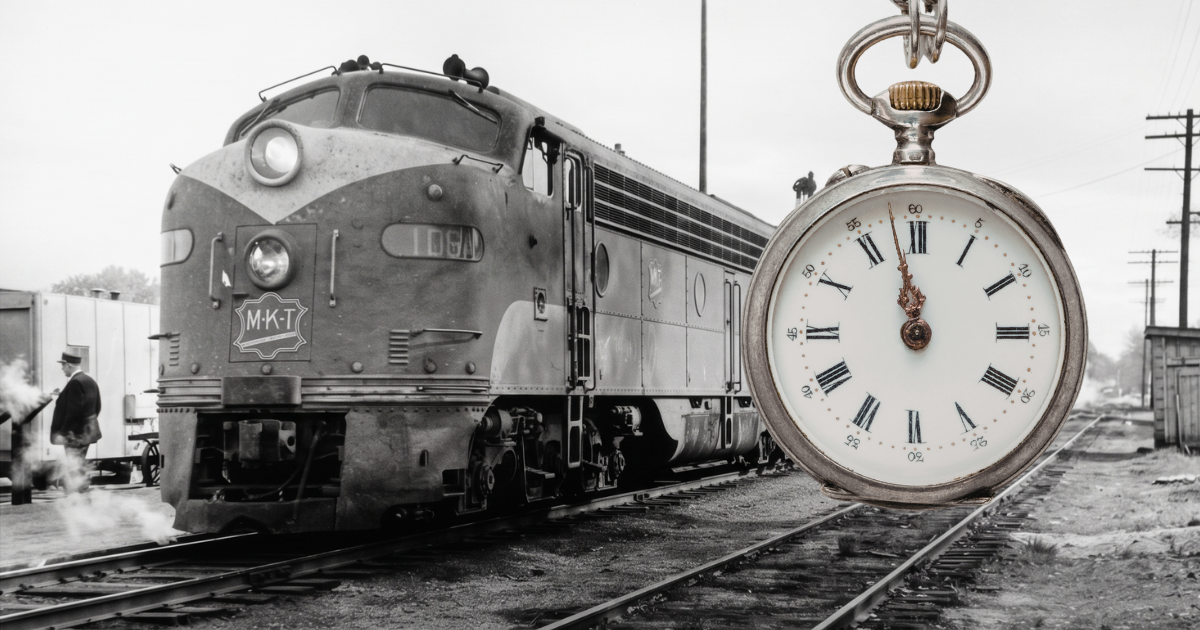
Before railroads, “time” was local, fluid, and tied to the sun. Noon was simply when the sun reached its highest point, and each town set its clocks accordingly. But the arrival of the railroads—and the speed with which they connected distant places—forced Americans to rethink time itself. Nowhere was this transformation more evident than in communities like Clinton, where the MKT and Frisco railroads shaped daily life.
For centuries, even short trips required adjusting to shifting local times. A person could leave home at “noon” and arrive somewhere minutes ahead or behind. As railroads expanded, these small differences created big problems. Major hubs sometimes listed dozens of local times on a single timetable. Passengers misread clocks. Crews struggled to coordinate schedules. And as The Clinton Advocate reported in January 1883, railroads were already pushing toward greater precision—down to the half‑minute—because stations were so close together and trains so fast that older methods simply couldn’t keep up.
The need for a unified system became undeniable. In April 1883, railroad leaders met in St. Louis and Chicago to advance a proposal first floated in 1872: the creation of four national time zones—Eastern, Central, Mountain, and Pacific. The plan was bold, simple, and revolutionary. Once adopted, the Allegheny Observatory in Pittsburgh would become the keeper of “official time,” transmitting a telegraph signal at precisely noon on the 90th meridian. And so it was agreed that on November 18, 1883, every railroad clock in the country would be reset to what became known as “railroad time.”
Clinton newspapers prepared residents for the shift. The Advocate warned that travelers on long routes sometimes had to reset their watches seven times between Boston and Denver—an exhausting ritual the new system would eliminate. Another article predicted a temporary spike in accidents as crews adjusted to the new schedules, a reminder of how deeply timekeeping was woven into railroad safety.
By mid‑November, Clinton readers were told exactly what to do: anyone keeping “railroad or Jefferson City time” was instructed to set their clocks forward nine minutes to align with the new standard. Professor H. S. Pritchett of Washington University explained that daily telegraphic time signals—double beats, single beats, and a final precise strike—would allow jewelers and businesses in towns like Clinton to synchronize their clocks with scientific accuracy. Missouri’s governor, Thomas T. Crittenden, even issued a proclamation urging all citizens and municipalities to adopt the new “central time” on November 18.
Across the nation, the shift reshaped daily life. Train crews compared pocket watches before every run. Newspapers printed updated schedules. Watchmakers offered time‑setting services. Schools, churches, and merchants gradually aligned their routines with the new standard. Even emergencies changed: as the Advocate noted, standardized schedules meant that when a special train or a delayed section was announced, every man along the line could consult the tables and know exactly where it should be at any moment.
The federal government lagged behind, though, waiting until 1918 to pass the Standard Time Act. By then, Clinton—and nearly every other American community—had long since synchronized itself with the rhythms of a modernizing nation.
The Henry County Museum’s MKT and Frisco Railroad exhibit, on display through Saturday, May 2nd, offers a closer look at the railroads that shaped our region—and the timekeeping revolution that changed daily life across America.
This article was researched and written by Mark Rimel, a volunteer at the Henry County Museum. All rights reserved © 2026.