
Montgomery's Drugstore Museum
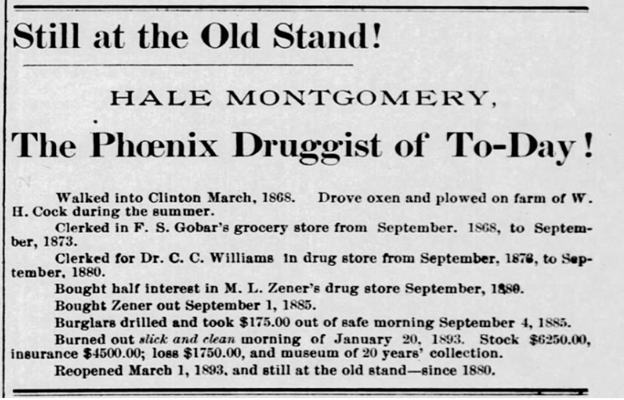
In the 1880s and 90s, long before Clinton had anything resembling a formal museum, townspeople could walk into Hale Montgomery’s drugstore and find themselves in a world where bottles of medicine shared space with curiosities no one could quite explain. That was Hale’s intention. He was a druggist by profession but an avid collector at heart—one of those rare souls who couldn’t resist an odd stone, a strange creature, or a fragment of history with a good story attached.
Fire and Loss
In January 1893, disaster struck. A fire swept through Hale’s store, burning it “slick and clean.” He lost $1,750 worth of stock, but worse than that, he lost the artifacts he had spent twenty years collecting. Specimens, stones, relics, curiosities of all kinds—all gone. Yet Hale rebuilt. His passion for the unusual never faded, and he soon resumed collecting.
A Collector with a Geologist’s Eye
In the fall of 1885, Hale joined Dr. Britts, Dr. Moad, and Kansas State Geologist F. H. St. John on a tour of the coal fields in Deepwater and Brownington. The group descended into the Keith & Perry mines, where the veins ranged from two to nearly four feet thick. St. John called the deposits “wonderful,” but Hale found his own treasure: a smooth, unusually hard, glass‑cutting boulder weighing two and a quarter pounds. The stone had been excavated at a depth of forty-two feet, and Hale carried it home like a trophy. Whether it was a prehistoric tool or a stone shaped by ancient waters, he added it to his museum with great pride.
A Store That Drew a Crowd
Hale’s museum was drawing a crowd. By October 1885, The Clinton Advocate noted that a small group gathered daily around his displays, eager to see whatever new curiosity he had added. Sometimes it was a mineral specimen; other times, something feathered or furry. In January 1886, he introduced a large white owl—stuffed, of course—but it still captivated the children who pressed their noses against the glass.
Birds From California and a Four‑Legged Chicken
Hale’s reputation spread well beyond Clinton. In 1894, former Clintonian Dr. Davidson of Los Angeles sent him a case containing twenty-seven stuffed California birds and animals. Hale planned to arrange them “in an artistic fashion,” expanding his drugstore exhibit into something resembling a natural history museum.
Three years later, the Clinton Eye reported the arrival of a four‑legged chicken. Hale, always the showman, chloroformed the poor creature and prepared it for display. Oddities like this kept the curiosity seekers coming back.
A Fragment of War
By 1895, the museum he kept in his drugstore held a new treasure: a 25‑pound fragment of brass from a cannon originally captured from Mexican forces during the Mexican‑American War. Recast into state artillery and loaned out for reunions, one of the guns had exploded at Fairplay, in Polk County, killing a bystander. Conductor Tom Wooderson retrieved a piece of the shattered metal and sent it to Hale, who placed it among his curiosities—a relic of war, tragedy, and Missouri history.
A Museum of Curiosities
Hale never stopped being a curator. His drugstore was a business, yes, but also a place where Clinton residents could step briefly outside the ordinary and into the extraordinary. Children grew up remembering the white owl, Hale’s pet alligator, the strange stones, and the birds from California. Adults stopped by to see what new curiosity had appeared in the window.
Hale Montgomery never built a museum in the traditional sense. Instead, he created something more personal and entertaining: a place where curiosity was at the center, where the odd and the beautiful shared space on a shelf, and where a druggist with a collector’s passion introduced Clinton to what a museum could truly be.
This article was researched and written by Mark Rimel, a volunteer at the Henry County Museum. Sources include The Clinton Advocate, The Evening Advocate, The Clinton Eye, The Clinton Daily Democrat, and the Henry County Democrat. All rights reserved © 2026.