
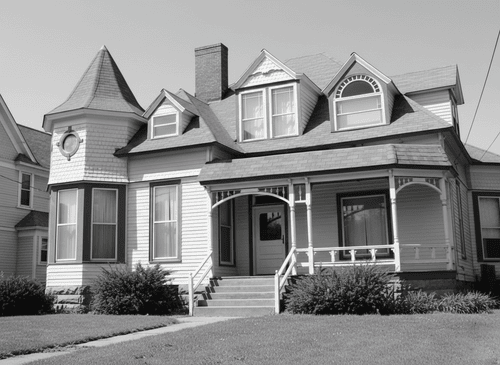
During the vibrant 1880s, as Clinton was emerging as a bustling county seat, a young jeweler named Frank B. Wadell was establishing more than just a career—he was building a thriving business, a Victorian‑style home, and a growing young family.
Frank’s journey to Clinton began in Warrensburg, where he was born on March 22, 1864. After completing his normal school education, he learned his trade the traditional way—by gaining practical watchmaking experience under the guidance of the old‑time jeweler L. B. Everhardt. He later worked for a jeweler named Walter Sams in Warrensburg before spending 1883–84 in Kansas, briefly involved in the jewelry business there.
At age 20, he returned to Missouri and went to work for W. E. Sams in Clinton—though it remains unclear whether he was connected to Walter Sams in Warrensburg. Within a year, Frank purchased a half‑interest in the business. The firm Sams & Wadell soon became one of the town’s most respected establishments, and in time Frank assumed full ownership, continuing to operate the store under its well‑known name.
The shop, located on the east side of the square in the Post Office building, was known for honest dealings, skilled repair work, and a wide variety of fine goods—watches, clocks, cut glass, silverware, and an impressive selection of jewelry.
Local records indicate that Sams & Wadell displayed a large wooden replica of a pocket watch above their entrance, reflecting a long European tradition of tradespeople using symbolic signs to mark their crafts. These, appropriately called “trade signs,” served as clear visual indicators of the business’s focus on timepieces, jewelry, and repairs—especially useful in an era when literacy rates varied widely. The simple imagery also helped attract customers.
In January 1887, just two years after Frank became a partner, the business faced a serious setback. A lamp left burning overnight exploded, igniting a fire inside the store. The blaze gutted showcases, shelving, and much of the shop’s interior before the fire department—working in freezing conditions and hampered by the fact that several gas lamps around the square were dark—managed to bring it under control.
Most of the firm’s jewelry had been secured in the safe and survived. The loss, estimated between $1,800 and $2,000, was partially covered by insurance, and within days adjusters settled the claim for $850. The quick resolution allowed the business to recover, and the firm’s reputation for reliability endured.
Frank married Carrie Wilder, the daughter of longtime Clinton resident A. R. Wilder, on October 22, 1887. They lived in their newly built Victorian‑style home at 313 South Third. The house no longer exists, but it was once a fine example of the craftsmanship and optimism that characterized the era. It was in this home that they raised their four children: Frank Jr., Louise, Robert, and Charles. Each went on to lead a distinct life—Frank Jr. advancing in the Navy to command the battleship USS Idaho, Louise becoming well known locally for her musical talent, and Robert and Charles contributing to the family story in quieter but equally meaningful ways.
Despite the demands of running a growing business and establishing a young family, Frank remained active in Clinton’s social circles. In March 1889, he and W. E. Sams hosted a birthday banquet in the Henry County Bank building for their friend Paul Tyler. Twenty‑one young men attended, enjoying refreshments, stories, and an ample supply of cake provided by “young lady friends.” The gathering reflected the camaraderie and good humor that characterized Frank’s early years in Clinton.
Frank’s friendly personality and warm greetings made him well‑liked. He was active in community life and a member of both the Modern Woodmen of America and Woodmen of the World, fraternal societies known for offering life insurance, mutual aid, and social fellowship at a time when such support systems were vital for families and small‑town businessmen. Those memberships became especially important as his health began to decline.
Behind his steady presence at the jewelry counter, Frank struggled with cirrhosis of the liver, a disease that caused months of worsening health and repeated trips to Hot Springs, Arkansas, in hopes of recovery. Eventually, out of desperation, he underwent a final operation in St. Louis, where he died on November 14, 1907, at just 43 years old. The insurance he carried through various organizations paid out $10,500 in benefits (about $365,000 today)—a crucial safeguard for Carrie as she faced the responsibility of raising their children and settling the family’s affairs.
The jewelry store—well stocked and long respected—was placed into an executor’s sale, what we would now call a liquidation sale. Advertisements emphasized that the entire inventory, valued at $15,000 (over $500,000 today), would be sold quickly “to wind up the estate.” The sale was notable enough to be described as the first of its kind in the region.
Carrie lived nearly half a century longer, passing away on October 4, 1956, almost 49 years after Frank’s death. She was remembered as a “brilliant, cultured woman” whose courage and resourcefulness guided her family through the difficult years that followed Frank’s passing. In her later years, she lived with her daughter Louise in Colorado Springs.
Though the Wadell home no longer stands today, a photograph taken more than 140 years ago preserves its appearance as a newly built house in a town that was changing quickly. Yet the world around the Wadells still featured horse‑drawn buggies, dusty streets, hand‑lettered shop signs, and a busy square where merchants knew their customers by name.
For those visiting the museum today, the connection deepens. The Keil’s Jewelry Store exhibit features tools and items from the once‑popular store, including a jeweler’s workbench, watch parts, engraving tools, jewelry collections, boxes, fine china, glassware, and a pewter figurine collection. The exhibit provides a rare glimpse into the trade that shaped families like the Wadells and helped define Clinton’s early commercial history.
This post was written by Mark Rimel, a volunteer at the Henry County Museum, drawing in part from the book Early Homes and Families by longtime museum contributors Brenda Dehn and Betty Maxwell. Their book is filled with remarkable stories of local homes and the families who lived in them. Copies are available in the Adair Annex & Museum Welcome Center. Other research sources include Heritage Museums & Gardens, The Clinton Eye, the Evening Advocate, the Henry County Democrat, and the Henry County Republican.