
When the Horses Retired and the Motor Age Arrived
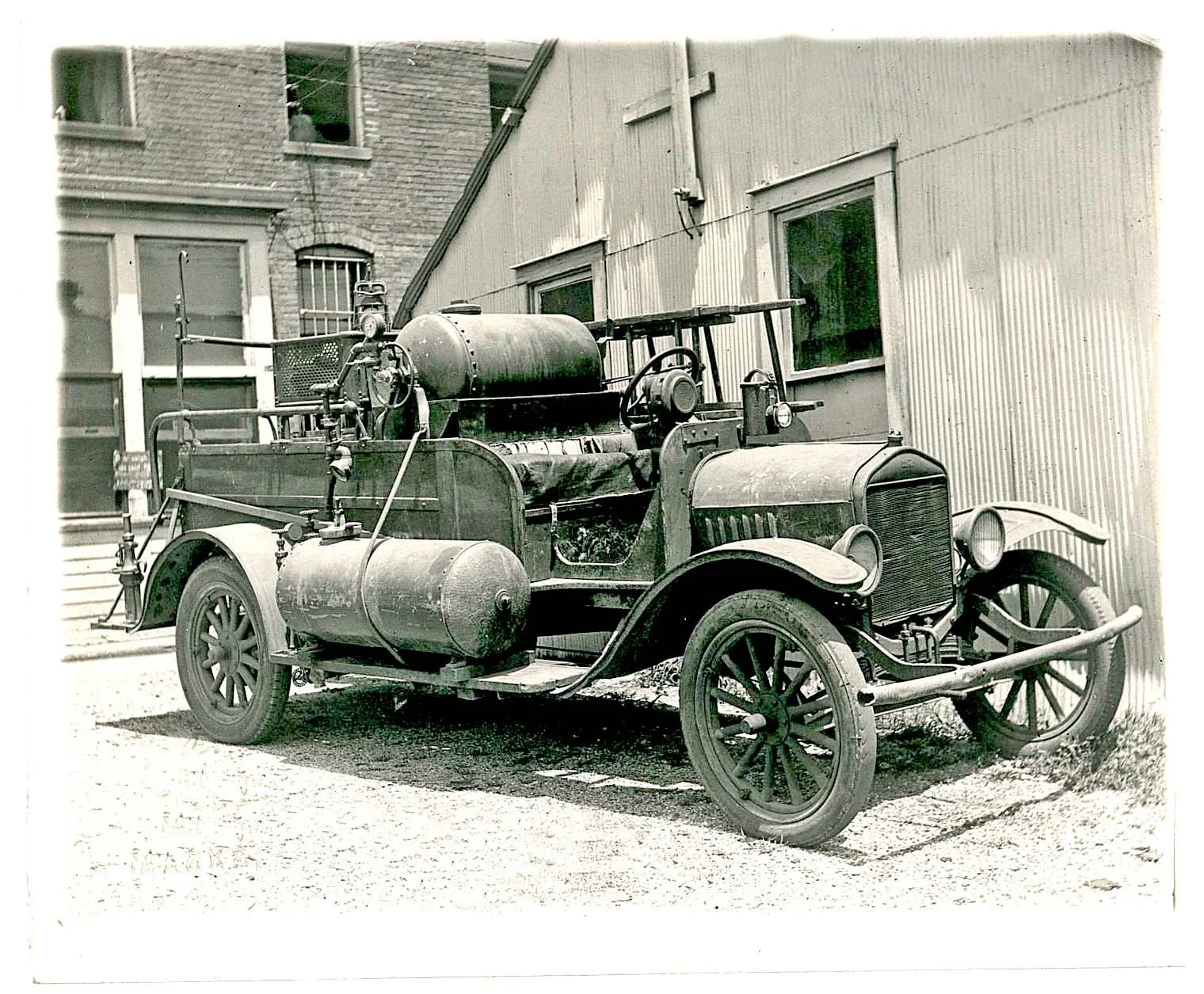
In the summer of 1919, the Clinton city council made a decision that signaled the end of one era and the beginning of another. After decades of faithful service from Doc and Bronc—the town’s veteran fire horses—the council concluded that the future of fire protection would no longer depend on hay and oats. As the Henry County Democrat reported, “the present team of horses has done good work, but must soon be displaced,” noting that the annual cost of keeping them—$795—was now enough to buy a motorized chassis.
The council’s discussions also reflected a town learning new vocabulary as quickly as it was adopting new machinery. Early articles called the proposed purchase an “automobile fire truck,” while others shortened it to “auto truck,” as if the language itself were trying to catch up with the speed of technological change.
A Long Journey from Ithaca
On June 19, 1919, the council voted to buy an American LaFrance automobile fire truck, built in Ithaca, New York—a considerable distance in an era when cross‑country shipping was neither quick nor simple. The machine would arrive equipped with a 40‑gallon chemical tank, two Babcock extinguishers, scaling ladders, and 200 feet of hose. The agent assured the council that the truck “would pay for itself in two years” simply by eliminating the cost of feeding horses.
By mid‑September, the Democrat reported that the new “automobile fire truck and chemical extinguisher… has been shipped.” Clinton waited eagerly for its arrival.
Arrival and First Trials
The truck reached Clinton on Thursday, October 9, 1919. It immediately drew attention, as it was proudly displayed in front of the fire department. Of course, department officials were eager to share that their new truck was capable of reaching 25 miles per hour—an astonishing speed compared to the old horse‑drawn wagon.
The Democrat noted that it “made its initial trial run over the city Friday morning,” with Adlie Jones at the wheel. To demonstrate its capabilities, the fire department staged a dramatic test. On a vacant lot west of Oak Grove Cemetery, they piled boxes and lumber, soaked them in oil, and set them ablaze. When the alarm sounded, the new fire truck roared to life. According to the paper, it took “a minute and a half… to run to the spot,” another half‑minute to activate the chemical tank, and “a minute and a half longer till the fire was put out.”
For a town accustomed to horses, this was nothing short of revolutionary.
Farewell to Doc and Bronc
The Clinton Eye captured the poignancy of the moment. The old fire wagon, about 25 years old, was still in fine shape. And the horses had served faithfully. Doc, age 22, had been on duty for 15 years; Bronc, age 19, had answered every alarm for 12. Their retirement marked the end of Clinton’s horse‑drawn firefighting era.
Learning the Live with a Fire Truck
Clinton’s citizens, excited by the novelty of a motorized fire engine, developed a new habit: racing it to fires. The council quickly realized that the public’s enthusiasm was outpacing good judgment. As the Democrat dryly observed, “nearly every one owning a car indulges in [racing] when the alarm is given.” An new ordinance was proposed to prevent motorists from driving too close or overtaking the fire truck. The new rules would also prohibit private motorists from using their own sirens, which was apparently becoming a fad.
The truck’s early months brought a mix of real emergencies, false alarms, and human moments. One of the most memorable came in November 1919, when Mrs. George Kessler discovered her father’s roof on fire. She sounded the alarm, but before the new fire truck could arrive, her father, Harry Staples, “with ladder and buckets of water had the fire out when the department reached the scene.” It was a reminder that even in the age of machinery, a determined homeowner with a bucket still had a role to play.
False alarms also became part of the rhythm of the department’s work. In one 24‑hour stretch, the fire truck responded to three alarms—two of them false. Still, the paper noted that the truck’s “quick responses… proved the worth” of the city’s investment.
And then there were the trains. In August 1924, the truck was delayed “several minutes by a passing freight” on its way to a small roof fire. Even the most modern equipment couldn’t outrun the Missouri–Kansas–Texas line.
A Foundation for the Future
Despite the occasional hiccup, Clinton’s first automobile fire truck transformed the city’s firefighting capabilities. Chemical extinguishers allowed small fires to be handled quickly and with less damage. Response times improved dramatically. And the town began to see firefighting as a modern, mechanized service rather than a horse‑powered holdover from the 19th century.
The American LaFrance engine of 1919 was modest by today’s standards—no enclosed cab, no pump panel, no radios, no protective gear beyond a sturdy coat and a good hat. But it set Clinton on the path toward the sophisticated equipment used today. Every ladder truck, pumper, and rescue unit that followed owes something to that first machine that rumbled into town at speeds up to 25 miles an hour.
In the end, the story of Clinton’s first fire truck is a story of transition: from hay to gasoline, from buckets to chemical tanks, from horse hooves to engine pistons. It’s a reminder that innovation is often embraced when the need is clear.
Researched and written by Mark Rimel, a volunteer at the Henry County Museum. All rights reserved 2026.