
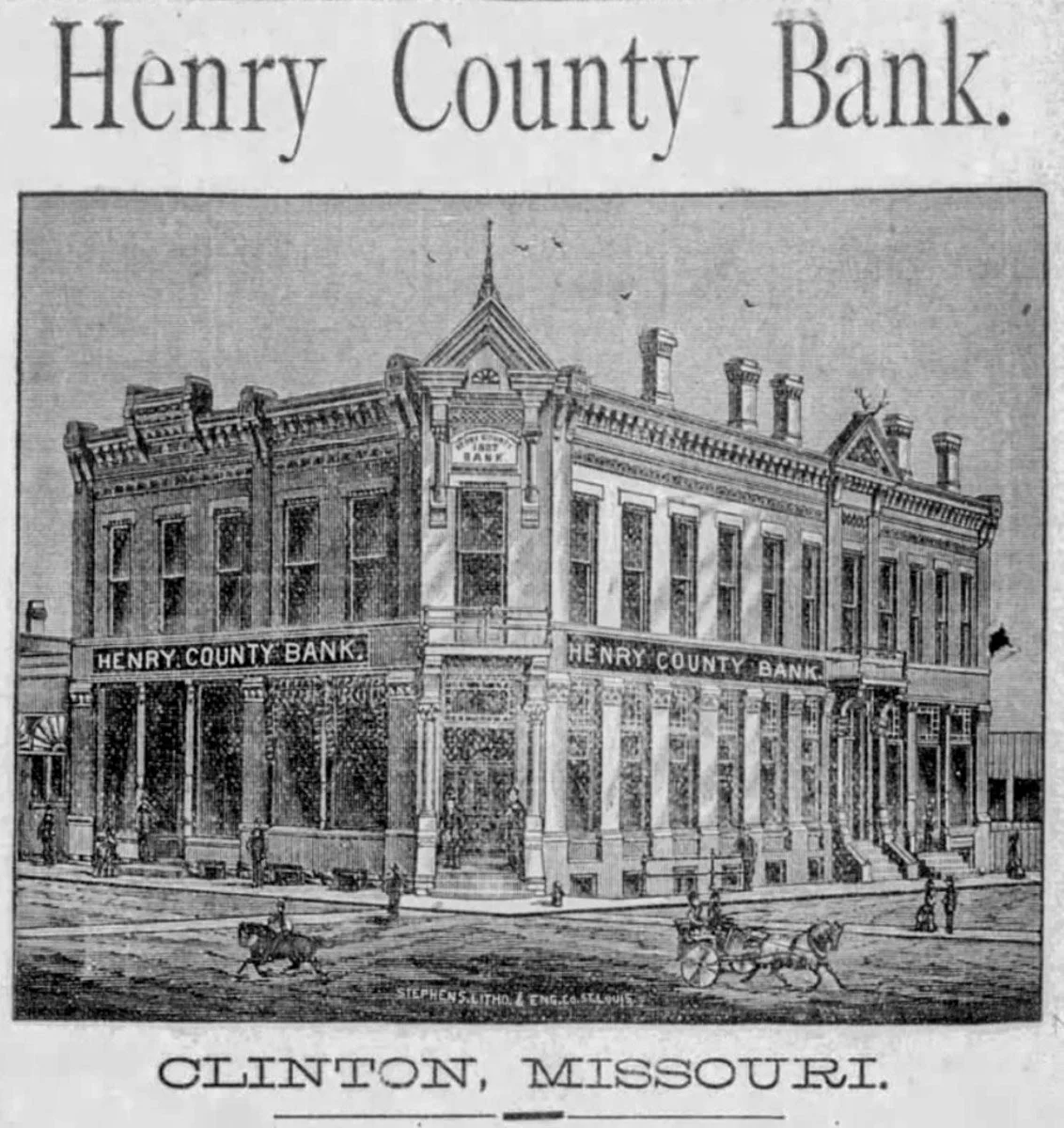
Architectural rendering of the Henry County Bank building as it appeared in the newspapers in 1887.
The Turning Point
If you stood on the northwest corner of Clinton Square in the spring of 1886, you would have felt it immediately — that restless sense that the town had outgrown itself. Clinton had been swelling with ambition for years. Its population had quadrupled from 1870 to 1880 and was well on its way to doubling again by 1890. New buildings were rising like corn after a good rain, the railroads were connecting Henry County to places it had only read about, and the air carried an optimism that made people believe anything was possible.
But beneath all that visible growth was something even more transformative. The entire town was still adjusting to the shock of it. The railroad had arrived less than a year earlier — so recently that when the Henry County Bank directors first envisioned their new headquarters, no locomotive had ever steamed into Clinton. Its arrival changed the town almost overnight, and the future seemed to expand as quickly as the rails could be laid.
People today can hardly grasp the intensity of that moment — how excitement and unease lived side by side. A railroad didn’t just carry freight or passengers; it gave the community a heightened sense of identity and opportunity, a feeling that the world was finally coming to meet them. In 1886, that sensation was still very new, almost overwhelming, and it shaped everything — including the motivation to build a new bank building on the Square.
And right there, on the northwest corner of Washington and Franklin, next to the newly completed Anheuser Busch Brewing Association building — a proud brick symbol of modern commerce — sat a livery stable that everyone knew was living on borrowed time. The stable had served its purpose, but the Clinton community was no longer satisfied with just usefulness. The town wanted impressive. It wanted modern. It wanted something that said, “We belong in the big leagues.”
So, when word spread that the Henry County Bank planned to build a new headquarters on that corner, people paid attention. This wasn’t just another storefront. This was going to be a landmark — a structure that would declare, in brick and stone, that Clinton was staking its claim on the future.
A Town Ready for a Landmark
The newspapers of the day spoke with unrestrained enthusiasm. The Evening Advocate promised a building rivaling “the finest bank in the state outside of St. Louis and Kansas City.” It was a bold claim, and Clinton’s leading citizens didn’t make it lightly. The town had been on a remarkable upward climb, and the bank’s directors — men like A. M. Rhoads, G. C. Haysler, and A. P. Frowein — were determined to match the city’s momentum with a building equal to the moment.
What the public didn’t know at first was that the bank’s directors had once dreamed of something much grander for that corner. In the fall of 1885, The Clinton Advocate revealed plans for a three-story hotel inspired by the famed Grand Union in Trinidad, Colorado. The Henry County Bank was to occupy the southeast corner of the ground floor, with parlors, dining rooms, hotel rooms, and even discussions about an opera house filling the rest. It was an ambitious vision — the kind a town envisions when it believes its future has no limits.
Economic conditions changed over the next few months, so the grand hotel was replaced by a more practical, albeit still impressive, two-story bank building. Even so, the scale of that early ambition remained in the public’s imagination for some time.
The bank’s goals in 1885 were ambitious, but to understand how the directors reached this point and why the new building was so significant, it helps to look back at the bank’s beginnings just a few years earlier.
The Bank’s Beginnings, 1881
When the Henry County Bank was founded in the spring of 1881, Clinton already had a locally owned private bank — Salmon & Salmon — but no incorporated institution governed by a board of directors drawn from the wider business community. A group of respected local businessmen believed the town needed a bank whose ownership and oversight extended beyond a single family. The original directors reflected the breadth of Clinton’s commercial life.
A. M. Rhoads, a prosperous farmer, county judge, and businessman. A. P. Frowein, a German born merchant and storekeeper. G. C. Haysler, a hardware dealer and civic leader. S. Blatt, a merchant. Joseph White, a businessman and landowner. James Brannum, a mill owner. J. W. Middlecoff, a farmer and future civic figure. W. H. Cheek and J. M. Cock, both active in local business affairs.
They were respected men, but not bankers. Their strength was by reputation, not formal financial training.
For expertise, they relied on their cashier, William D. Tyler, the only officer with a true banking background. Tyler had served as the first cashier of the First National Bank, worked in the paymaster’s department during the Civil War, and later held positions in railroad auditing and purchasing. The newspapers made a point of noting his experience, calling his appointment “a happy selection” that would lend credibility to the new institution. The line only made sense because the directors themselves were new to the profession.
The bank opened in a remodeled furniture store on the west side of the Square. The early newspaper reports were modest: a “mammoth safe,” freshly-grained counters, and the first deposits made by eager customers. The directors met regularly, studied the practices of established banks, and learned the business as they went. It was a practical education, shaped by necessity, but it worked. The bank grew steadily, its reputation strengthened, and the community embraced it as a symbol of local progress.
By the mid-1880s, the directors believed the bank had outgrown its small quarters. Clinton was expanding. Rail service would soon be available, businesses were multiplying, and the town’s ambitions were growing with each new enterprise. A larger, more impressive building seemed not only desirable but inevitable — a structure that would showcase the bank’s success and the confidence of its founders. The idea of a bank with a grand hotel was tempting but impractical. So, they adjusted their ambitions, even if only slightly.
That decision, in 1886, led to the construction of the building that still stands on the northwest corner of the Square. But its foundation — the real one — was laid in those early years, when a group of capable businessmen, but untrained financiers, began creating a bank they believed Clinton needed. Their optimism helped the institution survive its first decade, and their inexperience, though not visible at the time, would influence its future in ways no one yet imagined.
The Two-Story Henry County Bank Building
When architect F. S. Stewart of Kansas City finalized the plans, they revealed a structure far more substantial than anything previously built on the Square. The building would measure 50 feet wide by 90 feet deep overall, with a full basement and two stories above. The ground floor was divided into two sections running north to south, each 25 feet wide. Of the eastern half, facing Washington Street, the southeastern third, the most prominent corner of the building, was reserved for the bank itself. It included a president’s office, a director’s room, and a 24-by-36-foot counting room, the secure workspace where clerks handled the bank’s daily business. The western half, fronting Franklin Street, was designed as a 90‑foot‑deep storefront intended to attract a prominent tenant. The entire first floor featured 16’ high ceilings.
The bank’s rooms were finished with an elegance rarely seen in a town of Clinton’s size. The woodwork, of cherry and walnut, was polished to a high sheen in hard oil. The floor of the bank was laid in ornamental tile, and the fixtures, crafted in Chicago, were made of cherry and mahogany, fitted with plate glass, brass screens, and topped with bronze and nickel cornices. The vaults, one above the other, common in its day, measured 7 by 10 feet in the clear and stood as the building’s literal and symbolic core.
Excluding the washrooms and closets, the second floor had twelve rooms — more than originally reported — some designated as office space and others for sleeping quarters. Most of these rooms were intended for professionals and other tenants eager to occupy one of the most well-lit and well-ventilated offices in town.
The basement was divided into two separate areas. The front part, accessed by a step-down entrance from the sidewalk, was designed to be a barber shop and several bathing rooms — a modern feature that added a touch of big city style to the building. The back part housed the furnace and heating system, the mechanical core that provided steam heat throughout the building. There would also be chimneys in case the “hot air” system didn’t work.
The exterior was as impressive as the interior. The building was made of pressed brick with Carthage limestone trim, and its entrances were flanked by polished Nova Scotia granite columns topped with Corinthian capitals carved from New York and Italian marble. A solid marble balcony rested above stone brackets. It featured an abundance of ornamental work throughout the building’s exterior. The windows featured the finest French plate glass, and the transoms above them were made of prismatic glass with English colored glass centers that scattered light into brilliant patterns. Even the massive, solid cherry doors at the main entrance were regarded as works of art.
The Work Begins
By August 1886, Clinton was in the middle of a building boom. The Advocate sent a reporter “to take in the town,” visiting construction sites and gathering details from workmen who, as the paper noted, answered questions with “kind and courteous” patience. Even among the many projects underway, the Henry County Bank building stood out as the most imposing structure rising on the Square.
Gone were the old livery stables. Carloads of Carthage stone arrived by rail, each block carefully dressed and admired for its marble-like sheen. The stonework was handled by Hopgood & Cox, while the brickwork and plastering were entrusted to Nick Rodgers. The carpentry was overseen by brothers H. A. and H. J. Kratz, and the painting by John Williams. Crews worked steadily until winter forced a pause. When the weather allowed, the work resumed with vigor, and by early 1887 the walls were rising rapidly, giving the Square a fresh, modern silhouette.
Inside, craftsmen moved through each room. Plasterers smoothed the walls of what would soon become offices, meeting rooms, and the bank’s elegant new counting room. Chris Branch, a steam heating specialist who just returned from installing his systems in Memphis, was ready to install his equipment in the new bank building — showcasing the town’s commitment to modern technology.
As spring 1887 arrived, the building’s shape was well defined. The French plate‑glass windows had been set into place, the ornamental tile laid, and the last of the fixtures unpacked and polished. Construction was nearing an end.
A Building That Became a Stage
Even before the doors opened, the new building was already capturing the town’s imagination. The second floor — bright, well-ventilated, and unusually spacious — attracted early interest from organizations looking for a proper home. The Young Men’s Christian Association, recently formed and eager to establish itself, was among the first to seriously consider the space. Their interest indicated that the building would be more than just a place of business; it would also become a hub of civic life.
Merchants eyed the deep storefront on Franklin Street. Professionals — doctors, lawyers, and others — inquired about the upstairs offices. Newspapers reported each inquiry with increasing expectations, as if the building itself were drawing people toward it. Clinton was growing, and the Henry County Bank building was becoming the center of that growth.
And the bank itself? The Henry County Bank was already a respected institution, but this new home would raise its stature. The directors knew it. The townspeople knew it. Even the newspapers, never shy about praising local progress, spoke of the bank’s future with something close to reverence. The building was a declaration of confidence in Clinton’s future.
A Symbol of Clinton’s Confidence
On Monday, June 20, 1887, the Henry County Bank marked its sixth anniversary when it quietly opened its doors in its new home. There were no speeches or ceremonies, just a confident step into a building that announced Clinton was a rising commercial center willing to build boldly and beautifully.
Although the bank opened in mid‑June, one of the building’s most memorable features appeared a few weeks later, in early July. Mounted at the apex of the Washington Street façade were a pair of gilded antlers — yes, antlers. Covered in pure gold leaf, they caught the sunlight and drew the eye from half a block away. The Clinton Advocate called them “a brilliant ornament,” and they quickly became one of the most talked‑about topics in town. Whimsical as they were, they also signaled something deeper: the bank's owners wanted to be noticed.
Victorians rarely chose ornamentation without a meaning, and antlers carried a symbolism that would have been instantly recognizable in the 1880s. They suggested strength, renewal, and a certain frontier vitality — qualities that resonated in a town still close to its pioneer roots. They also reflected the era’s taste for bold, eye‑catching decoration, the kind of detail meant to signal confidence and modernity. Whether read as a symbol, a fashion, or simply a statement piece, the gilded antlers told passersby that this was a building — and a bank — unafraid to stand out.
Everyday Life in the New Building
Once the first tenants began to move in, the building quickly took on a life of its own. Its central location, modern conveniences, and handsome appearance made it one of the most desirable addresses in town. Newspapers recorded a steady stream of arrivals.
They came from every profession the town could support — doctors, oculists, lawyers, architects, merchants, dress makers and tailors, insurance agents and real estate agents, and traveling specialists of various kinds. They rented rooms for weeks or months at a time. Some became familiar names, while others slipped away as quietly as they arrived. Regardless, the building absorbed them all, its hallways echoing with the everyday sounds of work: footsteps on the stairs, the movement of chairs, the opening and closing of doors, and the steady murmur of conversation drifting through the air.
The picture that emerges is not a fixed roster of tenants but a place in constant motion. The Henry County Bank building was never static. It was a place where entrepreneurs tried their luck, where professionals established themselves, where tradesmen set up shop, and where the town’s daily life unfolded in small, unrecorded ways. The bank occupied a quarter of the ground floor with stability and purpose, but above, below, and beside it, the rooms shifted constantly, reflecting the needs and ambitions of a growing community.
As the building settled into its new role on the Square, the second floor’s string of well‑proportioned rooms proved surprisingly adaptable. With a few doorways opened between them, the space could function as a suite rather than a set of isolated offices, and it wasn’t long before an organization with broad civic aims took notice.
The Y.M.C.A. Takes Rooms on the Second Floor
After months of searching for rooms large enough to hold meetings and lectures, the association settled on an expansive suite of five rooms on the second floor. The rent was substantial — six hundred dollars a year, which included heat, water, and janitorial services. Newspapers enthusiastically described the layout: a secretary’s office facing Franklin Street, a parlor in the southwest corner, a library extending northward, a large lecture room beyond that, and a gymnasium at the back. The association furnished the rooms, organized programs, and gave the building a social and educational role that complemented the bank’s business below.
For a while, the second floor was one of the liveliest spots in town. Young men climbed the stairs for meetings or reading hours, and the novelty of a gymnasium — modest though it was — attracted some curiosity. But the Y.M.C.A.’s stay seems to have been brief. After the initial surge of activity, the newspapers fell silent about its rooms, and before long, another tenant—a photographer—was preparing to take over the space.
Photographers on the Second Floor
When the Y.M.C.A.’s brief tenancy ended, the large suite on the second floor—bright, spacious, and easily adaptable—became the most desirable suite in town for a photographer. Light was the lifeblood of nineteenth-century photography, and the Henry County Bank building’s second-floor windows provided it in abundance.
The first to take advantage of the space was F. W. Morast, an accomplished photographer whose reputation already extended well beyond Clinton. In the fall of 1891, he traveled to Chicago to select equipment for what the newspapers promised would be “an elegant new studio.” Workmen installed a skylight, adjusted partitions, and prepared the space for backdrops, props, and the necessary chemistry of the trade. For a time, Morast’s studio was a point of local pride.
But photography in the 1890s was a restless profession. Competition was fierce, and photographers often moved quickly in search of better prospects. Morast, true to his profession, soon moved on. His departure left the studio vacant once again, but not for long. Another photographer — one with a young family and a reputation for ambition — arrived from Dodge City, Kansas, ready to make the space his own.
James Sherer quickly made a name for himself. He was energetic, confident, and eager to stand out. He advertised boldly, claiming to use only the finest “Aristo” photographic papers, and newspapers praised his gallery as “one of the neatest and most attractive in the state.” His arrival did not go unnoticed.
Sherer’s bold introduction to the community caught the attention of Ellsworth Marks, a young photographer who had spent seven years working with W. P. Hubbell, another well-known photographer on the Square. The newspapers never recorded when the two men first met or how their discussions unfolded, but Marks clearly saw opportunity in Sherer’s momentum. Whatever passed between them, the result was decisive: the two photographers formed a partnership and planned to operate the second-floor studio together.
The partnership lasted two days.
In one of the more remarkable twists in the building’s history, Sherer abruptly sold his interest in the partnership to Marks and left Clinton to take charge of the “Gold Medal” studio in Dallas, Texas — a move reported in the Henry County Republican on April 4, 1895. Marks suddenly found himself running a business he had not expected to run alone, in a studio he had barely settled into.
Then came the second twist.
A few months later, Sherer returned to Clinton — and partnered not with Marks, but with W. P. Hubbell, the very man Marks had left to join Sherer.
Truth, as they say, is stranger than fiction.
And yet, despite all the movement, all the shifting alliances, and all the comings and goings, it was Marks — the man left holding the bag — who would remain the most lasting figure in Clinton’s photographic history.
Marks settled into the second‑floor studio and made it his own. His photographs — crisp, composed, and unmistakably his — captured the faces of a generation, but also the town itself. Clinton’s streets, storefronts, gatherings, and everyday scenes passed before his lens. Today, many of the images preserved in the Henry County Museum’s archives bear his imprint, and the museum’s complete period photography studio stands as a testament to the craft he practiced.
Throughout all of this, the building proved itself remarkably adaptable. The same rooms that once hosted Y.M.C.A. lectures and reading circles now contained skylights, cameras, and chemical trays. The same stairway that took young men to meetings now carried families in their Sunday best. And the same windows that once showcased the ambitions of a civic association now illuminated the faces of the townspeople themselves.
Photography gave the building a new purpose — to preserve memories. The images made on the second floor traveled far beyond the Square. They were tucked into albums, mailed to relatives, displayed in parlors, and eventually stored in museum archives. They became part of Clinton’s collective story, a visual record of the people who lived, worked, and dreamed within sight of the bank’s gilded antlers.
And at the center of that story stands Ellsworth Marks — the photographer who stayed.
Barbers in the Basement
When the Henry County Bank building was planned in 1886, the directors made a practical yet forward-thinking choice. The basement would serve its usual roles — coal storage, mechanical equipment, and the multipurpose functions typical of nineteenth-century buildings — but part of it was also designated for a barber shop. The plans included a dedicated room with its own sidewalk entrance, a step-down storefront more common in larger cities. It was a small detail, but it reflected the belief that the building should serve not only commerce and finance but also the community's everyday needs.
And serve it did – though not always in ways anyone could have predicted.
The first of the “under the Henry County Bank” barbers were Wheatley & Smith. They established a steady enough trade, but when they hired a new barber, Steve Murry, a self-proclaimed “tonsorial artist,” The Clinton Eye made sure readers knew about him. Murry’s arrival was treated almost like the signing of a star player. But Wheatley & Smith didn’t last long.
By 1892, the barber shop experienced a sort of rebirth. Renamed the Oriental Barber Shop, the new owners aimed to appeal to the era’s fascination with exotic branding more than to any real changes in services. Unable to attract enough customers, the shop was soon purchased by W. F. Curry of Columbus, Kansas, who, The Evening Republican assured readers, was “an expert barber.”
Then the real barber parade began.
C. C. Knoles, formerly of the South Side Barber Shop, arrived next, but not alone. He partnered with W. E. Hammond to purchase the Oriental. Not long after, Guy Williams bought them out and renamed the place Guy’s Barber Shop. Less than three months later, J. P. Stewart of Effingham, Kansas, bought the shop from Williams. Two years passed before another south side barber, L. E. Decker, moved in. Nine months later, Robert C. Settle of El Dorado Springs, Kansas, arrived to “engage in the barber business,” only to move out to the south side of the Square less than two weeks later. And then, in a twist worthy of a stage comedy, Settle moved back into the basement nine months after that.
If the basement barbers proved anything, it was that stability was optional.
Yet through all the turnover — the new names, new chairs, new signs, new promises — the basement barber shop remained a constant presence. Men descended the steps for a shave before church, a haircut before a photograph upstairs, or a bath after a long day in the fields.
The barber shop acted as an informal news hub, where men could freely discuss politics, weather, crops, and business prospects. A man could walk in needing only a trim and leave knowing who had bought a new horse, who was running for office, or who had been seen walking with whom on Franklin Street. In a town where information spread as much by word of mouth as by newspaper, the barber shop was one of the places where the town’s stories were shared, embellished, and passed along.
The barbers changed, but the basement’s barber shop role did not.
What makes the basement barbers especially interesting is how they mirror the building’s larger story. Just as the second floor shifted from Y.M.C.A. rooms to a series of photography studios, the basement absorbed each new barber, each new style, and each new personality. And through it all, it remained a place where ordinary life unfolded — shaves, haircuts, and conversations. It was never empty for long. It adapted and endured, as did those who worked on the second floor.
Despite all the grand ambitions for the Henry County Bank building — the Carthage stone, the plate-glass windows, the gilded antlers — it was the basement barbers who created some of its most lasting human moments. They kept the building grounded and connected to the everyday people who passed through its doors.
In the end, the barbers in the basement remind us that history isn’t only made in boardrooms, counting rooms, or grand second-floor studios. Sometimes it’s made in a busy barber shop, where men gather for conversation in a place where the town feels comfortable, familiar, and completely itself.
Across the Border and Beyond
One of the quieter stories from the early years of the Henry County Bank building is just how many people came to Clinton from somewhere else. The barber shop alone was a revolving door of Kansans — Columbus, Effingham, El Dorado Springs — as if the western border were a kind of talent pipeline for men with razors and ambition. But the barbers weren’t the only ones drawn in. At least one photographer had Kansas ties, and others came from towns scattered across western Missouri. Clinton, in other words, was not simply growing; it was attracting skills and expertise.
The newspapers of the day help explain why. Clinton was in the middle of a true boom — new rail connections, new buildings, and new businesses. The town was developing an air of confidence that bordered on swagger. The town talked about itself as if it were destined for something much larger. Word of that optimism spread farther than you might expect. Small-town papers constantly reprinted each other’s news. Stories about Clinton’s new bank building, its modern conveniences, and its bustling Square circulated across western Missouri, into eastern Kansas, and northward to Nebraska.
For tradesmen, professionals, and young men looking for opportunity, Clinton offered a sense that the future was unfolding rapidly. A barber could rent a chair and be in business by the end of the week. A photographer could set up a studio in a well‑lit second‑floor room and catch the steady trade of families wanting portraits. A tailor, a doctor, or a lawyer could find a room on the Square and step into a town that seemed to be rapidly moving upward.
Some stayed for a few weeks. Others stayed for several years. A few, like the barbers, seemed to treat Clinton as a kind of professional waystation — a place to try one’s luck, test the market, and move on if the wind shifted. But their comings and goings show that Clinton was getting noticed outside of Henry County, and people paid attention. It was promising. And for a brief, lively period in the late 1880s and early 1890s, it was the kind of place that attracted folks from across county lines, across the state line, and sometimes from across the region.
The Henry County Bank building stood at the heart of that movement — a handsome, modern structure that signaled to anyone passing through that Clinton was a town on the move. They came with trunks, tools, trade cards, and families, eager to see whether the promise they’d read about in the papers matched the reality on the Square.
The Post Office in the Building
When the post office moved into the Henry County Bank building in 1891, it brought a level of daily traffic that no other tenant could match. Bankers, lawyers, and barbers brought steady crowds, but the post office attracted everyone. Farmers from the countryside, merchants collecting payments, families waiting for letters from children who had gone west — all of them passed through the doors on Franklin Street. For a time, the building became one of the busiest federal outposts in Henry County.
The newspapers noted the move without fanfare, but their arrival in the building was immediately felt. The building’s usual flow of office workers and tenants was now joined by the thud of mailbags, the swoosh of sorting tables, and the constant swinging of the heavy front door. The post office occupied the deep storefront space facing Franklin Street on the west side of the ground floor — a room the bank’s directors had originally hoped would attract a prominent merchant. If anyone ever took it, the newspapers left no evidence of it being occupied. For nearly three years, the space had remained unused, waiting for a tenant with enough activity to justify its size. The post office met that expectation handily.
Once the postal service took possession, the postal staff quickly became familiar figures around the building. Postmasters, clerks, and carriers moved efficiently between the sorting room, the Square, and beyond. Their work was steady and unglamorous but essential. During a time when letters carried news of births, deaths, business deals, and family fortunes won or lost, the post office served as the town’s lifeline, and for over a dozen years, that lifeline ran directly through the Henry County Bank building.
Not every day was routine. In 1892, the building became the scene of one of the most shocking episodes in its early history when Postmaster Keiser was shot three times in his office. He survived — a fact that the newspapers covered with a mix of relief and astonishment. His attacker was eventually committed to an asylum, but rumors swirled about the motive. Whispered suggestions of personal entanglements spread through the town’s gossip channels, but the papers printed only what they could verify. Whatever the cause, the incident underscored something the building had already begun to reveal: when so many people pass through a single place, the unexpected is never far away.
Most days, though, were far more ordinary. People lined up for stamps, picked up packages, or waited for the mail to be sorted. The post office made the building feel less like a monument and more like a crossroads — a place where the town’s daily life came together in small, barely noticed ways.
As Clinton grew and postal services expanded, the department needed more space. In 1903, it expanded its quarters by leasing the building's rear room to accommodate the growing staff and the demands of rural delivery. But eventually, this, too, was not enough space, and plans were made for a new post office. Their presence in the building left its mark, though; it filled the building with the bustle of daily life and added another chapter to the long list of people who passed through its doors.
In a building known for its ambitious tenants — bankers, photographers, and tailors — the post office offered something enduring: the steady, vital work that keeps a community connected. And for a while, that work happened behind the same walls that had already witnessed many of Clinton’s hopes, plans, and enterprises rise and fall.
Clinton was changing, its businesses were becoming more complex, and the skills required to keep pace were changing with them. It was only natural that the building, already filled with businesses, would also become a place where young people came to prepare for the future.
Smith’s Business Institute
By the early 1890s, Clinton was already a town that valued education. Baird College, the impressive women’s school on the west side of town, had been attracting students since 1885, offering languages, literature, music, and the refinements expected of a first-class institution. So, when Smith’s Business Institute opened rooms on the second floor of the Henry County Bank building, it wasn’t introducing Clinton to schooling — it was adding a new, practical branch to the town’s educational landscape.
Clinton’s businesses were becoming more complex, its offices more active, and its bookkeeping more detailed. Someone who could keep accounts, write a clear business letter, or handle correspondence effectively had a real advantage, and Smith’s Institute aimed to teach those skills. Its curriculum matched the community’s needs: bookkeeping, commercial arithmetic, penmanship, and business correspondence. These were the essential skills of the modern clerk.
What made the Institute notable was not its size but its purpose. It reflected a shift in Clinton’s identity from a town defined by mills, merchants, and railroads to one that also recognized the importance of clerks, accountants, and office workers. Students climbed the stairs with their notebooks, practiced the habits of the modern office, and stepped back into a town that increasingly needed exactly those skills.
Smith’s Business Institute didn't leave behind dramatic stories or colorful anecdotes, but it contributed something quieter and just as meaningful. It brought a different kind of ambition into the building — not the grand ambition of architecture or bustling commerce, but the quieter ambition of young people preparing for a changing world. For a time, the second floor echoed with their efforts, adding another layer to the building’s long history of people who came there to work, improve themselves, and take their next step forward.
Smith & Harness Business College
Ellis Smith had already established himself on the second floor of the Henry County Bank building with his business institute. His classes in bookkeeping, penmanship, and commercial arithmetic attracted a steady stream of students who understood that the business world was changing and that clerical skills could open doors. Smith was ambitious, energetic, and eager to expand. So, when he partnered with Henry Harness to establish Smith & Harness Business College, it seemed like a natural next step.
For a while, the partnership functioned much like Smith’s earlier school, upstairs in the Henry County Bank building, in rooms that had previously hosted everything from Y.M.C.A. lectures to photographic darkrooms. Students walked up the stairs, carrying ledgers and notebooks, while the two men planned something bigger.
Their ambitions soon led to the design of a new building at 121 North Second Street. And in one of those coincidences that can only happen with a building filled with many tenants, the architect they hired to design the new school, A. W. Woods, also kept his office in the Henry County Bank building. The plans were being drawn just down the hall from the men who intended to occupy it.
But before the new building was completed, the partnership fell apart. Smith withdrew from the project, leaving Harness to carry it alone. When the doors finally opened in 1895, the sign read Harness Business College. The school soon incorporated as the Clinton Normal Business College, and for a short time, it seemed set to become one of Clinton’s lasting institutions.
Yet the promise did not last. Less than four years after opening its new building, the school closed. The reasons were never fully explained in the newspapers — perhaps enrollment declined, perhaps finances were strained, or perhaps the town’s educational needs changed. Whatever the cause, the college’s existence was short, and its ambitions exceeded its capacity to survive.
What remains is the small irony that its origins were formed inside the Henry County Bank building, where Smith taught his students, Harness planned his future, and an architect drew the plans and specifications for a school that would not outlast either its founders or its first decade. It served as another reminder of a truth the building would see again and again: in a town full of dreams, few ambitions last, and those that do often endure for reasons no one could have foreseen.
Even as schools and studios came and went, the institution that had built the structure remained the building’s anchor. Through all the shifting tenants and short-lived ventures, the Henry County Bank continued its steady work on the ground floor, projecting an air of stability that seemed to stand above the comings and goings around it. And for the early 1890s, that confidence appeared well-placed.
A Year of Liveliness on the Square, 1896
Author’s Note: Newspapers in the 1890s repeatedly described large public events, as many as 300 in attendance, as taking place “in the west room of the Henry County Bank building.” At the same time, other articles make clear that the post office occupied the west‑side ground‑floor space throughout this period. The surviving sources do not resolve this contradiction. The exact room the newspapers meant — or how the bank building accommodated such large gatherings — is not clear from the record.
In 1896, the Henry County Bank building was one of the busiest and most cheerful places in Clinton. The west room became a kind of all‑purpose gathering hall, hosting an assortment of events that reflected the town’s energy and good spirits.
The year began with a three‑day poultry show, of all things, filling the room with crates, feathers, and the proud commentary of local breeders. A few days later, the building’s resident architect held drawing classes there, turning the bank into a center for artistic instruction. In February, the Ladies of the Episcopal Church transformed the space for a benefit they were hosting, bringing refinement and social purpose to the same room that had recently echoed with roosters. A spelling contest followed, drawing students and spectators alike. Music filled the air as well, with concerts held in the same west room, adding yet another layer to the year’s spirited activity.
Not every event was so easily classified. One evening, the Daily Democrat reported that “many brave young ladies and fair young men will participate in a scene of pleasure,” a line vague enough to raise eyebrows and spark plenty of conversation around town. Whatever it was, it was lively enough to get a mention in print.
For much of 1896, the Henry County Bank building served not only as a place of business but also as one of Clinton’s most lively social spaces — a hub where the town gathered for entertainment, education, and community life. It was a remarkable year. A very remarkable year. As the building filled with events, the bank stood at the center of Clinton’s social scene, mirroring the optimism that seemed to touch every corner of the Square.
The Bank’s Golden Years
In 1896, the Henry County Bank was at the peak of its influence. Fifteen years had passed since its founding, and what began as a small operation in a former furniture store had become one of the most respected financial institutions in western Missouri. Its new home — the most imposing building on the Square — reflected that rise.
Its directors were among the town’s most prominent citizens, and its officers were trusted. The building on the northwest corner of the Square had become a symbol of Clinton’s confidence and promise of future expansion. The bank’s advertisements conveyed quiet assurance, and the newspapers echoed this sentiment, calling it “one of the soundest institutions in the West.”
Inside the counting room, the work was steady and organized. Farmers delivered the proceeds from their harvests, merchants deposited the week’s receipts, and local industries could depend on the bank for loans and credit. The directors — men like A. M. Rhoads, G. C. Haysler, and A. P. Frowein — were active in civic life, serving on committees, supporting public improvements, and helping shape the town’s ambitions.
The bank’s leadership reflected the era’s blend of personal reputation and public duty. Judge A. M. Rhoads, the longtime president, was widely respected for his judgment and steady temperament. His presence gave the bank a sense of reliability that mattered greatly in a community where personal trust still held more importance than printed statements. Cashier A. P. Frowein, who had risen from assistant cashier to the senior role, managed daily operations with an ease that impressed both customers and colleagues. Together, the officers projected an image of competence and stability.
These years marked a period of growth for Clinton, with the bank playing a key role in that expansion. It financed improvements, supported local businesses, and helped underwrite ventures that propelled the town forward. The Electric Light Plant, Tebo Mills, and other enterprises all appeared in the bank’s records in some way, reinforcing the belief that Clinton’s future was bright and that the bank would help lead the way.
These were the bank’s golden years — a time when its reputation was secure, its officers respected, and its future seemed certain. In those years, the Henry County Bank stood as one of the clearest symbols of Clinton’s confidence and ambition.
The First Signs of Trouble, 1893–1896
The Henry County Bank had every reason to feel secure in 1896. Its officers were respected, its building admired, and its role in the community unquestioned. But banking is a profession where strain rarely announces itself. It appears quietly, in ledgers and loan books, in obligations that seem manageable until they are not.
In 1893, circumstances shifted. That year brought the Panic of 1893, one of the worst financial crises of the nineteenth century. Railroads failed, entire industries faltered, and credit tightened across the country. Clinton did not feel the panic as sharply as the larger cities, but its effects still reached here. Collections slowed. Borrowers asked for extensions. Money moved more cautiously. And the bank examiner, whose visits had once been routine, began to look more closely at the bank’s books.
At the same time, the bank suffered a loss that could not be measured in dollars. Judge Andrew M. Rhoads, the longtime president and one of the bank’s founding directors, died in 1893. His steady presence had anchored the institution since its earliest days. In a community where personal trust mattered as much as printed statements, his absence left a void that no ledger entry could fill.
Leadership passed to George C. Haysler, a capable and civic‑minded man, but the transition came at a difficult moment. The bank’s support of local industry — especially Tebo Mills — had long been a point of pride. Now those same commitments required patience, confidence, and a margin of safety that was beginning to narrow.
The examiner’s reports from these years grew increasingly pointed. They noted the concentration of loans in a few large ventures, the slow collections, and the need for greater caution. None of the findings suggested immediate danger, but they revealed a pattern: the bank’s optimism about Clinton’s future was beginning to outpace the prudence that banking demanded.
To the public, however, nothing seemed amiss. The bank opened each morning as it always had. Depositors came and went. The counting room hummed with familiar activity. And the building on the northwest corner of the Square — solid, handsome, and filled with the confidence of the town — gave no hint of the pressures quietly gathering behind its polished woodwork and marble trim.
The Collapse of the Henry County Bank, 1896
By the winter of 1896, the tension within the Henry County Bank had become impossible to overlook. The examiner’s warnings had grown more urgent, collections were slow, and the bank’s exposure to Tebo Mills, which had been idle more often than productive, had become a burden the institution could no longer bear. The optimism of the early 1890s had faded into a quieter, more cautious outlook, though few outside the boardroom realized how thin the margins had become.
The final reckoning arrived at the end of the year, but the trouble had begun long before. For months, the bank examiner urged greater caution, warning that the bank’s resources were too heavily tied to a few large borrowers and that its reserves were too thin — far below the 25 percent of deposits required by law. Each visit brought sharper language, and by late autumn the examiner’s concerns had hardened into formal criticism.
As Clinton prepared for the Christmas season — merchants decorating their windows, farmers coming to town for holiday supplies, families planning gatherings — the examiner issued his most serious report yet. It did not accuse the officers of dishonesty, but it made plain that the bank could not continue without immediate and substantial changes. The warning was not new, but its urgency was.
Those changes never materialized.
On Friday morning, December 4, 1896, a hard northwest wind pushed flurries across the Square, the kind of dry, needling snow that stung the face and rattled against the windows. The temperature never climbed above freezing, and the sky hung low and gray — a winter day that felt heavier than it should have.
Against that bleak backdrop, the Henry County Bank closed its doors and announced that it had made an assignment (the formal step of voluntarily turning its affairs over to the courts). The notice, posted quietly but unmistakably, drew people almost immediately. Small groups gathered on the sidewalks, the bank’s heavy cherry doors now locked, reading the announcement, talking in low voices, and trying to understand how an institution that had seemed so solid could falter seemingly overnight.
The newspapers reported the shock. The Clinton Eye called the failure “a heavy blow,” and other papers noted that the bank had long been considered one of the safest in western Missouri. Many pointed to the death of Judge Andrew M. Rhoads three years earlier, suggesting that his steady leadership might have prevented the crisis. Others blamed the lingering effects of the Panic of 1893, the slow recovery of local industries, or the heavy loans to Tebo Mills. But regardless of the cause, the outcome was the same: the bank that once represented Clinton’s confidence in itself had failed.
Inside the building, the change was immediate and jarring. The counting room that had once hummed with the orderly rhythm of daily business now only the rustle of papers could be heard as the assignee began the painstaking work of sorting the bank’s affairs. Customers arrived hoping for answers, but there were few to give. Depositors would eventually receive a portion of their funds, but no one yet knew how much or how long it would take.
For the directors, the collapse was a personal and public blow. They had believed in Clinton’s future, believed in the ventures they supported, and believed in the institution they had built. But belief was not enough to withstand the pressures of a tightening economy and obligations that had grown too large to manage.
For the town, the bank’s failure cast a shadow over the Christmas season. The Square still glittered with holiday displays, and the shops still bustled with end‑of‑year trade, but the closure of the bank introduced an undercurrent of unease. It was a reminder that progress carried risks, that ambition could lead to overreach, and that even the most admired institutions were vulnerable.
In the days and weeks that followed, the community watched closely as the assignee worked to settle the bank’s affairs. Lawsuits were filed, assets examined, and creditors were listed. And as the process unfolded, another story — one far more dramatic — began to take shape, centered on the man who had become the bank’s most visible officer.
That story would soon carry the Henry County Bank far beyond the borders of Clinton, into headlines across the region, and into a chapter of the building’s history that no one could have predicted.
A. P. Frowein: Responsibility, Departure, and Return
When the Henry County Bank failed in early December 1896, the public naturally looked to its officers for answers. In that era, presidents and vice presidents often served more ceremonial or supervisory roles. As cashier and majority stockholder, August P. Frowein was not merely an employee — he controlled the institution. In small banks of that time, the cashier handled daily operations, approved loans, kept the books, and interacted with the examiner. His handwriting filled the ledgers; his decisions shaped the bank’s fortunes. And, to his credit, in the days immediately following the collapse, he did not run.
On December 5, the day after the bank closed, he appeared before a notary public and swore to the accuracy of the bank’s assets. Less than two weeks later, he deeded over all of his personal real estate to help cover any losses. He publicly declared that no depositor would lose a cent, and the bank examiner soon confirmed it. Whatever mistakes had been made, the depositors were protected.
Those mistakes, however, were significant. Frowein had loaned $25,000 of the bank’s funds to Tebo Mills, a business operated by a relative, and another $10,000 to the Clinton Pottery Company, which he himself owned. These transactions were not hidden — they were recorded in the books — but they were unwise. These and other large loans placed the bank in a precarious position. In a small community, where personal relationships and business interests often overlapped, such decisions were not unusual. But in this case, they proved too great a strain.
By mid‑1897, the civil matters surrounding the bank’s failure had largely been resolved. Lawsuits were dropped or satisfied, and depositors were made whole. But the legal story was not finished.
In September 1897, a Henry County grand jury returned a sealed indictment charging Frowein with receiving deposits while the bank was insolvent, a criminal offense under Missouri law. Court officials declined to discuss the matter, but local newspapers reported the indictment within days. The Clinton Daily Democrat noted that the rumor was “well‑founded,” and the Windsor Review stated it plainly: the grand jury had indicted him.
And at that very moment, Frowein was already in the City of Mexico.
The timing was difficult to ignore. Whatever mixture of motives he may have carried — fear of prosecution, exhaustion, embarrassment, or the desire to begin anew — the indictment provides the clearest explanation for his departure. He had cooperated fully in the civil settlement, surrendered his assets, and faced the public in the months after the collapse. But when the prospect of criminal charges emerged, he left the country.
Years later, before returning to the United States, he sought and received a gubernatorial pardon. The record does not explain his reasoning for seeking a pardon, but the sequence of events speaks for itself: indictment, departure, pardon, return.
What remains is a portrait of a man caught between duty and consequence. He stayed when the bank failed. He surrendered what he had. But he left when the law turned its focus on him criminally. And he returned only when he believed it was safe to do so.
The Settlement of the Bank’s Affairs
In the months following the collapse of the Henry County Bank, the work of settling its affairs fell to the assignee, whose task was both painstaking and public. Every ledger had to be examined, every loan evaluated, and every asset accounted for. The process unfolded slowly, but with a clarity that reassured the community: the bank’s obligations would be met.
As the investigation advanced, a picture emerged not of fraud, but of overextension. The bank was strained by its commitments, but its officers did not hide their actions. The loans were recorded. The transactions were transparent. The issue was not dishonesty but poor judgment.
As winter turned to spring, the assignee began converting the bank’s assets into funds to repay depositors. The process was aided by the fact that the institution’s officers had already surrendered their personal property to cover any shortfall. Frowein’s real estate, deeded over on December 18, became part of the pool from which creditors would be paid. Other officers contributed as well, ensuring that the burden did not fall solely on the bank’s remaining resources.
By mid‑1897, the outcome was clear: every depositor would receive the full amount of their deposit. In a time when bank failures often left families ruined and businesses crippled, this was no small achievement. The newspapers noted the result with relief, and the community, though shaken, recognized that the officers had fulfilled their obligations. Everyone remained calm throughout the ordeal.
The legal matters that had arisen in the wake of the collapse were resolved just as decisively. Lawsuits filed against the officers and directors were dropped or satisfied, and no criminal charges were pursued. The assignee’s final report closed the matter formally, and the Henry County Bank passed into the town’s history as an institution undone not by deceit, but by ambition and the economic pressures of the era.
With the settlement complete, attention turned to the building's future. The structure that had once housed the bank — a symbol of Clinton’s confidence in the early 1890s — would soon find new occupants and new purposes. Its next chapters would reflect the changing needs of the community, even as the memory of the bank’s rise and fall lingered in the stories told around the Square.
The collapse of the Henry County Bank left a lasting impression on Clinton, but it also revealed something about the town’s character. The officers who oversaw the institution took responsibility. The assignee performed his duties diligently. The depositors were made whole. And the community, though wounded, moved on.
The building stayed, its walls echoing a complex chapter — one defined by optimism, mistakes, responsibility, and the quiet resilience of a town determined to set things right.
After the Bank
The collapse of the Henry County Bank was a shock, but it was not an ending. Clinton absorbed the news, settled the bank’s affairs, and then did what towns usually do: it kept moving.
Within weeks, the building was back to its familiar pace. Prof. Hall opened adult dance classes upstairs, filling the rooms with music and the sound of shuffling feet. Ellsworth Marks continued to advertise his photography, offering portraits “in the latest style.” Young attorney E. C. Munson, son of Judge Munson, opened his first law office in the building. Tailor E. C. Kent announced his fall and winter suit lineup. Life, in all its ordinary ways, resumed.
In August 1897, John L. Woolfolk purchased the bank’s assets, including the building itself. One by one, the founders of the Henry County Bank passed away, their obituaries recalling the optimism of the institution’s early years. But the building they envisioned and built remained, adapting to each new owner, each new tenant, and each new era.
Over the decades, the ground‑floor banking rooms changed hands several times. The Henry County Bank gave way to Hunter & Co., an insurance agency and investment brokerage. It soon became Citizens Bank, which later became a savings and loan.
The second floor continued its long tradition of housing professionals, tradesmen, and small enterprises. The basement barbers came and went, as they always had, until the spring of 1903, when A. C. Landon opened his real estate office there.
The building’s greatest transformation came in 1946, when the Dunning Furniture Company purchased it and remodeled the structure to suit mid‑century tastes. Many of the ornate Victorian features, both inside and out, were removed, giving way to modern lines and showroom floors.
For the next half-century, the building continued to serve as one of Clinton’s most notable commercial landmarks. Then, in a gesture that secured its restoration and preservation, Tracy DeLozier, owner of the DeLozier Farm Machinery Company, purchased the historic building in late 1994 and donated it to the Henry County Historical Society in honor of his late wife, Juanita, an avid supporter. The structure that once represented Clinton’s ambitions now stands as a guardian of its history. It may have started as the Henry County Bank, but it is now affectionately called the Delozier Building, in honor of the man who saved it.
For nearly 140 years, the building has stood at the northwest corner of the Square, watching the town change around it. Many businesses have come and gone — too many to count — and most are long forgotten. Barbers have sharpened razors in the basement. Photographers have posed families upstairs. Clubs have met, dances have been danced, deals have been struck, and lives have unfolded within the building’s walls. It has served as a bank, a post office, a business school, and a furniture store. Now, it is a treasured historical site of the Henry County Historical Society.
But in 1887, what the people of Clinton saw was progress and promise — a building with a future as solid as its Carthage stone foundation, a symbol of the town’s success. It has seen prosperity and setbacks, optimism and uncertainty, and the steady, unremarkable passage of everyday life. It has been altered, adapted, and repurposed many times over, yet it has remained unmistakably and recognizably itself.
Buildings seldom choose their own stories. They simply stand long enough for people to write about them. In Clinton, few buildings have collected more stories or kept them more faithfully than the one built by the visionaries who dreamed of and constructed the Henry County Bank building in 1887.
Authur & Sources
This story was researched and written by Mark Rimel, a volunteer at the Henry County Museum.
All content is historically sourced, including hundreds of newspaper articles from Buffalo Reflex (Buffalo, Missouri), The Clinton Advocate, The Clinton Daily Democrat, The Clinton Eye, The Evening Advocate, The Hamilton Farmer's Advocate (Hamilton, Missouri), The Henry County Democrat, The Henry County Republican, St. Louis Globe-Democrat, and The Windsor Review (Windsor, Missouri). And other historical resources in the Henry County Museum archives.
Copyright & Use Restrictions
© 2026 Mark Rimel, Henry County Historical Society, and Henry County Museum. All rights reserved. No portion of this document may be copied, altered, printed, distributed, or posted online in any form without prior written consent.