
Christmas Trees: From Ancient Times to Today
From Eccentricity to Tradition
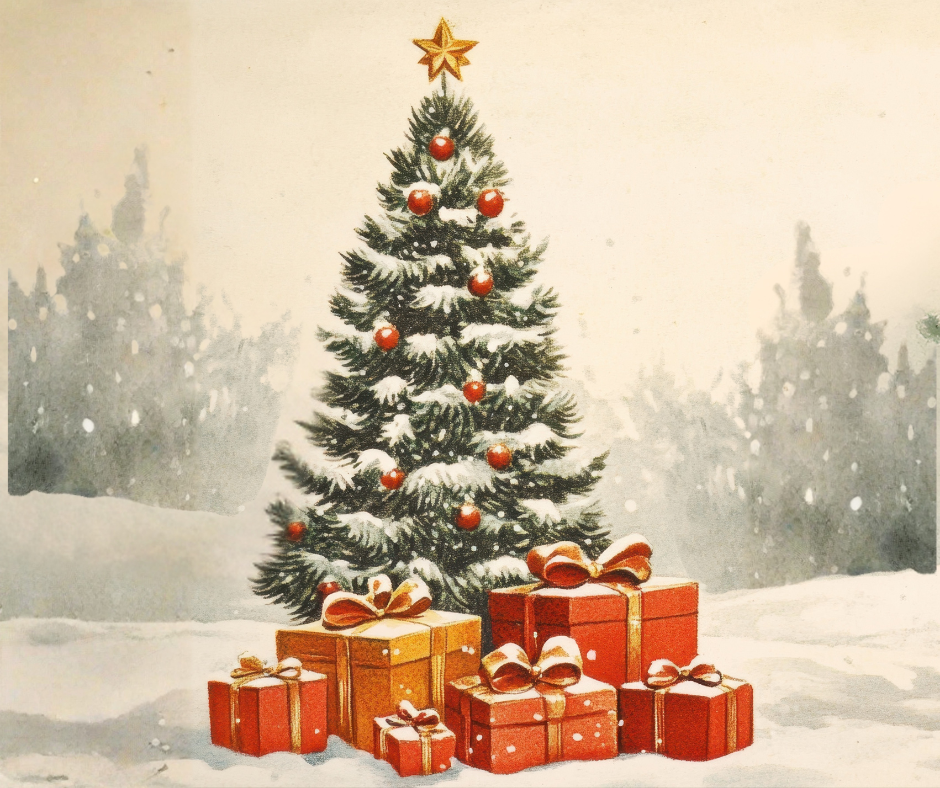
When we see a Christmas tree today, with its branches decorated with lights, ornaments, and garland, and gifts stacked underneath, we think of it as the most natural centerpiece of the season. But the idea of bringing an evergreen tree into the living room was once so unusual that many found it eccentric or even scandalous. The story of how Christmas trees went from being unconventional to essential is a fascinating one to explore.
Ancient Roots of Evergreen Symbolism
The roots of this tradition go back to ancient peoples who saw evergreens as symbols of life during mostly barren winters. Egyptians decorated their homes with green palm fronds to celebrate victory over death. Romans honored Saturn during Saturnalia by decorating their homes with evergreen boughs. The Druids and other Europeans viewed evergreens as symbols of eternal life. These customs laid the foundation for what later became a religious symbol known as the Christmas tree.
Paradise Trees of the Middle Ages
Decorating outdoor evergreen trees dates back to the Middle Ages in southern Germany. Every year on December 24th, Christmas Eve, during the Feast Day of Adam and Eve, families decorated what was known as “paradise trees.” They decorated them with bright red apples, which symbolized the forbidden fruit in the Garden of Eden. To this day, bright red apple ornaments are popular Christmas tree decorations.
The Move Indoors
By the 16th century, during the transition from the Middle Ages to the Renaissance period, people were bringing full-sized fir trees indoors. A well-known story about Martin Luther, the Protestant reformer, was that he was so inspired by the sight of starlight shining through evergreen branches that he wanted to recreate the experience indoors. He did so by attaching candles to a tree. Whether true or not, the story captured the imagination of German families who adopted the custom as their own.
From Germany to Britain and America
Outside of Germany, however, the practice of placing trees in living rooms was far from common. For many, the idea of having a tree in the parlor seemed odd, at the very least. Still, the tradition of indoor trees spread to Britain when Prince Albert, the German-born husband of Queen Victoria, introduced it to the royal family in 1848. An artist's rendering in the Illustrated London News that year showed the royal family gathered around a decorated tree. Suddenly, what once seemed eccentric became fashionable. The image was reprinted in America, and the Christmas tree began to become part of mainstream culture in this country.
In the United States, German immigrants had already brought the tradition with them in the 1830s. Initially, Puritan influence made Christmas celebrations seem suspicious. In 17th-century Massachusetts, Christmas trees were banned because they were viewed as a pagan extravagance. However, by the mid-19th century, the attitude had shifted. Popular magazines like Godey’s Lady’s Book published engravings of families gathered around trees, and the idea spread quickly. By the late 1800s, Christmas trees were appearing in homes across the country, including here in Missouri.
Changing Decorations Through the Centuries
Decorating Christmas trees has changed a lot over the years. Early decorations were simple—apples, wafers, paper roses, and maybe a few sweets. Candles provided a warm glow, even though they posed a fire risk. In the late 1800s, electric lights started replacing candles, making trees safer and more dazzling. German artisans began exporting delicate glass ornaments, which became treasured objects for many in America. By the 1900s, hanging tinsel and candy canes on trees had become popular. Stars or angels at the top of trees became standard. Each generation added its own style. Aluminum trees, with their shiny metallic branches, were all the rage in the 1950s. In the ‘60s, PVC trees became the most popular artificial trees due to their realistic appearance. They are still popular today. Fiber-optic displays appeared in stores during the 1990s. But the true meaning of Christmas trees has remained the same throughout the centuries. A tree, out of place as it may seem to some, somehow turns our living rooms into places of pure joy.
Real and Artificial Choices
The question of real versus artificial trees has long been part of the tradition. Real trees—fir, spruce, or pine—carry the scent and feel of nature indoors. In Missouri, Scotch pine and Douglas fir are popular choices, and families often make outings to tree farms to cut their own. Artificial trees, meanwhile, have their own history. The first appeared in Germany in the 19th century, made from dyed green goose feathers. Later came aluminum trees, which shimmered in mid-century living rooms, and eventually PVC trees, which offered convenience and reusability. Today, families choose based on preference, practicality, or nostalgia, but both options carry the same symbolic weight.
Gifts Beneath the Tree
The practice of placing gifts beneath the tree is another tradition that evolved over time. In Victorian England, small presents were originally hung on the branches themselves. As gifts grew larger, they migrated beneath the tree, creating the familiar sight of wrapped packages waiting to be opened. The tree became not only a symbol of life and light but also the stage for generosity and family celebration.
Continuity and Change
What makes the Christmas tree so enduring is its ability to embody continuity and change. It connects us to ancient rituals of life in winter, to medieval German families celebrating paradise, to Victorian households embracing fashion, and to modern families gathering in living rooms across Missouri. It is both timeless and adaptable, carrying forward the essence of hope, renewal, and togetherness.
A Tradition in Henry County
In Henry County, families have embraced this tradition for generations. Whether choosing a real pine from a local farm or setting up an artificial tree in the living room, the act of decorating and gathering around it connects us to centuries of history. The ornaments may change, the lights may evolve, but the meaning remains constant. The Christmas tree is a living symbol of joy, memory, and community.
A Beloved Symbol of the Season
As we celebrate the season, it is worth remembering that what once seemed eccentric—bringing a tree indoors—has become the most beloved symbol of Christmas. Its branches hold not only ornaments and lights but also the stories of generations, the laughter of children, and the warmth of family gatherings. In Clinton and across Henry County, the Christmas tree continues to stand as a beacon of tradition, reminding us that even in the darkest days of winter, life and light endure.
Mark Rimel, a museum volunteer, wrote this story based on sources such as Britannica, History, Wikipedia, the Missouri Christmas Tree Association, The Medievalists, and the Curious Christian Blog.