
Penny Postcard Texting
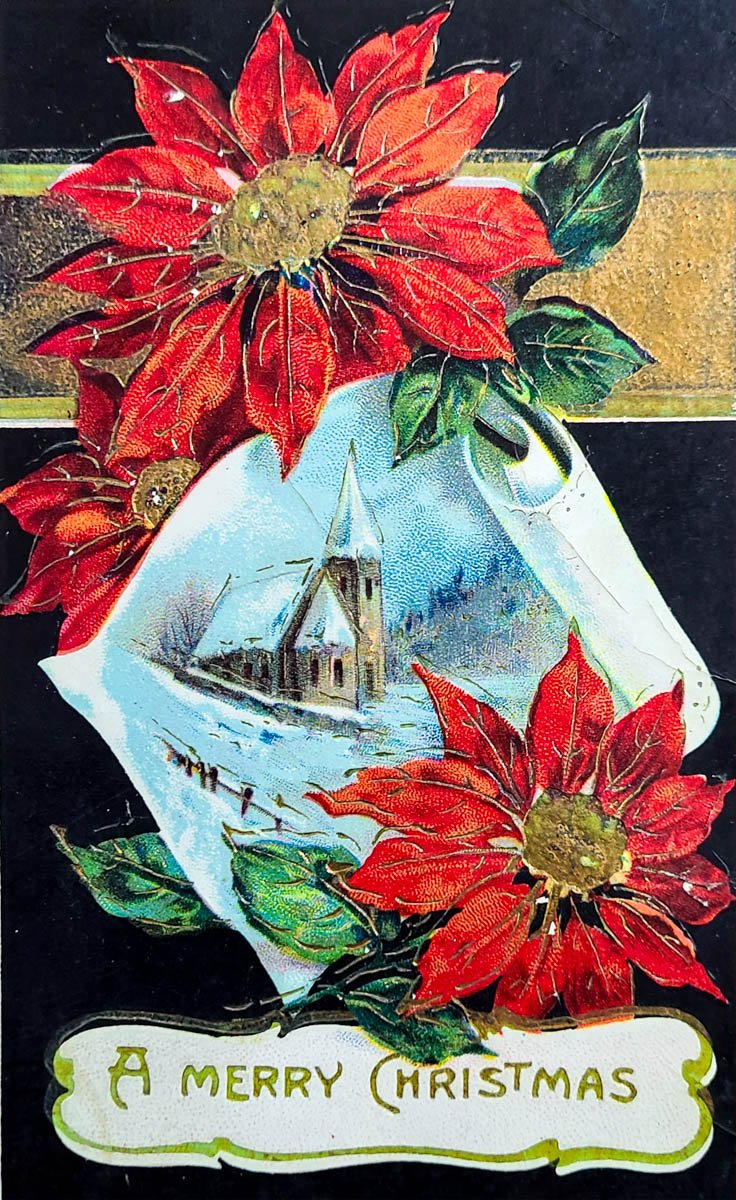
A Cheerful Christmas Greeting
The photo above features beautiful poinsettias and a painting of a church offering a cheerful Merry Christmas wish to everyone who sees it. It’s a penny postcard.
A Sister’s Message
This postcard, addressed to Miss Cromer of Forest City, Missouri, is from her sister, Alice. On the back is a one-cent postage stamp, which is why it’s called a penny postcard. It cost a penny to mail it. The cost of postcards themselves ranged from two cents to 10 or even 15 cents during the first quarter of the twentieth century, when this card was likely mailed and received. Alice must have thought highly of her sister because this one is made from high-quality, glossy stock with embossing and was manufactured in Germany, which made it even pricier.
The First Penny Postcards
The Morgan Envelope Company of Springfield, Massachusetts, printed the first official penny postcard. They sold the first one on May 12, 1873. These early cards had postage pre-attached and could only be sold by the U.S. Postal Department. They were plain, with space only for an address, and cost just one cent to mail, making them an accessible option for millions to stay in touch.
Innovation and the Divided Back
By 1898, Congress permitted privately printed postcards to be mailed for a penny, igniting a surge in postcard creation and innovation. Postcard production surged in 1907, when the “divided back” format was introduced—allowing both a message and an address on the back. That year alone, Americans sent over 677 million postcards. You might say this is when the idea of text messaging was born.
A Cultural Phenomenon
Postcards became a cultural phenomenon. They were used for quick notes, holiday greetings, business ads, and scenic souvenirs. Sending postcards was as much a part of everyday life back then as sending text messages by phone is today.
Messages That Last
I can’t help but wonder, though: will someone a hundred years or more from now be able to find a text message sent between two sisters today? I doubt it. Will it have the same visual impact? Will it convey the same meaning or evoke the same sentiments or feelings?
Holding History in Your Hands
This old postcard, exchanged between two obviously close sisters over a hundred years ago and recently found in a nearby shop, is now in my hands. I can see it and feel the embossing as I run my fingers over it. And of course, there is a personal handwritten message on the back.
What Will We Leave Behind?
It may just be a postcard, but it held meaning then, and it still does now. What will our generation and those who come after leave behind for future generations to read and reflect on? I don’t believe it will be quite the same experience. Do you? Happy texting!
---
Mark Rimel, a Henry County Museum volunteer, wrote this article based on several sources, including The Clinton Eye, the Henry County Republican, KC Yesterday, Hallmark Cards, Inc., The American Antiquarian, The New England Historical Society, The Vintage News, United States Postal Service, and Wikipedia.